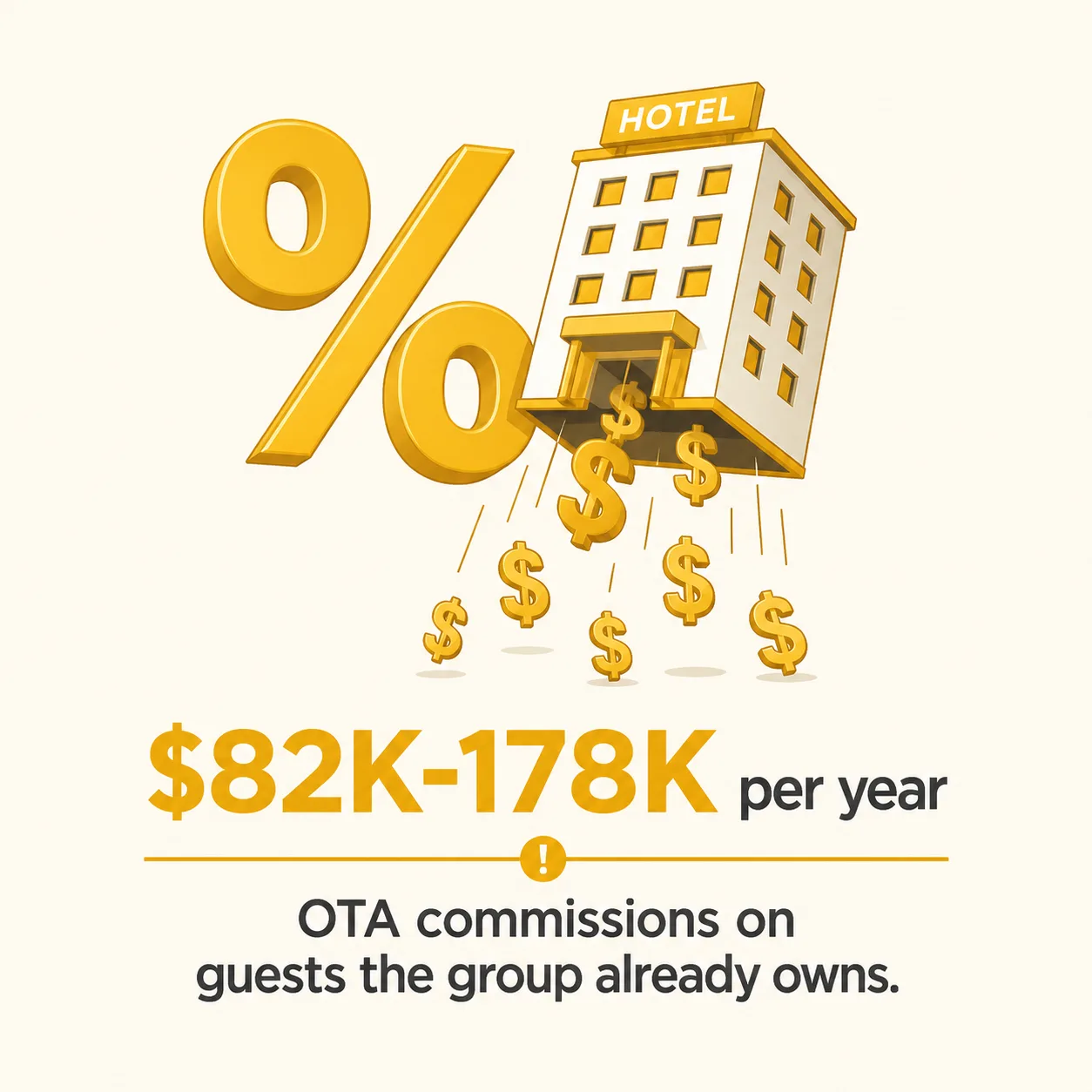
Hotel groups pay OTA commissions on guests they already own because the PMS treats each property as a separate database and never connects a loyal guest at the downtown property to the airport property three miles away. The traveler books through Booking.com, and the group pays 18 percent on a guest it already spent $400 to acquire.
A business traveler stays at a downtown property every quarter. Books direct. Joined the loyalty program. Left a 9.2 satisfaction score on the last three stays. Next trip, a meeting near the airport. The group owns a property three miles from the terminal. The traveler searches "[hotel name] airport." Booking.com is result number two. One click. One booking. The group pays an 18% commission on a guest it spent an estimated $400 in marketing and three prior stays to acquire.
Nobody at the group level ever knows this happened. The airport property sees a "new OTA booking." The downtown property sees a loyal guest who did not return this quarter. The connection that would have saved $240 in commission and preserved a direct relationship does not exist. The PMS treats both properties as separate hotel companies.
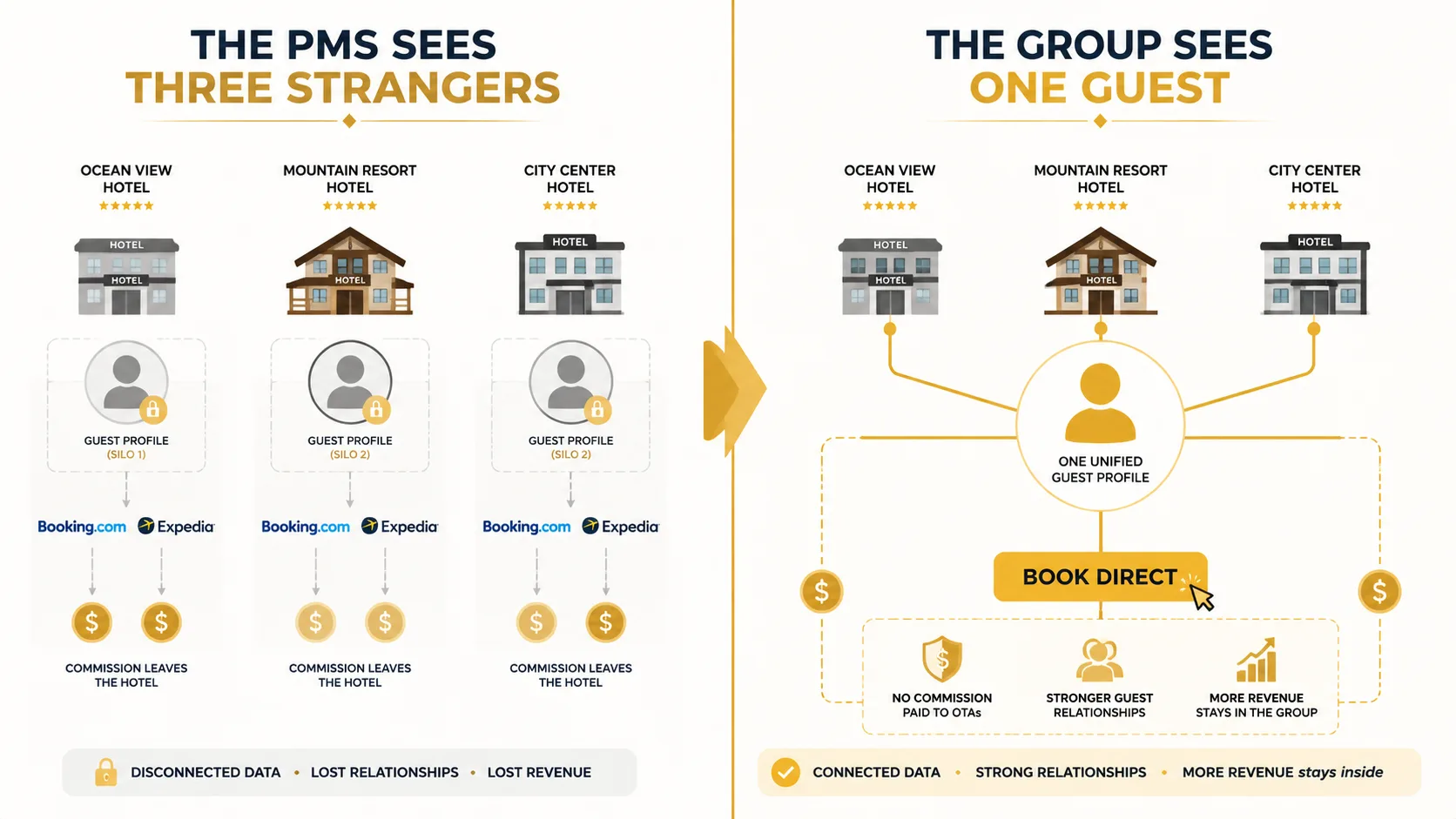
The PMS was never designed to ask the cross-property question
PMS systems like Opera, Mews, Cloudbeds, and RoomKeyPMS were architected for single-property operations. Guest profiles live inside each property instance , name, email, stay history, preferences, loyalty tier. But every guest table has a property_id foreign key. Not a group_id. There is no cross-property guest matching. No unified profile. No way to ask "has this person stayed at any of the other properties?"
This is not a missing feature. It is architectural. The data model was designed when a hotel company meant one building. When groups grew to 5, 10, 20 properties, the PMS schema did not grow with them. Each property remains an island. Every guest who walks through the door of Property B is a stranger , even if they stayed at Property A 14 times last year.
Enterprise CRM platforms , Cendyn, Revinate, Salesforce Hospitality Cloud , do cross-property guest unification. They maintain a single guest record across properties. But the economics break at the mid-market threshold. These systems require dedicated revenue management teams, six-figure annual license fees, and implementation timelines that stretch 6–12 months. A group running 8 properties with a part-time revenue manager and a general manager who also handles sales cannot justify the investment. The tool that bridges the gap , between single-property PMS and enterprise CRM , simply does not exist.
What the recognition gap actually costs
The commission line item is visible. Everything behind it is invisible. And the invisible costs compound faster than the obvious ones.
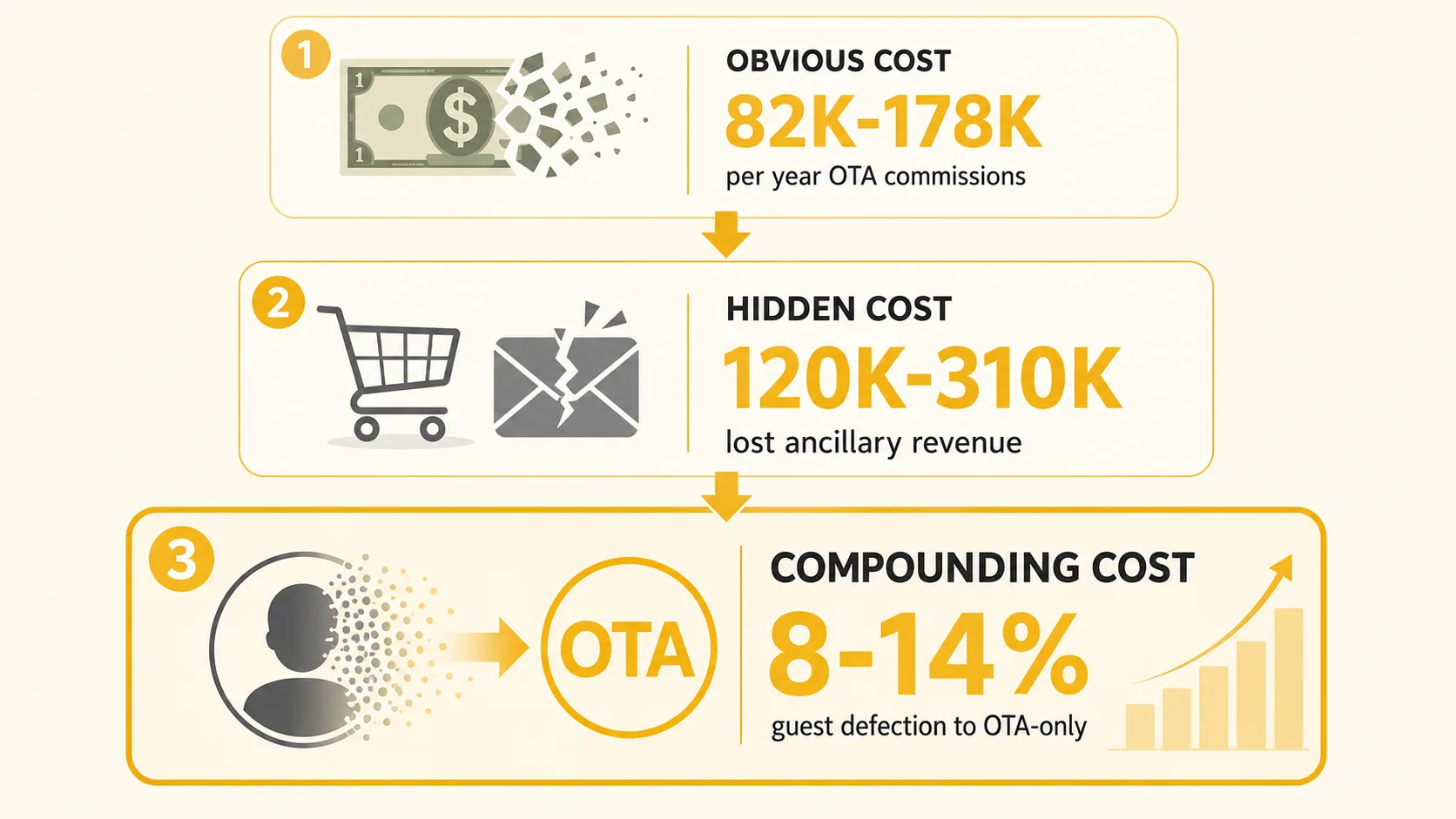
The obvious cost: $82K–$178K per year in unnecessary OTA commissions. For a 10-property group averaging 120 rooms each at 68% occupancy, roughly 12–18% of guests are cross-property repeats who booked through an OTA instead of direct. At an average ADR of $165 and an effective OTA commission of 15–25% per booking, that is $82K–$178K per year in commissions paid to OTAs on guests the group already acquired. These are not new customers. They are repeat buyers paying a finder's fee to Booking.com because the group cannot recognize them.
The hidden cost: $120K–$310K per year in lost direct revenue and marketing waste. When a known guest books through an OTA, the group loses the pre-arrival email sequence: upsell offers, early check-in upgrades, F&B reservations. Direct-booked guests spend 12–18% more on ancillary services than OTA guests , partly because they arrive through a relationship rather than a transaction. A 10-property group losing 400–700 direct bookings per year to OTA leakage leaves $120K–$310K in ancillary revenue on the table. Add $30K–$60K per year in retargeting ads served to guests who would have booked direct had the group website recognized them. The lifetime value of a direct booker is 2.5–3.2x higher than an OTA-acquired guest , and a cross-property repeat guest who cannot be recognized becomes an OTA-acquired guest by default.
The compounding cost: the relationship migrates permanently to the OTA. A guest who books through an OTA does not join the loyalty program. Does not receive group-wide offers. Does not develop brand preference. Each OTA stay makes the next OTA stay more likely. Within 24 months, an estimated 8–14% of repeat guests shift to OTA-only booking behavior , still staying at the properties, but no longer belonging to the group. The CRM database degrades. Marketing ROI drops. The group's negotiating position with OTAs weakens as direct booking share erodes. Guest lifetime value shifts permanently from the group to the OTA.
Why the industry accepts an invisible cost
The groups with 5–20 properties do not have a bad strategy. They have no tool. The AHLA's 2025 State of the Industry report documents rising operating costs and flattening revenue growth across the sector , conditions where every point of margin matters. But mid-market operators cannot act on what they cannot see.
A Regional Director of Operations managing 12 hotels spends every Monday morning logging into 12 different PMS instances, pulling occupancy and revenue reports, and consolidating them into a single spreadsheet. This is the same pattern described in the 15% manual task cost that hotel groups carry. The weekly report answers "how did each property perform?" It never answers "which of last week's OTA bookings were guests the group already owned?" The data exists across those 12 PMS instances. The question has never been asked.
Enterprise CRM platforms with cross-property guest unification require dedicated revenue teams, six-figure annual licenses, and 6–12 month implementations. Group booking quote delays are another symptom of the same structural gap , the tools that would answer cross-property questions exist only at enterprise scale. Mid-market groups accept the invisible leakage as "the cost of OTAs" , never seeing that 40–60% of it comes from guests they already acquired. The alternatives do not fit their operation, so the gap persists as an unexamined line item.
What changes when the recognition gap closes
Cross-property guest matching , linking guest profiles across PMS instances by email, phone, and name matching with confidence scoring , identifies which guests are staying across properties within 30 days. Not a CRM replacement. Not a new booking engine. A recognition tool that answers "who already knows us?" before the OTA gets the booking.
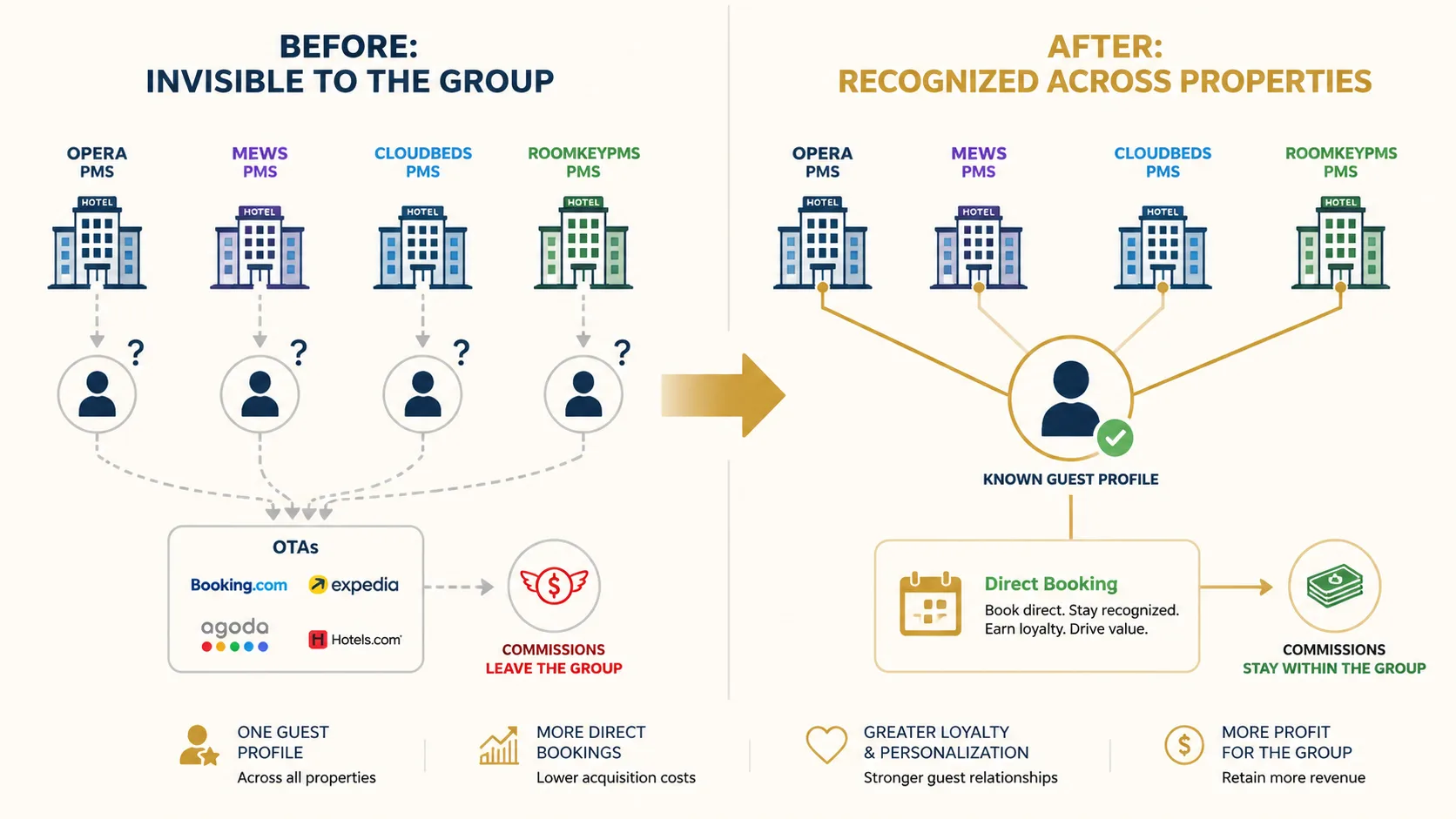
For a 10-property group, the math becomes visible immediately. Identify 600–1,100 cross-property repeat guests in the first month. Target them with direct booking links in pre-arrival communications, group-wide loyalty recognition, and property-to-property referrals. Convert 22–30% of identified guests from OTA to direct within 90 days. That is $38K–$68K in recovered commission in the first quarter. $120K–$210K annualized.
No CRM implementation. No new marketing spend. No asking a single OTA guest to change behavior. Just closing the recognition gap that makes a group invisible to its own guests.
The same multi-property intelligence approach that surfaces operational anomalies across hotel portfolios , staffing imbalances, complaint pattern clustering, recurring maintenance failures , applies equally to the revenue side. The guest data already exists. It is scattered across PMS instances that were never designed to talk to each other. The TheiaOps approach is to read from everything, normalize it, and surface the patterns that the architecture was designed to hide.
What to ask next
Common questions operators ask after reading this:
How much OTA commission do hotel groups pay on guests who already stay with them?
What is cross-property guest recognition and why do mid-market groups lack it?
How do mid-market hotel groups reduce OTA dependency without enterprise CRM spend?
Why cannot hotel PMS systems share guest profiles across properties in the same group?
Related read: The same recognition gap that leaks OTA commissions also decides how much revenue walks out when suite guests check into standard rooms at a sister property. One guest, two stays, and the group never sees the difference.