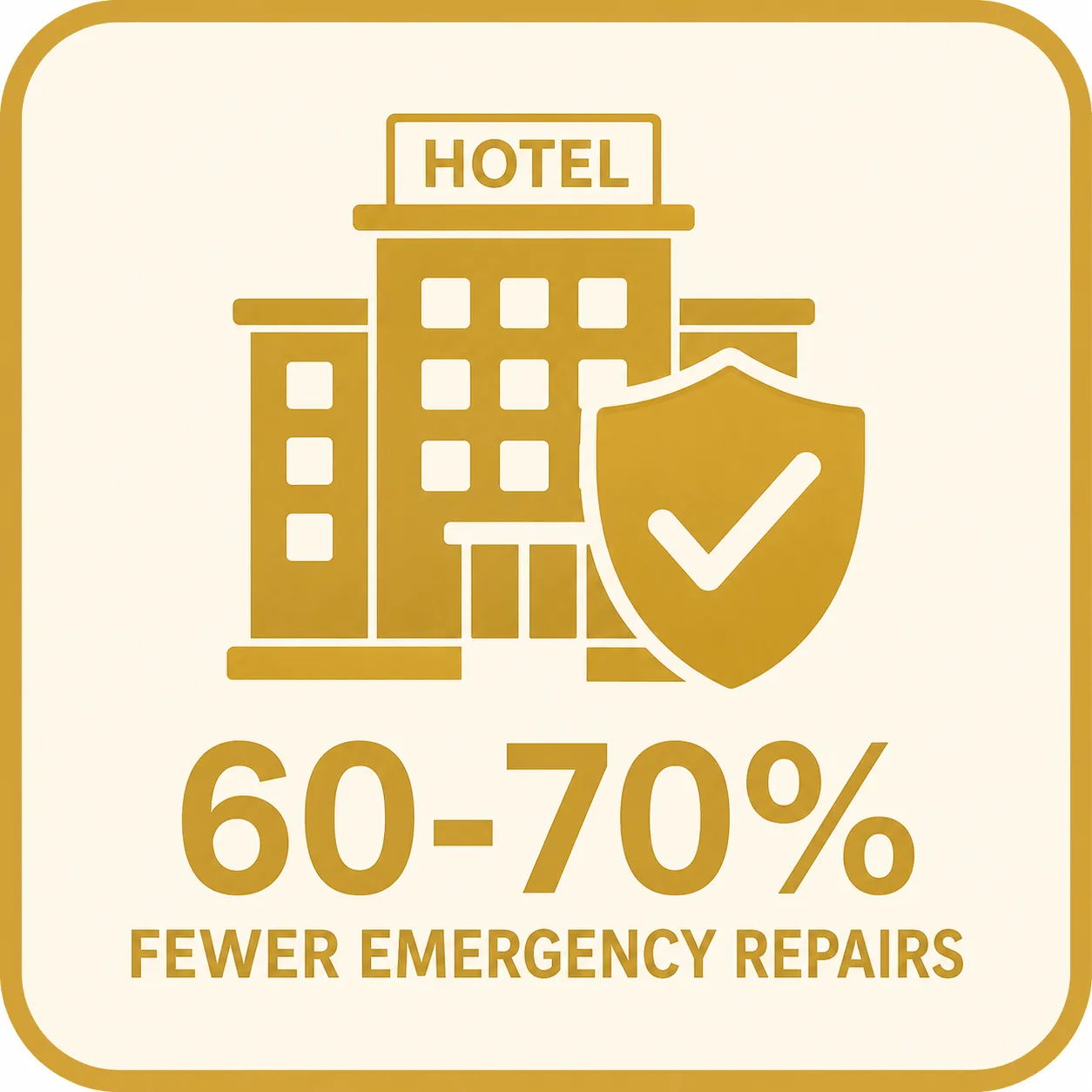
The same pipe bursts at every property because maintenance records live per property and nothing connects them. Property 2's compressor failure sits in Property 2's system. Property 4's sits in Property 4's. No regional view shows the failures side by side, so the pattern stays invisible until the emergency call.
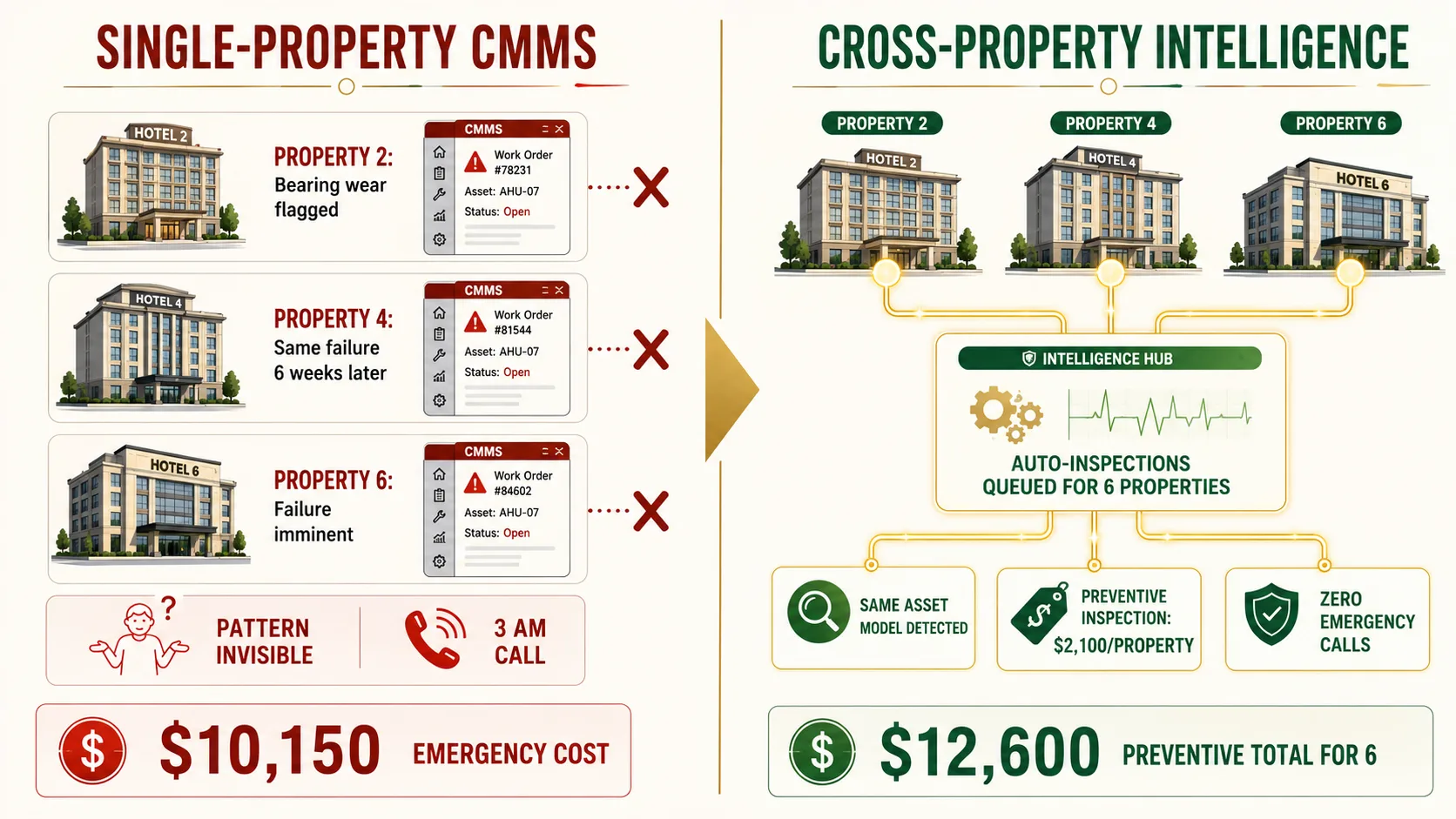
The phone rings at 3:12 AM. A Regional Director of Operations for an 11-property management group. Property 4's HVAC compressor seized. June in Phoenix. Lobby temperature climbing past eighty-two degrees. Forty-three guests. She authorizes the emergency repair call: $7,800 for the after-hours dispatch, $1,400 for the compressor, $950 for the overtime labor. Total: $10,150. She'll get the invoice next week. What she doesn't know: Property 2 had the exact same compressor failure six weeks ago. Same HVAC model. Same runtime hours. Same maintenance contractor who flagged the bearing wear on the work order and wrote "monitor vibration, likely 18-24 month remaining." Property 6 is three weeks away from the same failure. The bearing is already grinding. The GM at Property 6 mentioned it to the chief engineer. The chief engineer put it on a sticky note. The sticky note is behind a monitor. The Regional Director approves $10,150 in emergency spending for a failure that was predicted, documented, and entirely preventable. She didn't miss it. The system she depends on was never designed to show it to her.
Why Do Hotel Maintenance Systems Miss Repeat Failures Across Properties?
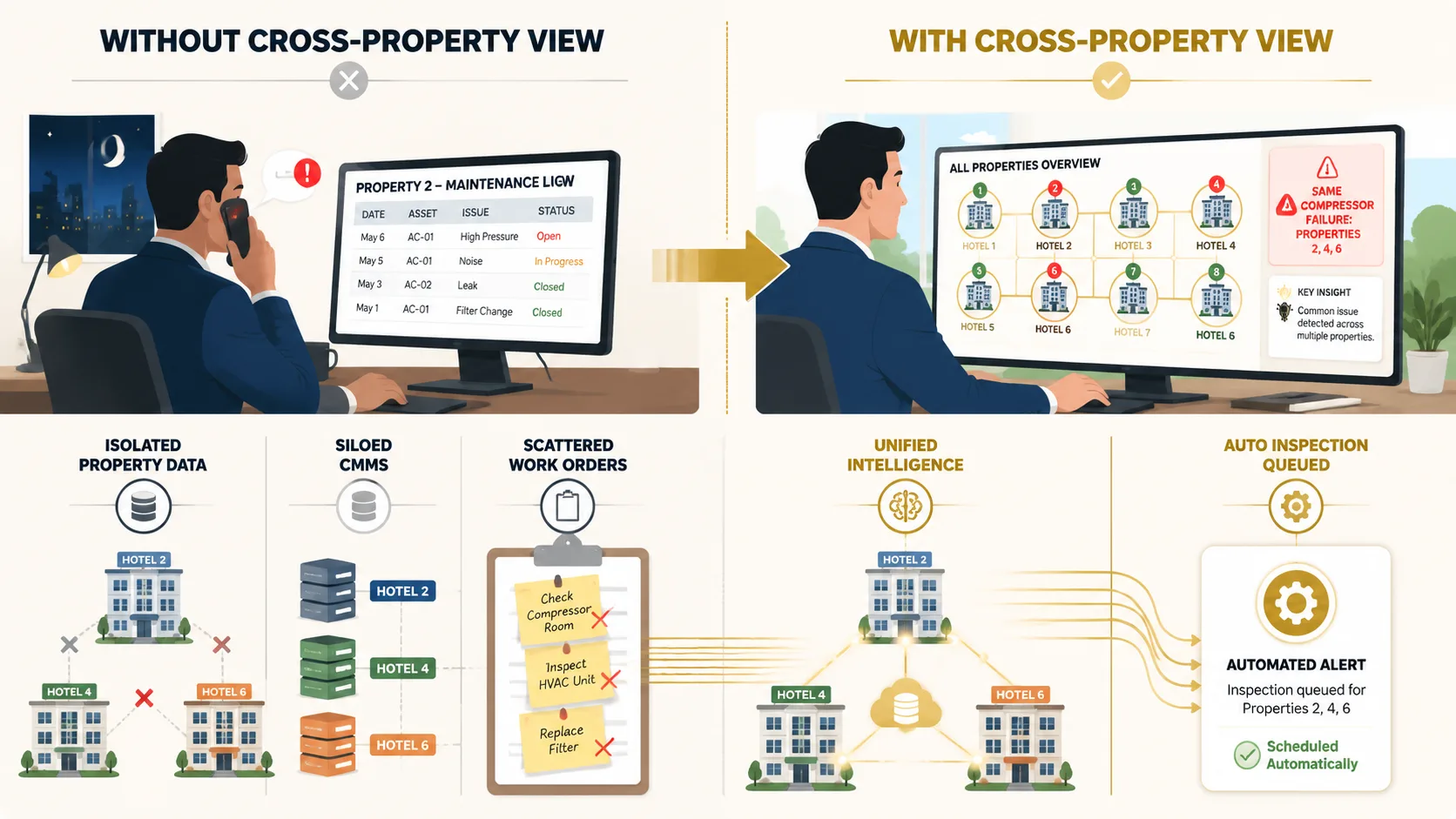
Property Management Systems like Mews, Cloudbeds, and Oracle Opera handle guest transactions. Reservations. Check-ins. Housekeeping assignments. Billing. They log maintenance requests as tickets, like "Room 314 AC not cooling," but they log them per property. Property 2's compressor failure sits in Property 2's PMS. Property 4's sits in Property 4's. The Regional Director has no view that displays them side by side. Neither PMS knows the other exists. The failure is identical. The asset is identical. The preventive flag was documented on Property 2's work order. But the connection is invisible because the software architecture is single-property by design.
Computerized Maintenance Management Systems should close this gap. They do not. Hippo CMMS (now Eptura) tracks work orders, preventive maintenance schedules, and parts inventory, for one facility. UpKeep brings work orders, compliance, and asset operations into a single interface, for one facility. MaintainX, recently acquired by Autodesk, layers AI-powered maintenance on top of work order management, for one facility. These are competent tools. They reduce downtime for the buildings they manage. They flag bearing wear on the compressor at Property 2. They generate a preventive work order. They do everything a single-property CMMS is supposed to do. What none of them does is ask: "Has this same asset failed at another property in the portfolio?" The question doesn't occur to them because it doesn't occur to their architecture. They are facility management tools. A portfolio is not a facility.
This is not a product failure. It is a category gap. The enterprise tier, custom CMMS integrations at hotel groups with 50-plus properties, solves this with six-figure implementations and dedicated reliability engineering teams. The mid-market group running 5 to 20 properties falls between the single-property CMMS and the enterprise integration. They have the same asset-repeat problem as the 200-property chain. They lack the budget that makes the problem solvable with custom software. So they accept the gap. The compressor fails at Property 4. The Regional Director authorizes the emergency repair. The invoice lands. Nobody connects it to Property 2. The pattern runs again at Property 6. And again at Property 11 when the next compressor ages out. The cost compounds. The learning doesn't.
What Does Emergency Maintenance Actually Cost Across a Hotel Portfolio?
The direct cost: emergency repairs run 3 to 5 times preventive fixes. A preventive HVAC compressor replacement scheduled during regular hours, with parts ordered at wholesale and labor at standard rates, runs $2,800 to $4,200. The same compressor replaced on emergency dispatch. After-hours callout at 2.5x labor, overnight parts shipping at 3x freight, guest compensation for the rooms that couldn't be occupied runs $9,000 to $14,000 per incident. A ten-property group experiencing three to five emergency HVAC or plumbing events per year burns $45,000 to $85,000 annually on repairs that could have been $12,000 to $22,000 in scheduled preventive work. The delta is not maintenance cost. It is ignorance cost. Money spent because nobody saw the same failure coming at the next property.
The hidden cost: guest compensation and review penalties. Maintenance failures that impact guest stays generate direct compensation: free nights, upgrades, amenity credits, averaging $350 to $800 per incident. Across three to five emergency events per year at a ten-property group, that's $5,250 to $20,000 in comp alone. Worse: the OTA review penalty. A guest whose AC fails in Phoenix in June leaves a review. That review depresses the property's aggregate rating. One point in average rating shifts occupancy 2 to 3 percent, which on a 120-room property at $135 ADR translates to $118,000 to $177,000 in annual revenue erosion. The emergency repair invoice says $10,150. The review penalty doesn't invoice. It just subtracts. The Regional Director never sees a line item for "revenue lost because Property 4's compressor was maintained by a system that couldn't talk to Property 2."
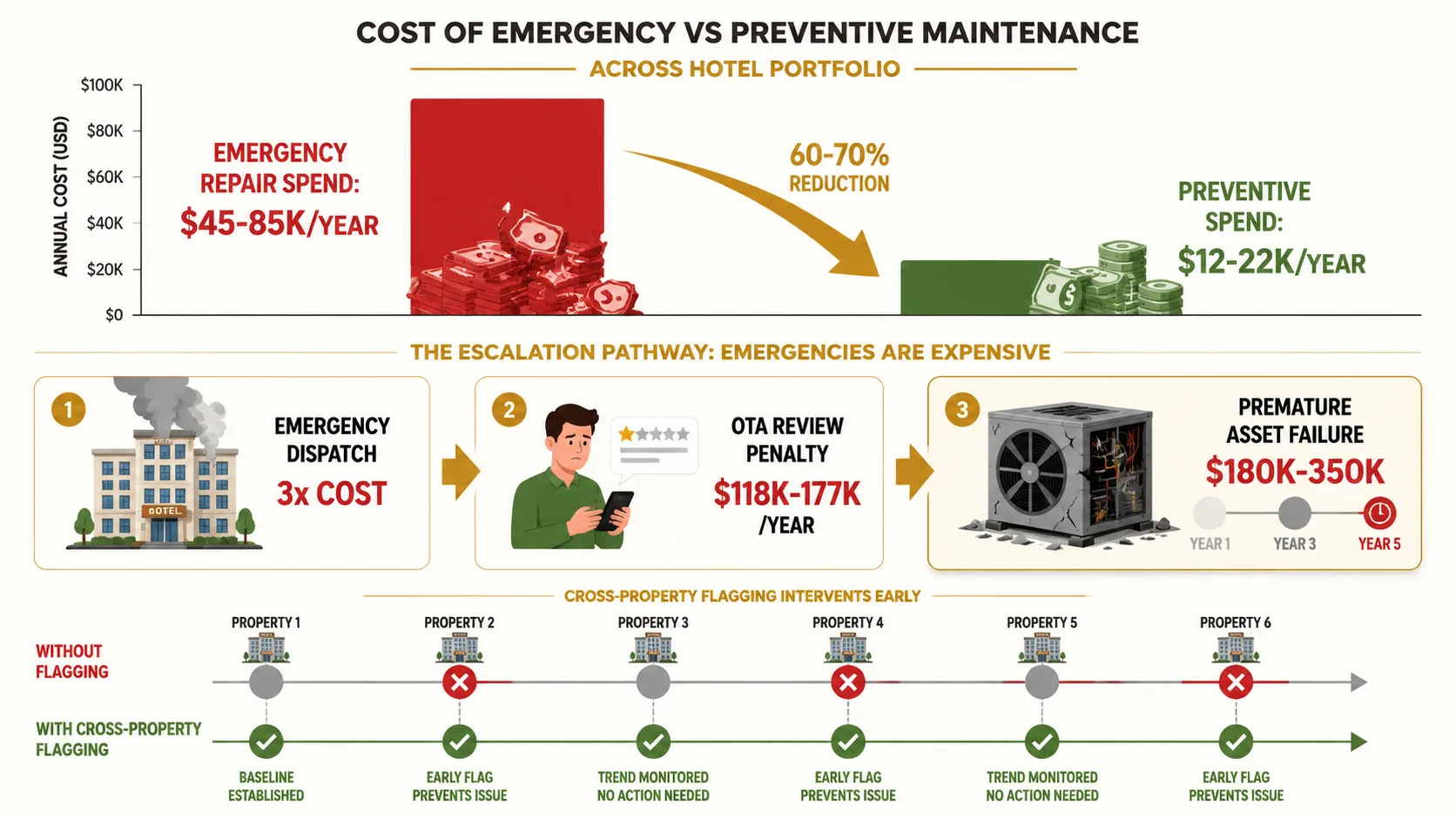
The compounding cost: asset lifespan erosion across the portfolio. HVAC units maintained on preventive schedules last 15 to 18 years in commercial hospitality environments, per ASHRAE equipment lifecycle data. Units run to failure and replaced on emergency cycles die at 10 to 12 years. The difference is 5 to 8 years of lost service life per asset. At $18,000 to $35,000 per replacement unit across a portfolio, that's $180,000 to $350,000 in premature capital expenditure at a ten-property group. The cost doesn't hit all at once. It arrives property by property, year by year. Property 4 replaces a compressor in 2026. Property 7 replaces the same model in 2028. Property 11 replaces it in 2029. Each replacement is budgeted as a standalone expense. Nobody sees the portfolio-level pattern because nobody is looking for it. The CMMS tracks the asset at the property that houses it. It does not track the asset model across the properties that bought the same unit from the same vendor in the same construction cycle. The accounting system records three separate capital expenditures totaling $54,000 to $105,000. A cross-property system would have recorded one preventable pattern costing $18,000 to $35,000 in early preventive work. Three HVAC units would still be running at Property 7, 11, and 14 in 2038.
Why Does the Industry Accept Single-Property Blindness?
Because the alternative has never been priced for the mid-market. Enterprise hotel groups solve cross-property maintenance visibility with dedicated facility management platforms. Oracle Hospitality integrations, custom asset management modules, centralized engineering dashboards. Implementation costs start at $100,000 and scale with property count. A group running 8 properties cannot close the math. The single-property CMMS costs $35 to $80 per user per month. It tracks work orders. It schedules preventive maintenance. It manages parts inventory. It does everything the mid-market operator needs. Except the one thing that would stop the same compressor from failing at three properties in 18 months. The operator accepts the gap because fixing it appears to cost more than living with it. The $10,150 emergency repair is painful. The $100,000 enterprise integration is impossible. Both numbers are real. Neither accounts for what happens when the pattern repeats.
The other reason: nobody owns the cross-property view. The GM at Property 4 owns the compressor that failed. The chief engineer owns the preventive maintenance schedule. The Regional Director owns the P&L. The CMMS vendor owns the work order software. Nobody owns the question "did this happen anywhere else?" Responsibility for the answer falls into the gap between roles. The GM assumes the Regional Director has the data. The Regional Director assumes the CMMS would flag it. The CMMS assumes every property is its own universe. Everyone is right about their own scope. Everyone is wrong about the portfolio. The failure doesn't happen because someone dropped the ball. It happens because the ball was never assigned to anyone. The architecture of single-property software created a coordination vacuum. No one filled it because no one was paid to fill it.
The acceptance is not resignation. It is structural. Operators at mid-market groups know the pattern exists. They hear about the same HVAC model failing from the chief engineer at Property 2. They make a mental note. They get pulled into the next fire. The note disappears. Six weeks later, Property 4 calls at 3 AM. The cycle is not a training problem. It is not a staffing problem. It is a system design problem that has been accepted as an industry norm because the tools that would break the cycle were built for companies three times the size.
What Changes When Maintenance Becomes Cross-Property Intelligence?
A work order closes at Property 2: "Compressor bearing wear detected — Model Trane RTU-240, serial 48291. Recommended inspection interval: 60 days." The CMMS records it. The chief engineer schedules the follow-up. The Regional Director never sees it. In a cross-property system, that same work order triggers three actions automatically. First, it queries the portfolio for every other instance of Model Trane RTU-240. Properties 1, 3, 4, 5, 6, 7. All six ran the same spec during the 2019 renovation. Second, it generates preventive inspection work orders for those six properties, prioritized by runtime hours and age. Third, it alerts the Regional Director: "This compressor model has a documented bearing issue at Property 2. Six other properties operate the same unit. Preventive inspections have been queued. Estimated cost if addressed now: $2,100 per property. Estimated cost if deferred to failure: $9,000 to $14,000 per property." The Regional Director doesn't discover the pattern at 3 AM. She is told about it at 10 AM on a Tuesday, with the math already done and the work orders already created. She authorizes the preventive spend. Six compressors get bearings replaced on schedule. Zero 3 AM calls. Zero emergency dispatch charges. Zero guest complaints about lobby temperatures in Phoenix in June.
The asset lifecycle flips from reactive to planned. When a property-level CMMS tracks an asset, it tracks the asset at that property. When cross-property intelligence tracks an asset, it tracks the asset model across the portfolio. Replacement cycles become predictable. Capital expenditure becomes forecastable. The Regional Director plans HVAC replacements across eight properties over a five-year window, phasing the spend to avoid three units failing in the same budget year. The CFO sees the capex forecast. The owner sees the avoided emergency spend. The asset that used to announce itself with a 3 AM phone call becomes a line item on a five-year plan. That shift, from reactive to planned, is worth more than any single avoided repair. It turns maintenance from a cost center that surprises the P&L into an operational lever that the portfolio can plan around.
Preventive compliance stops depending on human memory. In a single-property workflow, the chief engineer remembers the 60-day bearing inspection. Or doesn't. The GM reminds them. Or doesn't. The Regional Director follows up. Or doesn't. Compliance is a function of attention span. In a cross-property system, the work order exists independently of anyone remembering to create it. The system knows the asset model. It knows the inspection interval. It knows which properties have the unit. It generates the task. The chief engineer's job shifts from remembering what to inspect to executing what the system has already queued. Preventive compliance stops being a personality trait. "Property 2's engineer is great about this," and becomes a system property. The portfolio is protected regardless of which engineer works at which property this month.
What to ask next
Common questions operators ask after reading this:
How much does preventive maintenance save hotels per year compared to emergency repair cycles?
What is the difference between CMMS and multi-property maintenance tracking?
How do hotel groups track maintenance across multiple locations without enterprise integrations?
What percentage of hotel maintenance spend is emergency versus preventive across a portfolio?
Related read: The structural gap that makes maintenance failures invisible across properties is the same architecture that keeps operations data locked in per-property PMSs. a 3 to 7 day pricing blind spot costs hotel groups 2 to 3 percent in missed revenue every week, compounding to $400,000 to $600,000 per year at 10 properties.
Related read: Cross-property intelligence isn't only about maintenance. The same PMS architecture that isolates work orders also costs Regional Directors 4 hours every Monday morning compiling KPIs their systems already contain, across properties that cannot see each other.
If This Pattern Sounds Familiar
TheiaOps analyzes multi-property hotel operations to quantify the emergency maintenance spend that cross-property intelligence would convert to scheduled preventive work. The diagnostic maps last year's emergency repairs across the portfolio, identifies repeat failures on identical asset models, and calculates what the next 12 months look like if nothing changes. No pitch. Just the math the current systems cannot produce.
How TheiaOps builds multi-property intelligence for mid-market operators →