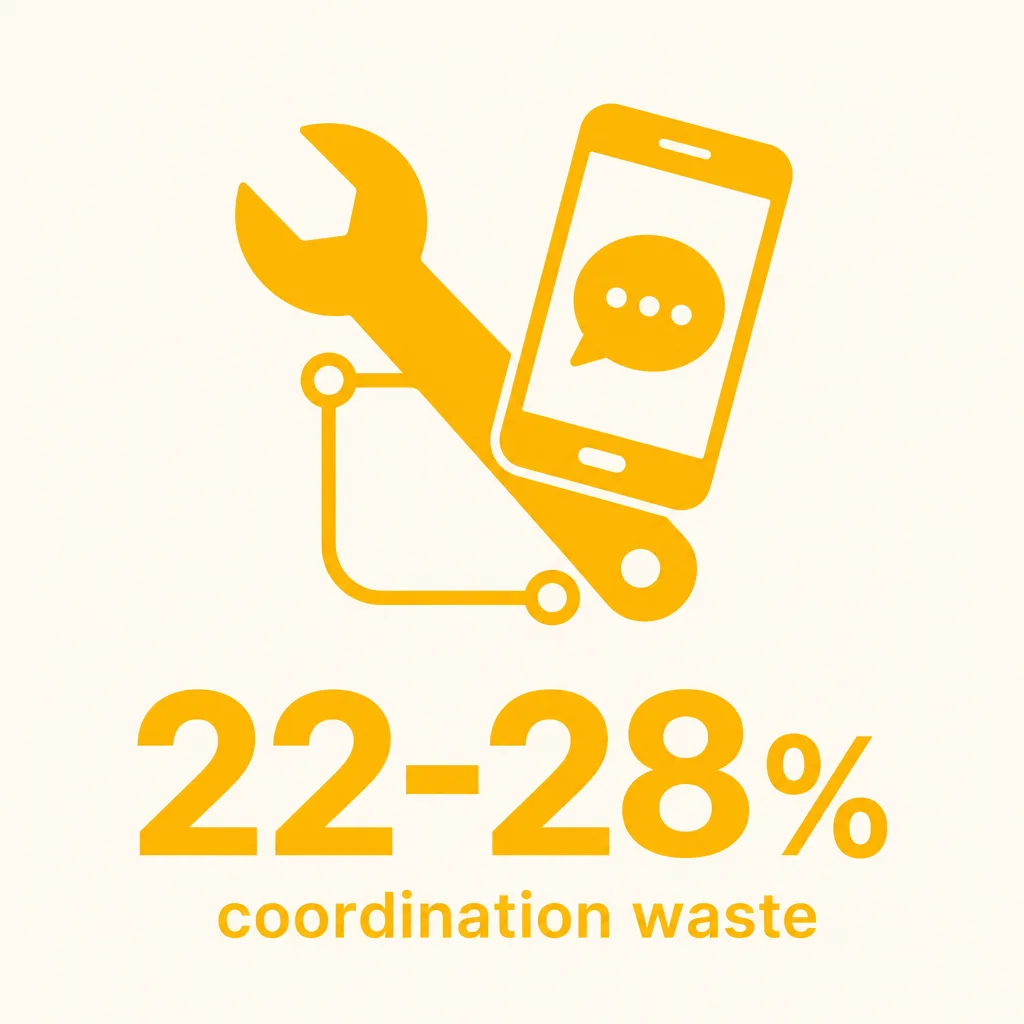
Task handoffs cost hotel groups 15 percent of labor because operations run on chat apps, phone calls, and hallway conversations instead of a system. A room stays vacant for 72 hours not because anyone failed, but because the handoff between shifts was never visible.
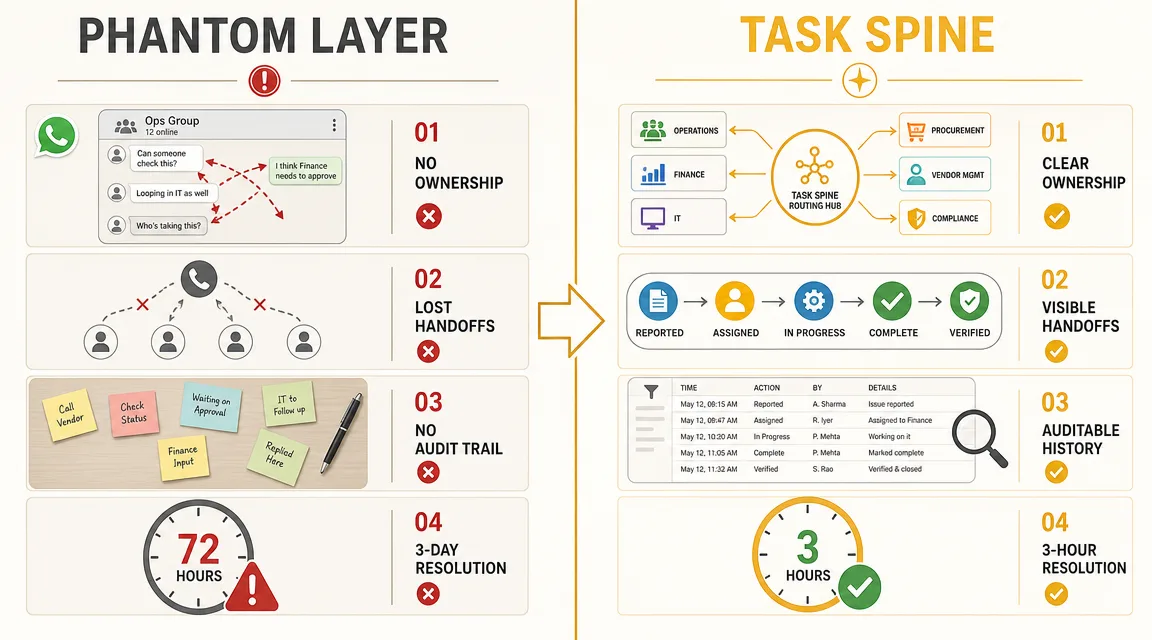
Room 304's AC unit failed on a Thursday at 2 PM. The front desk sent a WhatsApp message to the maintenance group chat. The engineer on duty was at Property 2 that afternoon and didn't see it. The next shift engineer assumed someone else had handled it. The housekeeping supervisor needed to know when the room would be ready for the 6 PM check-in but had no way to find out. Three days and four guest complaints later, someone finally put a work order into the PMS. The room had been vacant for 72 hours. Revenue lost. Guest lost. Nobody dropped the ball. There was no ball to drop.
Every Director of Operations managing 5 to 20 properties has a version of this story. Not because the team is incompetent. Because the operations layer runs on chat apps, phone calls, and hallway conversations. None of it is tracked. None of it is searchable. None of it rolls up to a view management can see.
The PMS Wasn't Built for Operations
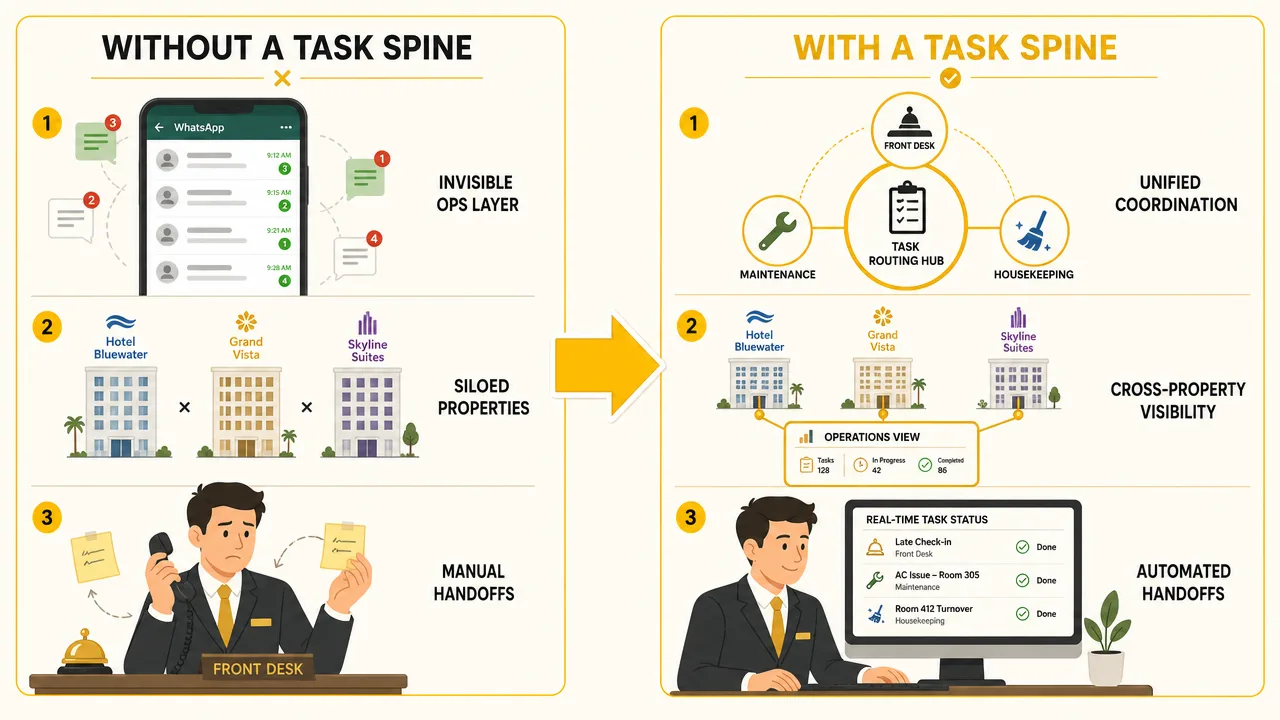
Property Management Systems handle transactions. Reservations. Check-ins. Check-outs. Folio billing. That's what they were architected to do, and most do it well. But a task is not a transaction. A transaction has a clear beginning and end. Guest arrives. Guest departs. Bill settled. A task has a chain: issue reported → assigned → in progress → completed → verified → communicated. Each handoff is a point of failure. Each step involves a different department. None of it lives in the PMS.
The actual operations system at most mid-market hotel groups is WhatsApp. Plus a text message to the engineer. Plus a phone call from the front desk to housekeeping. Plus a sticky note at the front desk for the next shift. None of this is visible to the Regional Director. None of it appears in any report. It's the phantom infrastructure every hotel runs on and nobody can audit.
Tools like Quore and Alice offer task management for individual properties. They digitize the work order. They give housekeeping a mobile checklist. They route maintenance tickets inside one hotel. What they don't do is show the Director of Operations what's happening across eight properties at once. They organize the work inside the building. They don't surface the cross-property patterns that matter to the person accountable for all eight P&Ls.
This isn't a shortcoming of those tools. It's a difference in architecture. They were built to solve property-level task management. The multi-property operator's problem is different. It's coordination across buildings where staff, tools, and expertise aren't dedicated to one location. That's a fundamentally different data model. Nobody built it.
What the Phantom Layer Actually Costs
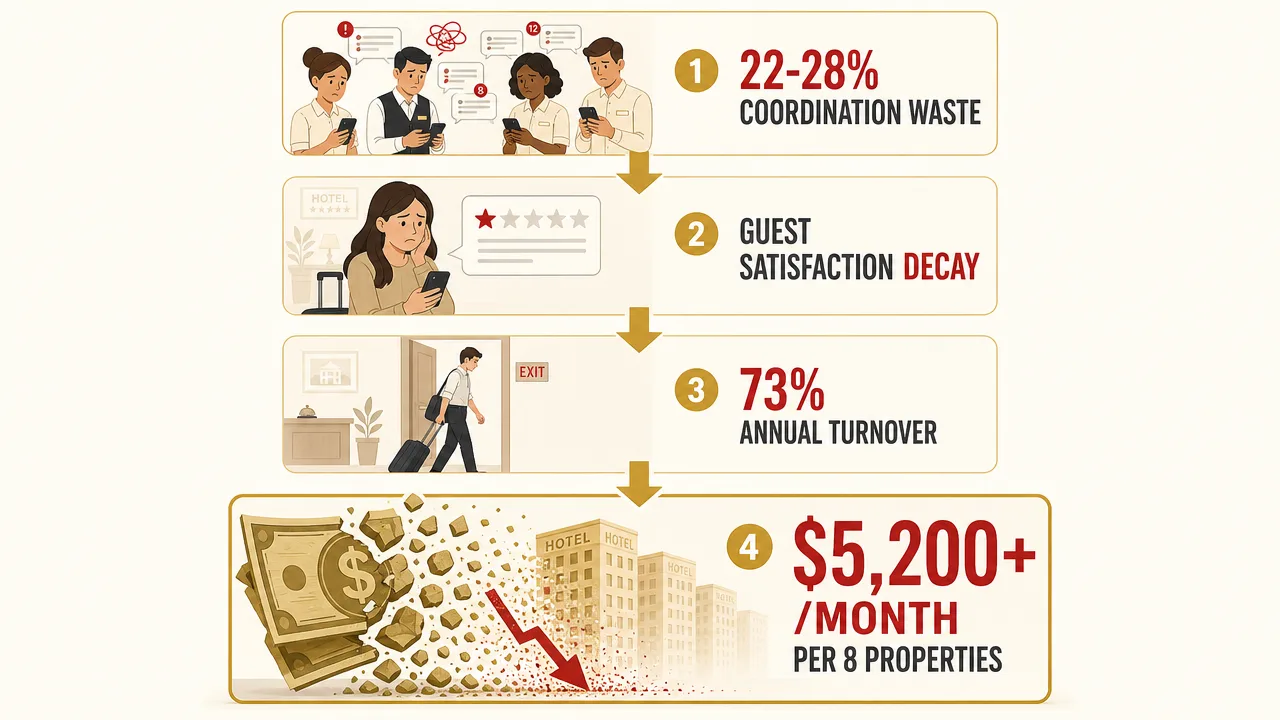
The visible number is coordination overhead. Staff spend an estimated 15% of their hours on task handoff: texting, calling, walking to find someone, repeating information that was already communicated. At a mid-market hotel group with 8 properties and 15 staff each, at a blended wage of $18 per hour, that's roughly $5,200 wasted per month on pure coordination labor. Fifteen percent is the conservative number. Factor in rework from miscommunication. The engineer showing up to the wrong room. The housekeeper cleaning a room maintenance had not released. The front desk calling a guest about a room that is not ready yet. The real waste lands between 22% and 28%.
But that's not the number that matters.
The hidden cost is guest satisfaction decay. A maintenance issue reported Tuesday at 10 AM that gets resolved Friday at 4 PM has generated four nights of complaints, one scathing review, and a guest who will never book again. The delay wasn't caused by incompetence. The engineer was competent. The delay was caused by the time it took for the task to find the engineer. Across chat groups. Across shifts. Across properties. Every hour of delay between report and resolution is an hour the guest is forming an opinion the hotel will spend months trying to reverse. Revenue management works on RevPAR. The ops layer works on guest patience. One is tracked to the penny. The other isn't tracked at all.
And then there's the compounding cost: staff turnover. Front desk agents burn out absorbing guest frustration for problems they can see but can't fix. Maintenance teams burn out firefighting instead of doing preventive work. Housekeeping supervisors burn out coordinating across departments with no system to support them. The industry's 73% annual turnover rate has many causes. One of them is this: giving people responsibility for outcomes without giving them the tools to coordinate the work.
Why Mid-Market Hotel Groups Accept This
The alternatives haven't fit, so the WhatsApp-and-sticky-note system survives. Not because it works. Because nothing else was designed for this segment.
Enterprise operations platforms like HotSOS and ALICE by Actabl serve portfolios of 50-plus properties. They come with centralized deployment, dedicated IT support, and integration teams. A hotel management company running 8 properties across three brands doesn't have centralized IT. It has a Director of Operations with a laptop and a group chat. Enterprise platforms are priced and architected for a different buyer. The mid-market operator falls through the gap. Too complex for a single-property work order app, too small for an enterprise deployment that requires a project manager and a six-figure annual contract.
Single-property tools like Quore digitize the work order. They're better than paper. But they don't solve the cross-property coordination problem. They can't answer the question a Regional Director actually needs answered: "Which of my 8 properties has the most open maintenance tickets right now, and is anyone working on them?" Each property runs its own instance. The data stays siloed. The Director is back to logging into 8 different systems. Different tools, same spreadsheet.
So the phantom layer survives. WhatsApp groups. Phone trees. The 30-minute morning huddle where department heads verbally reconcile what happened overnight. Every day. Because the market hasn't built for this gap.
What Changes When Tasks Have a Spine
Now imagine a different Thursday. Room 304's AC unit fails at 2 PM. Front desk logs the issue. The system routes it to the engineer covering Property 1 and Property 3 that afternoon. The engineer gets a notification, acknowledges it, and heads to Room 304. Housekeeping sees the room status change in real time: maintenance in progress. When the fix is done, the engineer marks it complete. Housekeeping gets notified the room is ready to turn. Front desk confirms it's available for the 6 PM check-in. The guest checks in on time. No complaints. No review. No revenue lost.
This isn't "better task management." It's a task spine. A single thread connecting every department across every property. Each handoff visible. Each step timestamped. Each status searchable. The Regional Director opens one view and sees: 12 open tickets across the portfolio, 3 approaching SLA breach at Property 4, 2 engineers available at Property 2 who could be routed to help. The morning huddle becomes a five-minute status check instead of a 30-minute verbal reconciliation.
The outcome isn't "improved efficiency." It's incidents that used to take three days now closing in three hours. Maintenance logs that take 30 seconds to search instead of scrolling through WhatsApp history. A Regional Director who knows which property is struggling before the guest tells them. And it all sits on top of existing PMSs. No rip-and-replace. No new app for staff to learn. Just the coordination layer their tools never had.
What to ask next
Common questions Directors of Operations ask after reading this:
How much does coordination waste actually cost across 8 properties at $18/hr average wage?
Can cross-property task routing work without replacing my existing PMS?
What does a task spine look like in practice for front desk to maintenance to housekeeping handoffs?
Related read: The gap between what PMSs track and what operators need to see extends beyond tasks — the same structural blind spot costs Regional Directors 4 hours every Monday morning just to compile KPIs their systems already contain.
Related read: Task coordination isn't the only thing your PMS is blind to. A 3-7 day pricing blind spot costs hotel groups 2-3% in missed revenue every week, compounding to $400K-600K/year at 10 properties.
Related read: Manual coordination waste is not limited to task handoffs. Fragmented hotel purchasing costs groups $48K-$112K a year in overpayment when every property buys from its own suppliers at its own prices.
If This Sounds Like Your Operations
We analyze multi-property hotel operations to quantify the task leakage your systems can't see. It starts with a diagnostic — a breakdown of where task handoffs break, what the coordination waste is costing per property per month, and which three changes would recover the most hours. No pitch. Just numbers.