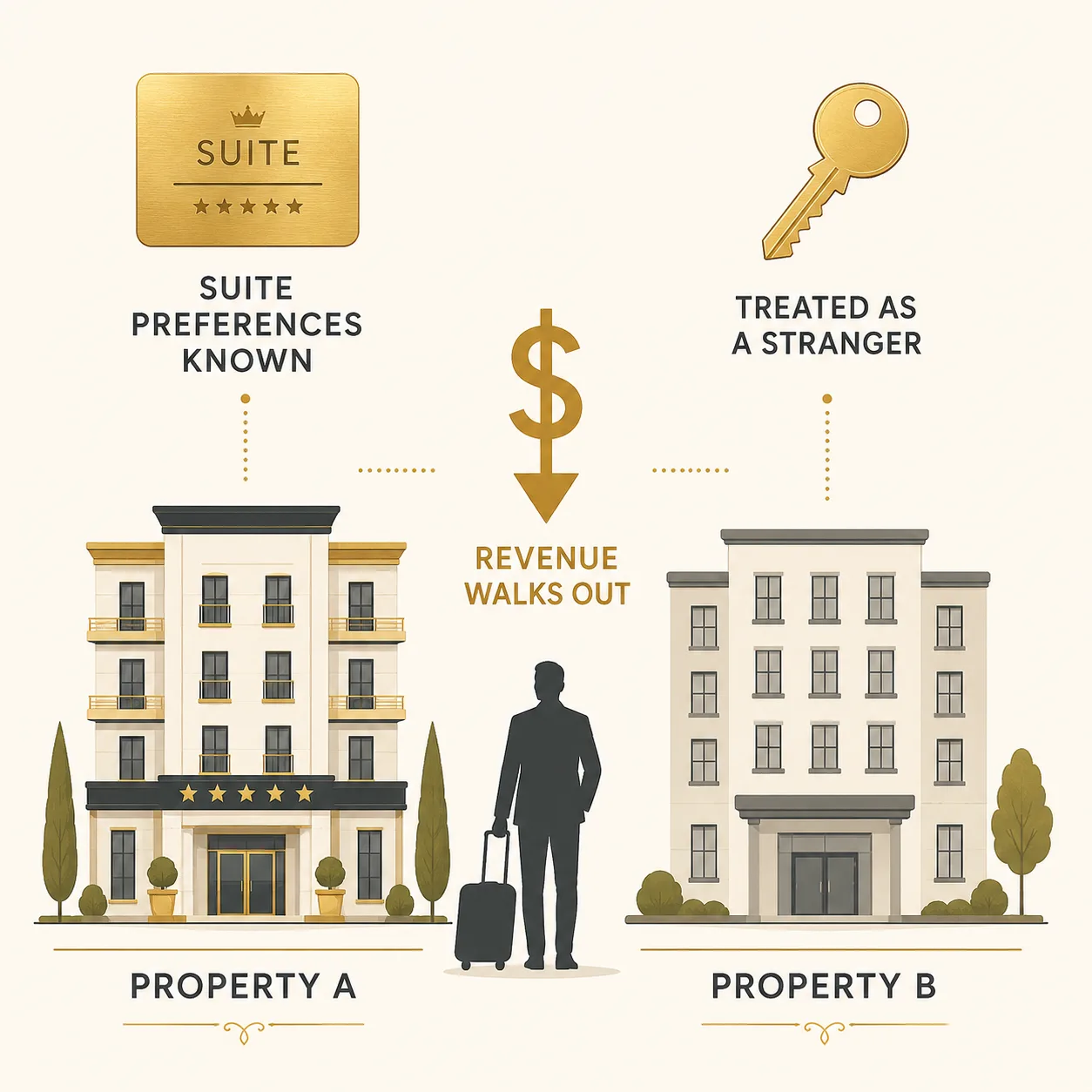
Revenue walks out when suite guests check into standard rooms because guest profiles stay locked inside each property's PMS and nothing connects them. Property A knows a guest books a corner suite, orders in-room dining twice per stay, and wants extra pillows and late checkout. Property B knows a name and a credit card number. The preference data stops at the property line, so the group's highest-margin guest is treated as a first-time customer at every sister property.
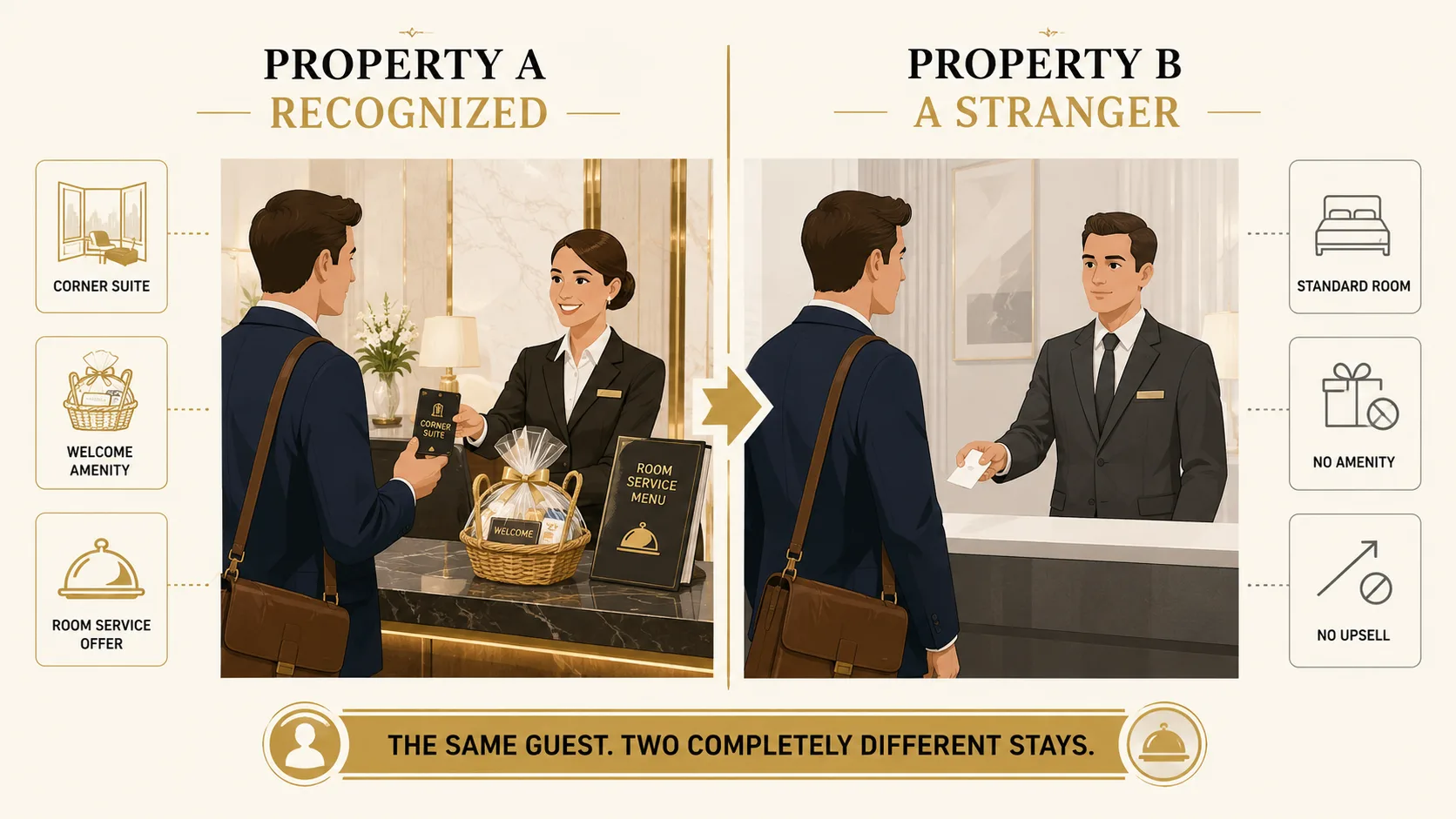
A GM at Property B checks in a guest named Chen at 3 PM. Standard room, no welcome amenity, no room-service upsell offer. Chen does not complain. He is polite. What the GM does not know: Chen stays at Property A four times a year, always books a corner suite, orders in-room dining twice per stay, and has a documented preference for extra pillows and late checkout. Property A's PMS knows everything about Chen. Property B's PMS knows Chen's name and credit card number. Nothing else transfers. Chen checks out, does not return to Property B, and never mentions why.
PMS guest profiles were built for one property, not a portfolio
PMS guest profiles are structurally per-property. Opera, Mews, and Cloudbeds were designed when a hotel company meant one building. The profile database is local to each instance. A guest history export is a manual CSV pull, property by property, merged in a spreadsheet nobody has time to maintain.
Guest relationship tools like Revinate, Cendyn, and Guestfolio bridge the gap but break even at 50-plus properties, with integration budgets mid-market groups do not carry. The PMS vendor's answer, upgrade to the enterprise tier, costs more than the revenue being lost. This is not negligence. It is architecture.
Hotel technology vendors admit the same thing. @STAAHOnline, a hotel connectivity provider, put it directly: "Many hotels have invested in technology. But when systems don't work together, efficiency, visibility, and guest experience suffer." The systems do not work together because the data model was never built to connect them.
What the recognition gap actually costs
The obvious cost is missed upsell: $18K–$42K per year for a 10-property group. A suite upsell at $60/night over 3 nights, 4 stays a year, is $720 per cross-property repeat guest. Multiply by 25–58 such guests per property pair, and the number compounds across every property combination in the group.
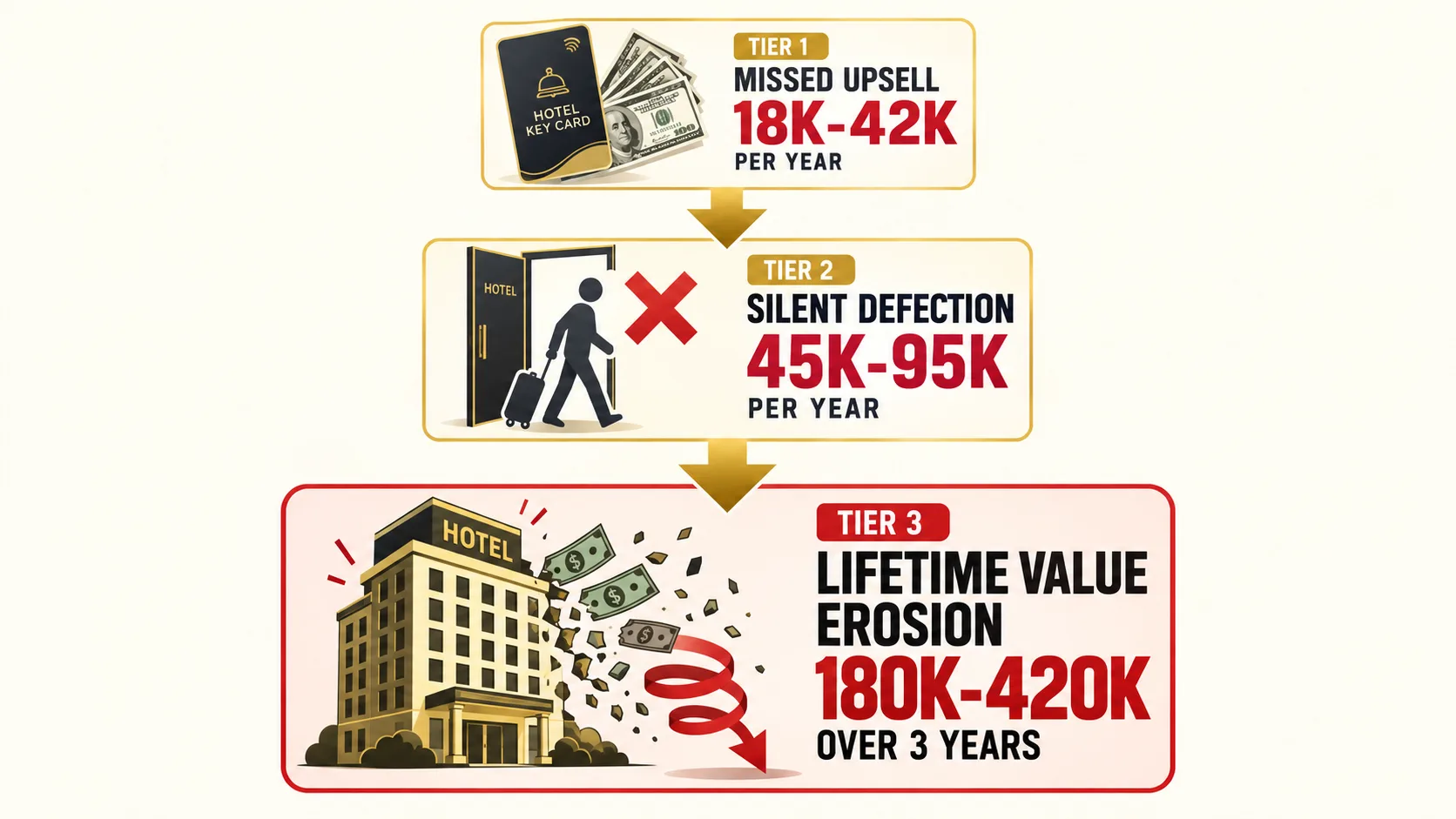
The hidden cost is defection: $45K–$95K per year. Chen does not complain. He stops booking Property B and slowly shifts more stays to the competitor that does recognize him. No exit survey captures "I booked a standard room when I always book suites and nobody noticed." Retention research from Harvard Business Review shows a 5% increase in retention lifts profits 25–95%, because the customers who stay are the ones who were already spending the most.
The compounding cost is lifetime value erosion: $180K–$420K over 3 years. Cross-property repeat guests are the highest-margin segment in the portfolio, and they gradually consolidate stays at the one property that knows them, or defect to branded chains where loyalty recognition is table stakes. The group's portfolio advantage becomes a liability: guests experience fragmentation instead of seamlessness.
Why the industry accepts an invisible cost
Enterprise CRM is priced for 50-plus properties. Manual guest-history sharing requires operational discipline that breaks down within six weeks: someone goes on leave, the spreadsheet stops getting updated. PMS vendors frame guest-profile unification as an upsell, not a core feature. Revenue managers know the problem exists but cannot quantify it, because the data lives in property silos. Nobody plots what nobody can see.
The industry accepts it because the mid-market never had a tool priced for the mid-market. AHLA's State of the Industry report documents rising operating costs and flattening revenue growth across hospitality, the exact conditions where a silent revenue leak is hardest to justify and easiest to ignore.
What changes when the recognition gap closes
Cross-property guest matching links profiles by email, phone, and name with confidence scoring. Within 14 days, a 10-property group identifies 300–700 cross-property repeat guests. No CRM deployment. No PMS migration. The data already exists in each system.
Flagging spend-pattern mismatches surfaces 15–25 missed upsell opportunities per week: the guest whose historical average room category is suite, booked into a standard room. Converting 35% of those flags delivers $14K–$28K in recovered revenue within 90 days.
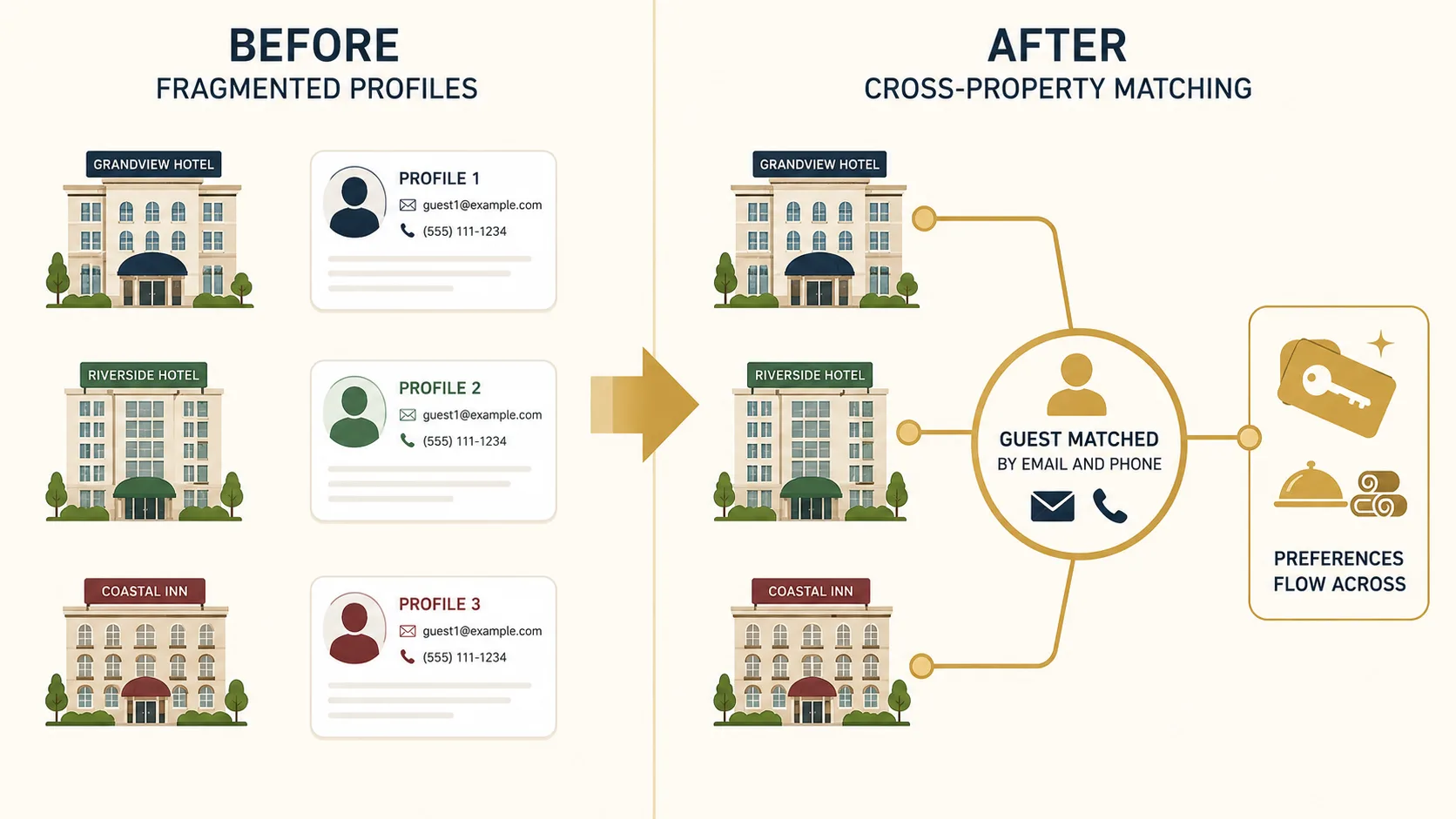
This is the same recognition gap that makes hotel groups pay OTA commissions on guests they already own. It is the same data isolation behind recurring guest complaints that never get linked, and the same manual consolidation that eats 15% of labor in cross-property reporting. The guest data exists in every PMS. It has just never been connected.
The same multi-property intelligence approach that flags anomalies across a hotel portfolio can answer the question revenue managers have never been able to ask: which of the highest-spend guests is checking into a standard room at a sister property right now. The TheiaOps approach is to read from everything, normalize it, and surface patterns the architecture was designed to hide.
What to ask next
Common questions operators ask after reading this:
How do hotel groups track guest preferences across multiple properties?
What does guest profile fragmentation cost a hotel group?
How do mid-market hotel groups do cross-property guest recognition without a CRM?
What revenue do hotels lose when they don't recognize repeat guests?