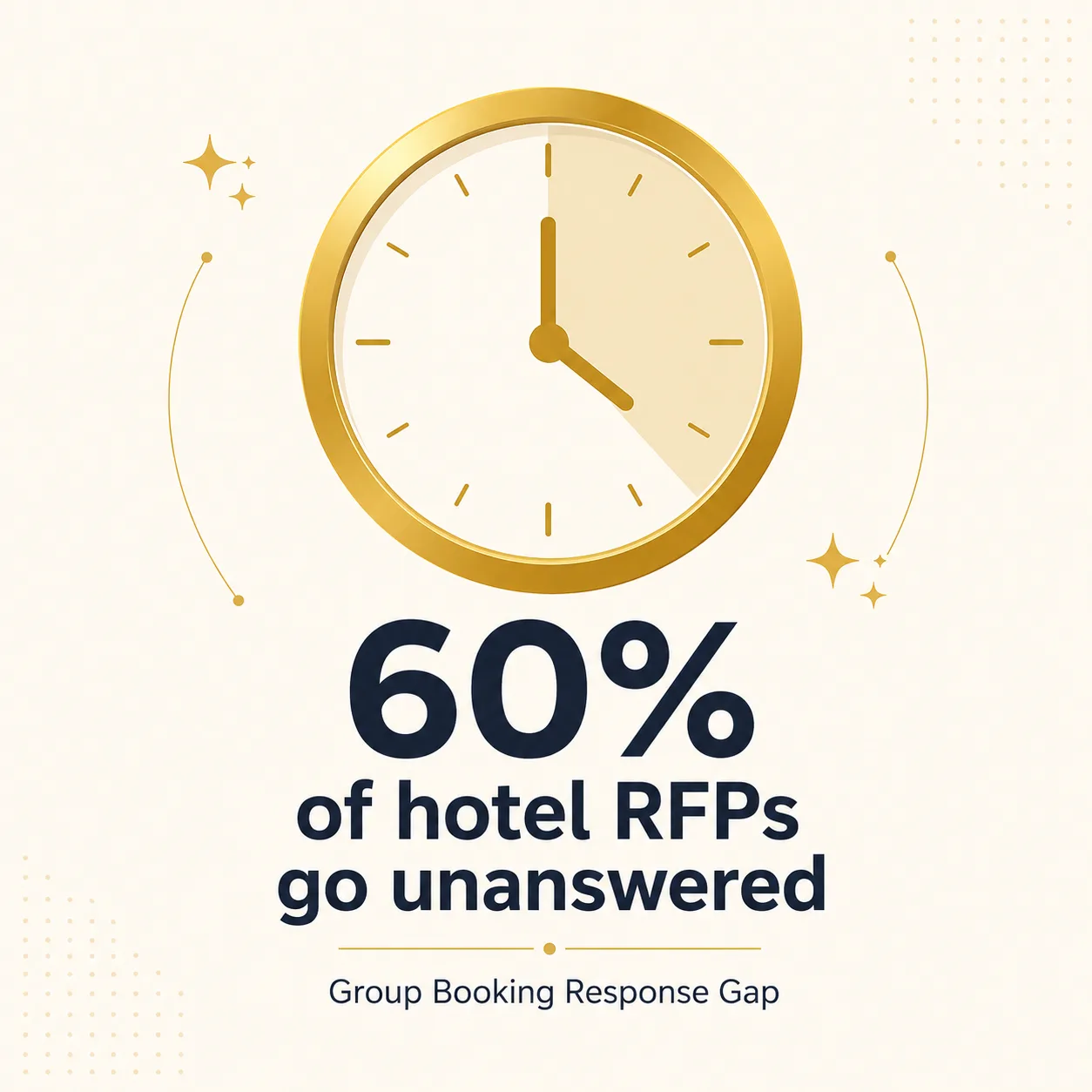
Hotel groups lose group bookings before they can quote because the PMS is structurally per property, and nobody has a portfolio-level room inventory view. The travel manager asks for 80 room-nights, the sales manager emails three properties, and 36 hours later the booking went to whoever answered first.
A corporate travel manager sends an RFP for 80 room-nights across a weekend to a 10-property hotel group. The sales manager at Property A opens their PMS. 120 rooms. 30 available. They email Property B's GM. The GM is in a revenue meeting. They text Property C. Property C's front desk manager says "I think we have 40 but let me check." 36 hours later, three properties responded, two have not, and the travel manager booked with the Marriott across the street 18 hours ago. The group never got a quote out. The booking went to whoever answered first. It was not them.
How Multi-Property PMS Fragmentation Kills Group Sales
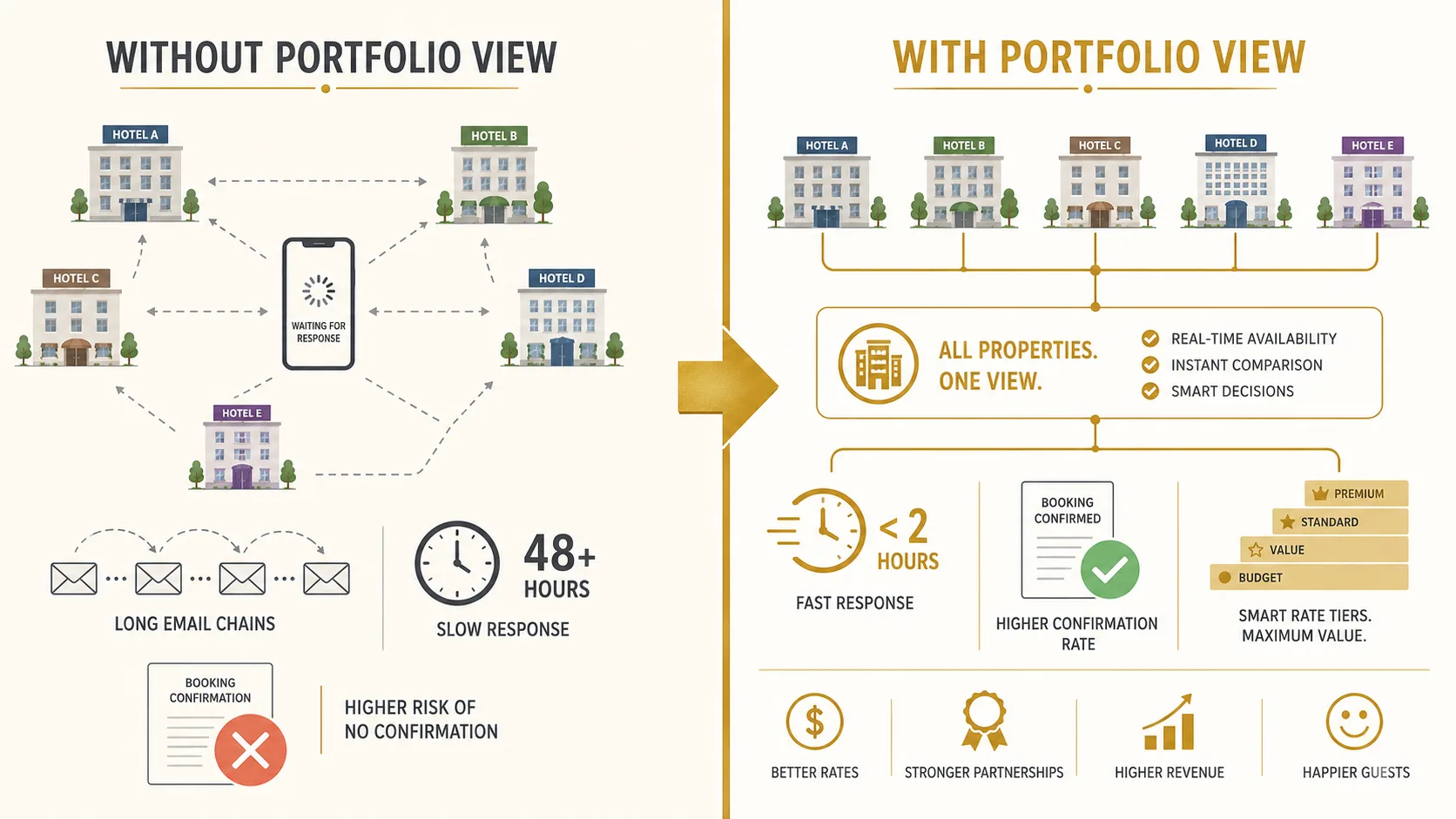
Property Management Systems are structurally per-property. They track rooms, rates, and reservations for one building. This is correct for transactions. It is broken for group sales. A group sales inquiry is fundamentally a portfolio question: "What can we deliver across all properties?" No PMS answers this.
The tools operators patch together fill the wrong gap. CRM tracks the contact but not the availability. Enterprise group sales systems like Amadeus and Delphi price per property and break even at 50-plus properties. The mid-market 5-to-20 property group falls through the gap. Sales managers stitch availability together via WhatsApp, email, and gut instinct. By the time they are ready to quote, the corporate buyer moved on.
According to hotel RFP tracking data from M1 Intel, the average hotel responds to fewer than 60% of the RFPs it receives. Properties on major RFP platforms like Cvent risk losing preferred status and search visibility when response rates stay low. Cvent and MeetingBroker deprioritize properties with poor responsiveness in their search results. The gap between RFPs received and RFPs responded to is one of the most preventable sources of lost group revenue in the industry. A dedicated RFP intake workflow, even a simple one, typically lifts response rate by 15 to 20 percentage points within 60 days.
What Slow RFP Response Actually Costs Hotel Groups
The obvious cost is the bookings that vanish. A 10-property hotel group loses 6 to 12 group bookings per year to slow response. Corporate meetings, wedding blocks, sports teams. At $15K to $80K per booking, that is $90K to $960K per year in direct lost revenue. This is not theoretical leakage. This is business that sent an RFP and got no answer.
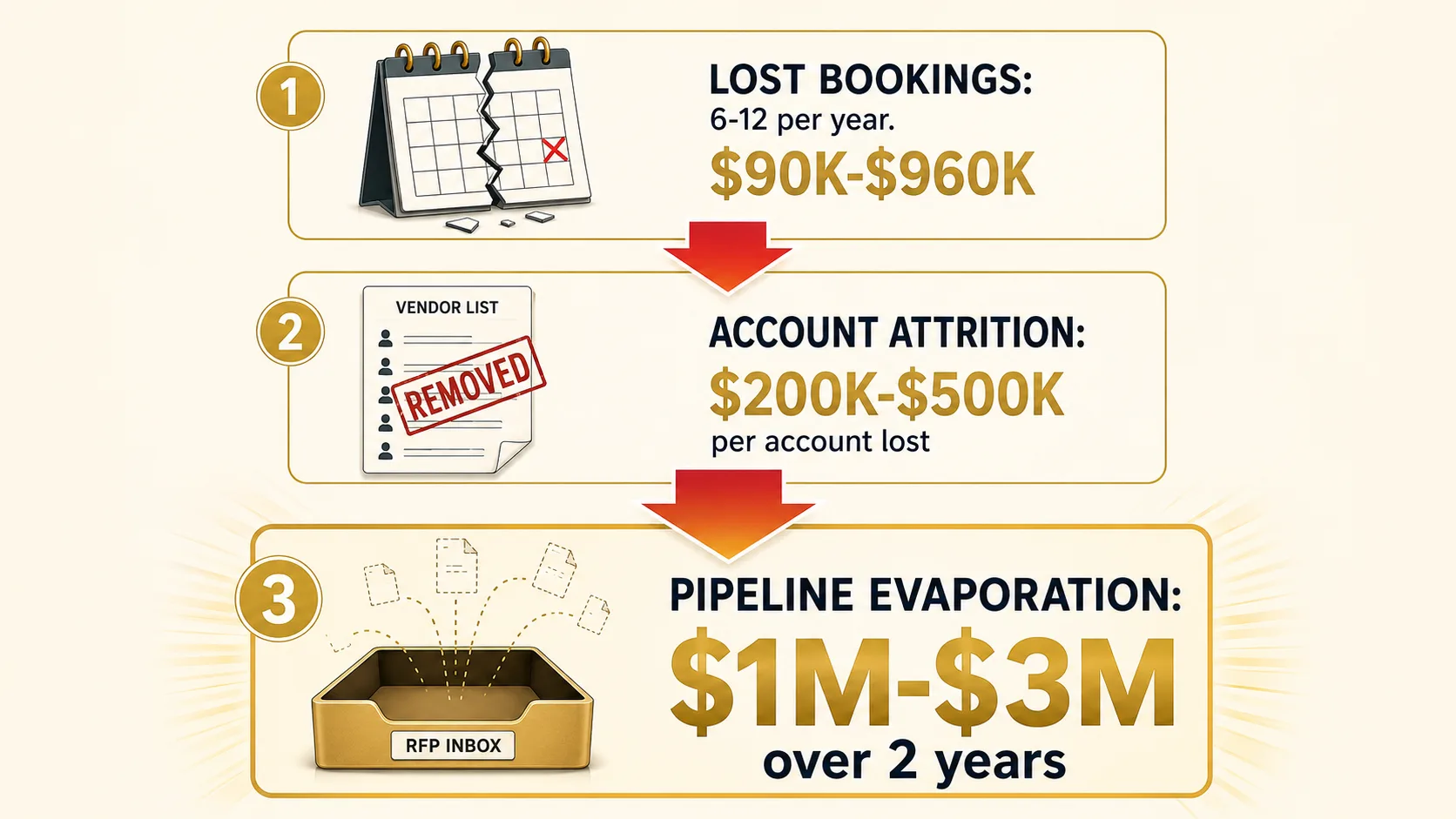
The hidden cost is worse. Corporate account attrition. A corporate travel manager who gets slow responses twice removes the hotel group from the vendor list. Losing one mid-sized corporate account with $200K to $500K in annual travel spend across properties more than doubles the obvious cost. They do not complain. They just stop sending RFPs. The pipeline dries up without a warning signal.
Then there is the compounding cost. RFP platform exclusion. Corporate travel networks and travel management companies track vendor response times. Three slow responses and the property drops below the response-time threshold for future RFPs. The pipeline evaporates. $1M to $3M over two years in group revenue that never reaches the inbox. It is not lost revenue on the P&L. It is revenue that was never counted because the RFP never arrived.
Why Mid-Market Hotel Groups Cannot Use Enterprise Group Sales Tools
Enterprise groups with 50-plus properties buy Delphi or Amadeus. $50K to $200K per year tools that justify themselves at scale. Single-property hotels have one PMS and one availability view. No coordination problem. The mid-market gap is where 5-to-20 property groups sit. Too large for single-property thinking. Too small for enterprise group sales tools.
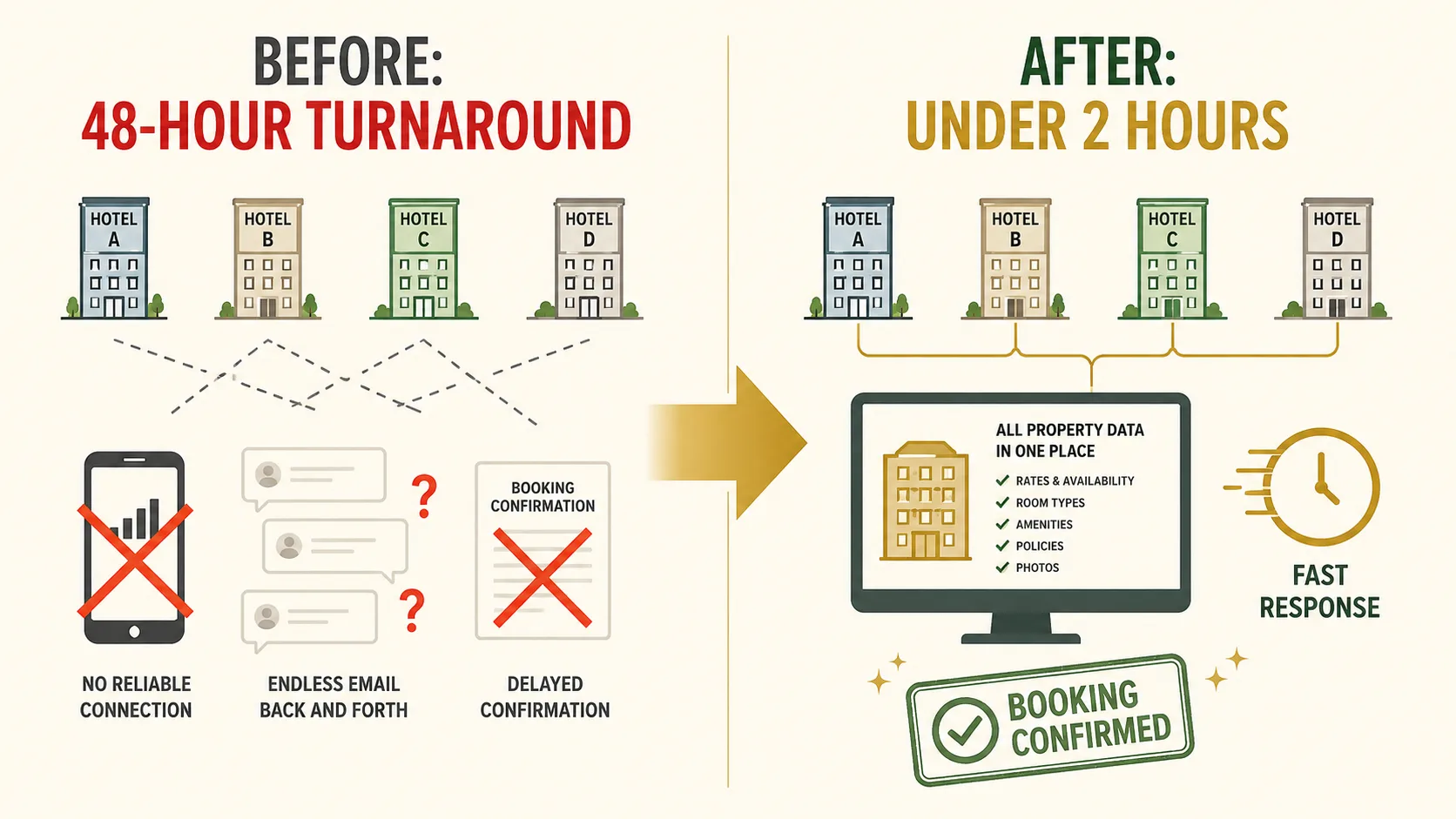
These groups accept 48-hour quote turnaround as "just how group sales works." Not because it is efficient. Because nobody built a mid-market alternative. The cost is invisible. Revenue that never arrived, not revenue that was lost. The corporate travel manager who stopped sending RFPs is not a line item. The account that quietly shifted 80% of bookings to the competitor chain is not tracked. The industry accepts the gap because measuring it requires seeing what did not happen.
Hotels that respond to RFPs within 4 hours win at materially higher rates, according to the same M1 Intel RFP benchmark data. The 4-hour benchmark is not aspirational. It is the dividing line between groups that book and groups that book with whoever answered first. A 48-hour turnaround across a 10-property group puts the sales team 44 hours past the line before the first property even confirms availability.
What Changes With Portfolio-Wide Availability Visibility
The fix is not a new PMS. It sits across existing systems. When a group RFP arrives, the sales manager sees every property's availability in one screen. No calling GMs. No texting front desk managers. No waiting for someone to emerge from a revenue meeting.
Quote turnaround drops from 24 to 48 hours to under 2 hours. The corporate travel manager gets a response before lunch. Room type breakdown. Rate tiers. Property options. The group wins 4 to 7 additional bookings in the first year from response-time improvement alone. This is not an aspirational projection. It is math. When 60% of RFPs currently go unanswered and a basic workflow lifts response rates by 15 to 20 points, the revenue gap is sitting in the inbox waiting to be opened.
Revenue managers also gain something they do not have today. When all five properties are pricing identically during a city-wide event, a portfolio view lets them stair-step rates across properties to capture willingness-to-pay at every tier. This is rate optimization that single-property PMS systems cannot perform because they cannot see the full inventory. The group moves from reacting to pricing to shaping it.
What to ask next
Common questions operators ask after reading this:
How long should a hotel group take to respond to a corporate RFP?
What do hotel groups lose when they respond slowly to group bookings?
Why cannot hotel PMS handle multi-property group sales?
How much group revenue do mid-market hotel groups lose from slow quoting?
Get a Diagnostic on Your Group Quoting Turnaround
Average response time on the last 10 group RFPs. If it is over 4 hours, bookings are being lost that the sales team never knew existed. The diagnostic identifies the gap between RFPs received and RFPs responded to across the portfolio. It finds the properties that consistently delay multi-property RFPs. The output is a response-time baseline and a list of the specific friction points that turn a 2-hour answer into a 48-hour wait. No software to buy. No PMS migration. Just the signal that shows where the revenue is leaking.
How TheiaOps builds operational intelligence for mid-market businesses →