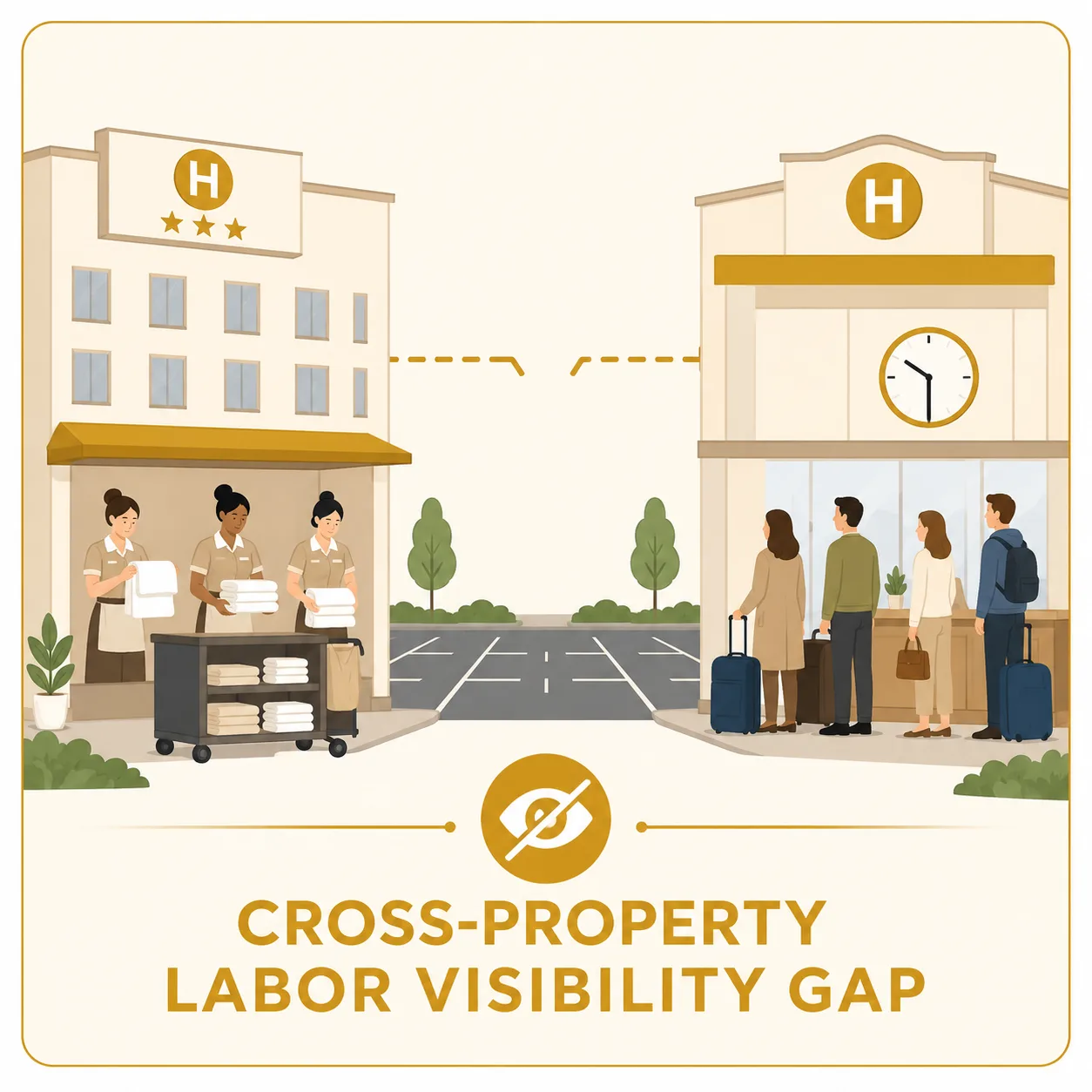
One hotel scrambles while another has idle staff because labor planning runs per property and no tool shows the picture across properties. The housekeeping supervisor can see the other building from the lobby window, but she cannot reallocate staff she cannot see in any system.
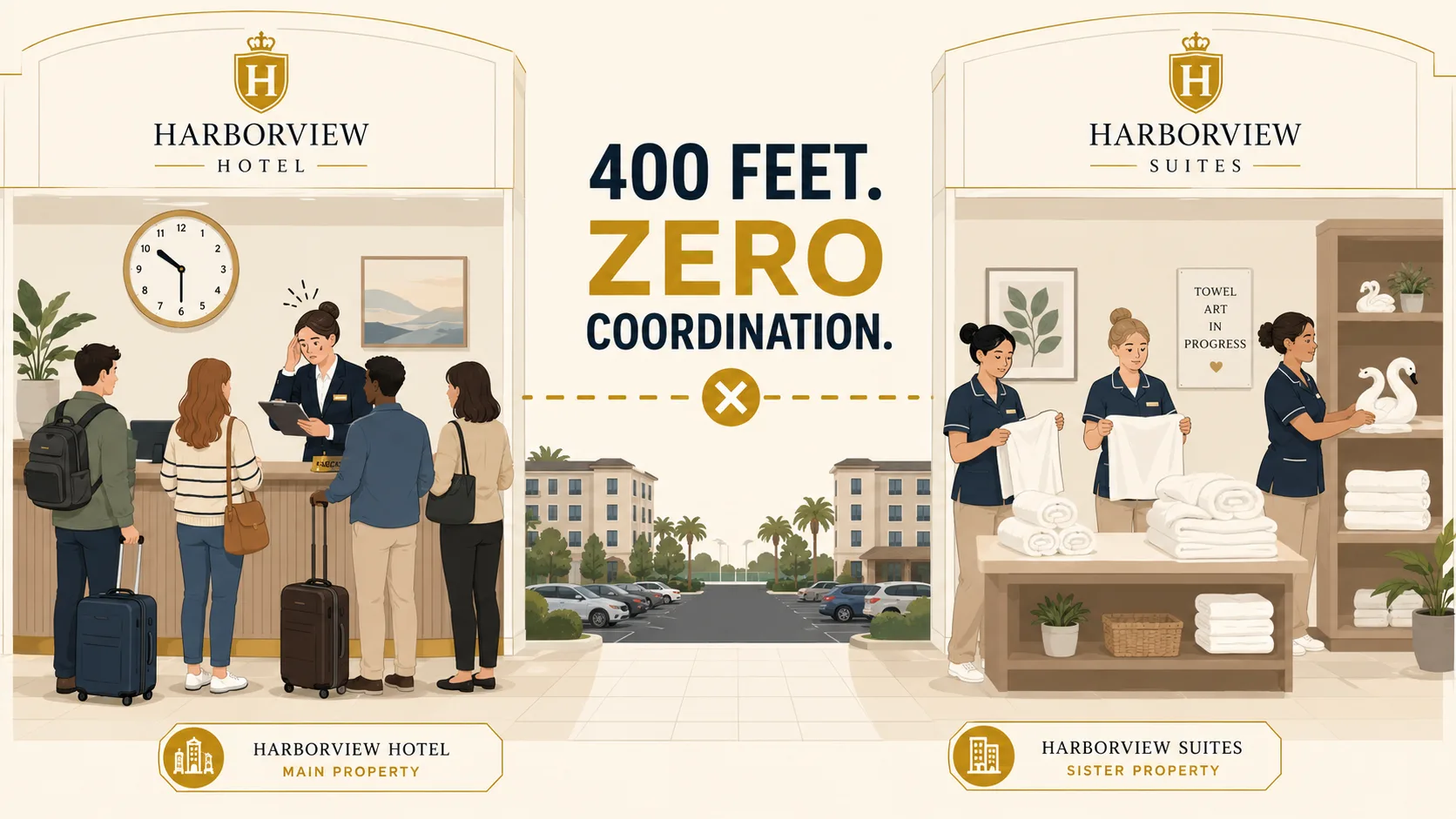
Property B's front desk has four guests waiting for rooms that aren't ready. The housekeeping supervisor is on her third loop of the floor, triaging checkouts against available staff. Across the parking lot at Property A, three housekeepers finished their eight checkouts by 10:00 AM and are now refolding towel displays. Two properties. One ownership group. Zero coordination. The morning huddle hasn't happened yet. When it does at 11:00 AM, the answer will arrive three hours too late.
Every Regional Director of Operations managing 5 to 20 properties has felt this. The parking lot is 400 feet across. The housekeeping supervisor can literally see the other property from the lobby window. She knows they have idle staff. She cannot reallocate them because no tool shows her the labor picture across properties. The absurdity is not that the answer exists. It is that the answer is visible. Just inaccessible.
PMS Systems Are Property-Siloed by Design
Property Management Systems (Opera, Maestro, RoomKey, Cloudbeds) scope everything to a single property ID. Room status, housekeeping assignment boards, occupancy dashboards — all firewalled inside one database. The housekeeping supervisor at Property B can see that room 214 is dirty and room 312 is being cleaned. She cannot see Property A's staffing picture because that data lives in a separate PMS instance with no cross-property join. This is not a missing feature. It is a structural limitation baked into the architecture of every mid-market PMS.
Property-level task tools like Quore, Alice, and HotSOS add workflow management but do not cross property boundaries. Enterprise workforce platforms like UKG and Workday handle multi-location labor but break even at 500-plus employees and require HRIS integration. The mid-market hotel group (5 to 20 properties, 50 to 200 housekeeping staff) falls into a dead zone: too big for spreadsheets, too small for enterprise HR systems. The tool that would solve this does not exist at their price point. This is the gap multi-property intelligence is built to close. Reading across systems without replacing them.
This is the same structural gap that causes the four-hour Monday report. Different symptom. Same root cause. Systems architected for single-property transactions cannot surface cross-property patterns. The housekeeping supervisor cannot reallocate idle staff any more than the Regional Director can consolidate RevPAR from six PMSs. Both problems live in the same blind spot.
What the Idle/Burnout Split Actually Costs
The obvious cost is direct labor waste. On the busy side: overtime at $18 to $22 per hour, 2 to 3 extra hours per shift, 3 to 4 days per week. That is $450 to $800 per week in unnecessary overtime. On the slow side: 3 staff members with 2 unproductive hours each at $15 per hour, $90 per day in idle labor. For a 5-property group, the visible labor waste runs $3,500 to $5,000 per month. Money the group already budgeted. Burned on scheduling imbalance.
The hidden cost is guest experience decay. Late check-ins trigger front desk comps: free breakfast vouchers, parking waivers, drink coupons at $15 to $30 per incident. OTA penalty scores compound: properties with chronic late check-in rates above 8 percent lose 0.3 to 0.5 points on review scores. That translates to a 5 to 8 percent booking decline on rate-sensitive mid-market properties. Group sales friction follows. Meeting planners who hear "rooms weren't ready" from attendees do not rebook. One lost corporate group contract is $25,000 to $50,000 per year.
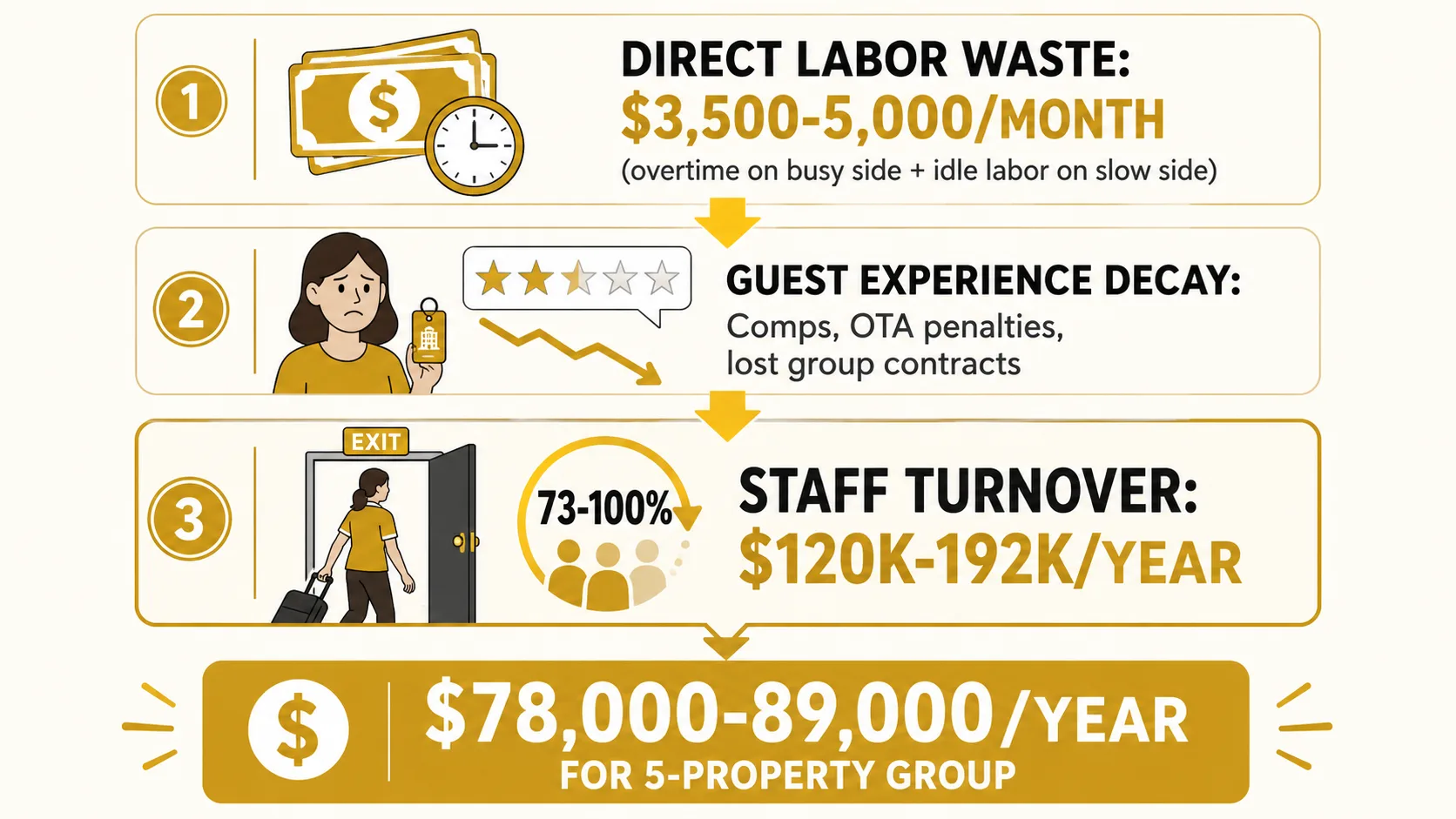
The compounding cost is staff turnover. BLS data shows leisure and hospitality turnover runs 74.6 percent annually. In mid-market hotels, housekeeping turnover hits 73 to 100 percent. Burnout drives turnover on the busy side. Boredom drives it on the slow side. Cost per replacement runs $2,500 to $4,000 in recruiting, training, and lost productivity during the vacancy period. A 5-property group with 60 housekeeping staff at 80 percent turnover replaces 48 people per year. That is $120,000 to $192,000 annually. Cross-property labor visibility that cuts turnover by even 15 percent saves $18,000 to $29,000 per year. On turnover alone. Before operational gains.
Why the Industry Accepts This Mid-Market Dead Zone
Alternatives do not fit. Enterprise workforce platforms are priced and scoped for 500-plus employee organizations. Property-level tools are scoped to single properties by design. The mid-market group runs on the morning huddle. The 15 to 20 minute ritual where GMs compare occupancy numbers and manually ask "anyone have spare housekeepers today?" That huddle produces a reactive answer that arrives after the morning checkout wave has already crested. Groups have normalized this because no tool has ever shown them an alternative that fits their size and budget.
The morning huddle is not a solution. It is scar tissue where the missing tool should be. Checkouts cluster between 8 AM and 11 AM. The huddle happens at 10:30 to 11 AM. Staff reallocation takes 30 to 45 minutes. Rooms are ready at 1 PM instead of noon. The decision window exists. Occupancy data is available before checkouts begin. The 7 AM advantage is real. The property-level PMS just cannot show it across properties. Groups accept the huddle not because it works. Because they have never seen an alternative priced for their scale. This is the kind of gap market-validated intelligence is built to close. Entering a category only after proving the pain is real, the cost is measurable, and existing tools are not solving it.
The same mid-market dead zone appears across hospitality. Revenue leakage of 2 to 3 percent weekly costs groups $400,000 to $600,000 per year. Pricing blind spots that the PMS never flags. Different symptom. Same structural cause. Tools designed for single properties cannot surface cross-property patterns. The gap shows up in housekeeping labor. It shows up in revenue management. It shows up everywhere the operator needs one answer from six systems.
What Changes When Housekeeping Can See Across Properties
Cross-property housekeeping visibility changes the morning from reactive triage to proactive allocation. Not automation. Not AI. Just seeing the labor picture across all properties at once. At 7 AM, before checkouts begin, the group-level view shows: Property B has 18 checkouts and 6 housekeepers. Property A has 6 checkouts and 4 housekeepers. The supervisor shifts 2 staff from A to B before the bottleneck forms.
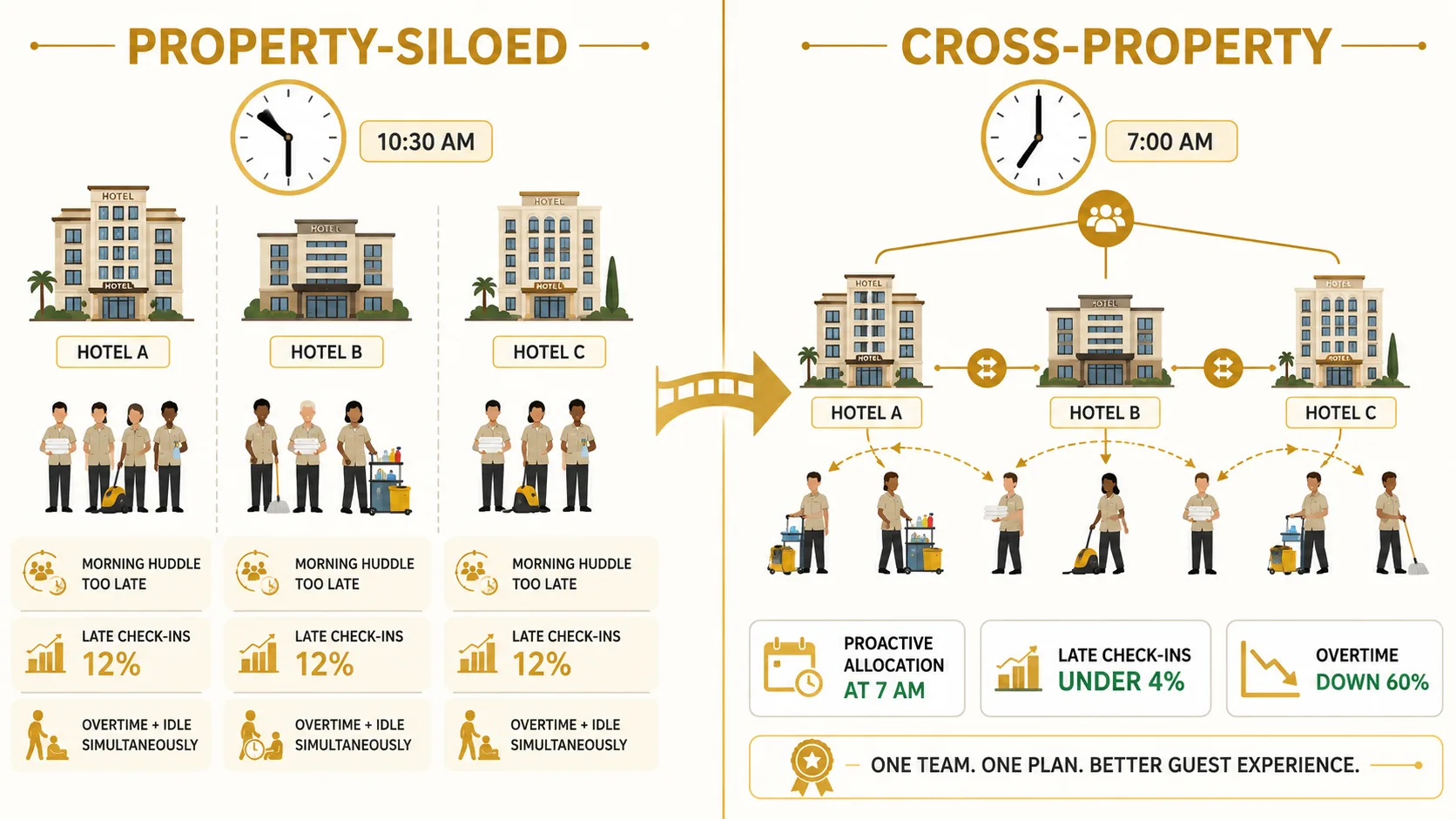
Concrete outcomes for a 5-property group. Late check-in rate drops from 12 percent to under 4 percent. Overtime hours drop 60 percent, saving $2,100 to $3,000 per month. The morning huddle shrinks from "who can help?" to "any exceptions today?" Fifteen minutes becomes two minutes. Turnover reduction of 15 percent: $18,000 to $29,000 per year.
Annual impact: $3,500 per month labor savings times 12 months equals $42,000. Plus $1,500 per month in avoided comps and OTA penalties equals $18,000. Plus $22,000 in turnover savings equals $78,000 to $89,000 per year for a 5-property group. Not from new software. Not from hiring more staff. From visibility into a problem the group already pays for.
This is not another report. It is the cross-property lens every PMS was architected without. Built for the Regional Director who manages a portfolio, not just a property. And it sits on top of existing PMSs. No rip-and-replace. No new login for staff. Just the question the systems were never designed to answer: where is the labor, and where does it need to be?
What to ask next
Common questions operators ask after reading this:
How much does hotel housekeeping turnover cost per employee?
What is the average housekeeping turnover rate in mid-market hotels?
How do hotel groups manage staffing across multiple properties?
What causes late check-ins at hotels and how much do they cost?
Related read: Staffing isn't the only pattern invisible across properties. The same compressor failure repeats at three properties before anyone notices because single-property CMMS tools cannot flag "same failure, different property" patterns. $45K to $85K per year in emergency repairs that cross-property visibility would have caught.
Related read: Cross-property blindness covers more than labor. Hotel groups lose $28K–$64K per year in ADR from rate self-cannibalization — same root cause. Different waste. Cross-property rate intelligence surfaces price conflicts between sister properties that PMS systems structurally cannot see.
Related read: The same cross-property blindness that strands staff also inflates buying. Hotel groups pay retail prices for wholesale volume because each property negotiates suppliers alone, overpaying $48K-$112K a year on recurring supplies.
If This Sounds Like Your Morning Huddle
We analyze multi-property hotel operations to measure the housekeeping labor utilization gap your PMSs cannot see. It starts with a diagnostic. We map occupancy patterns against staffing levels across your properties and show exactly where the idle/burnout split is costing money. Property by property. Shift by shift. No software to buy. Just visibility into a problem you already pay for.