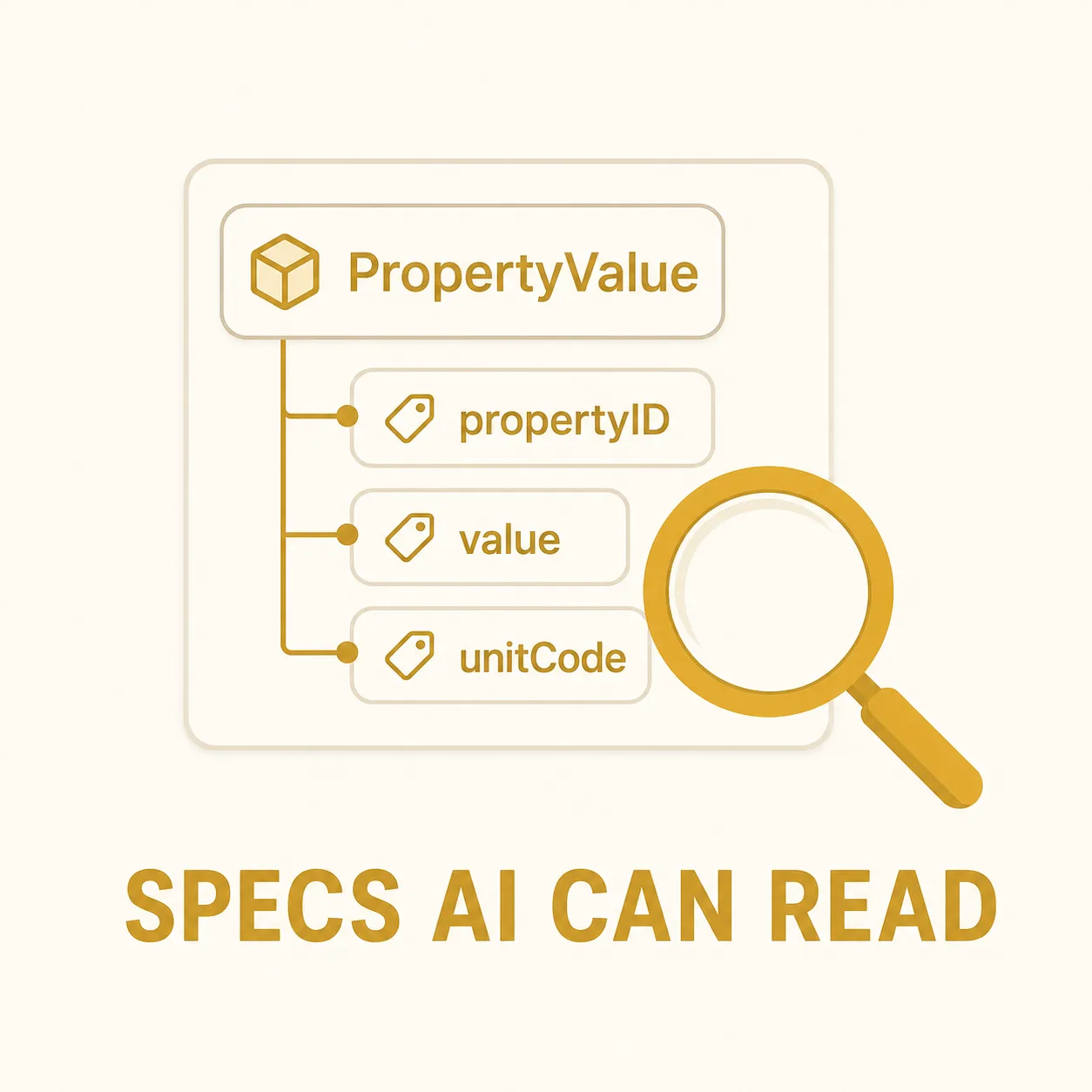
AI shopping assistants cannot compare products they cannot read as data. A spec that exists only as prose, a table, or an image is a blank wall to the assistant, so the better product stays invisible at comparison time and the customer buys the worse one.
A customer asks ChatGPT "which portable speaker has better battery life — Brand A or Brand B?" ChatGPT recommends Brand A with 8 hours. Brand B's product page clearly states 20 hours of battery life. It is in the hero paragraph. It is in the spec table below the fold. It is in a metafield labeled battery_life_hours. ChatGPT could not extract it because none of those formats are structured for machine comparison. The customer buys the worse product. The better product was invisible at comparison time.
This is not a ranking problem. It is a parsing problem. AI shopping assistants cannot compare specifications they cannot read as data. A product page that converts humans can be a blank wall to an AI. The spec exists on the page. It does not exist in any format the assistant can parse, compare, or cite. The competitor with machine-readable specifications wins the recommendation. Not because the product is superior. Because the assistant was given something to read. The same spec data, two different outcomes. Only one product page made comparison possible.
The Transaction Schema Stops at "Can I Buy It"
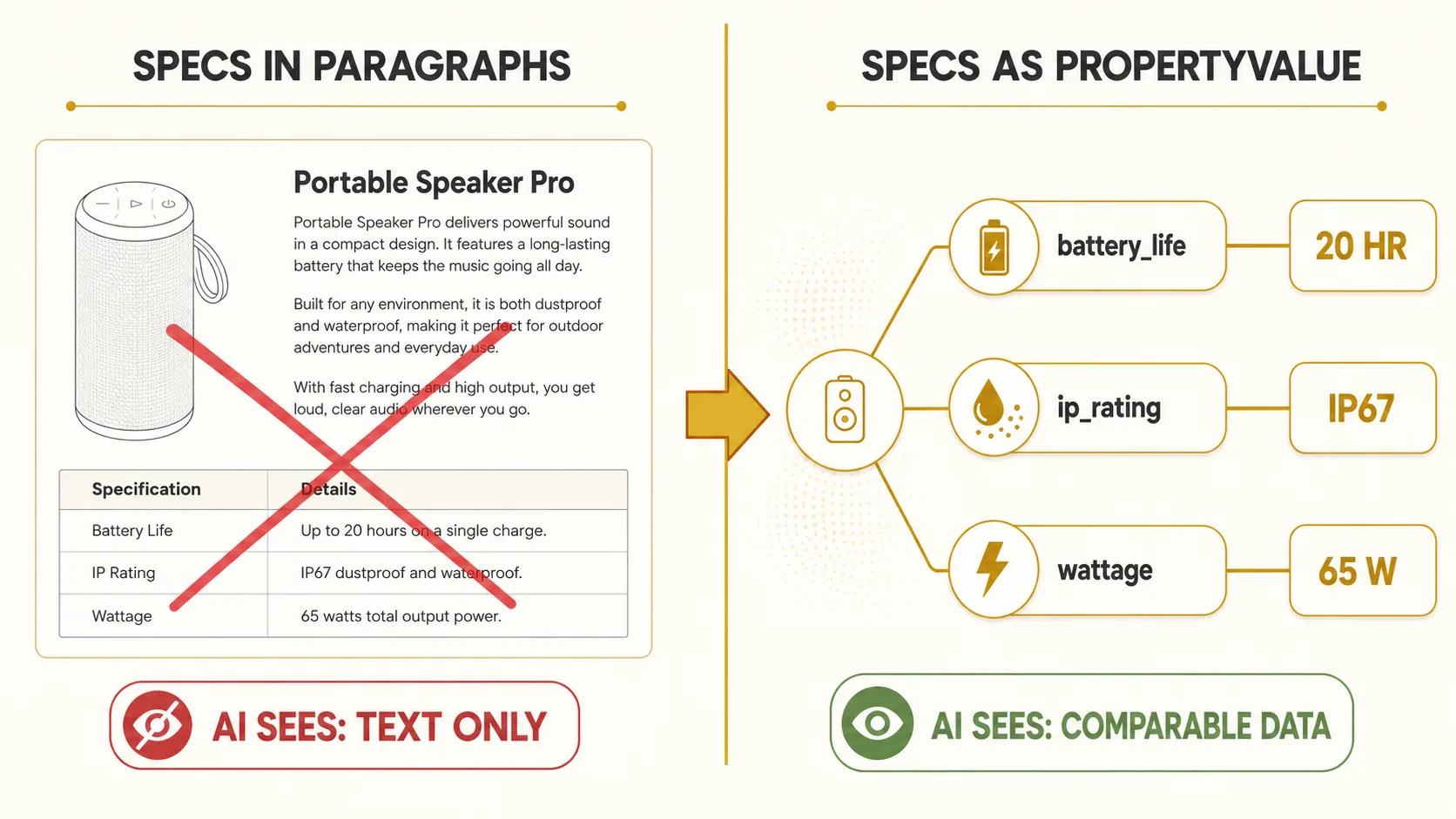
Shopify's product schema handles the transaction side. Price. Availability. Images. Offers. These fields answer "can I buy this product?" They do not answer "what can this product do?" Product specifications live outside the transaction schema. Battery life. Wattage. IP rating. Material composition. Certifications. Dimensions. Weight. These attributes determine whether a product wins or loses a comparison query. They exist on the page in three places. None of them are machine-readable.
First: product descriptions. Unstructured paragraphs. "The SoundPro X delivers an incredible 20 hours of continuous playback, making it the perfect companion for weekend trips." An AI shopping assistant sees a sentence about continuous playback. It cannot extract "battery life = 20 hours" and compare it to another product's "battery life = 8 hours." The number is present. It is not parseable as a property with a unit. The text flowed well for a human. It conveyed nothing to a machine.
Second: metafields. Custom key-value pairs like battery_life_hours: 20. Structured internally. No standardization. No unit specification. Shopify stores the value. It does not surface it as schema.org PropertyValue with unitText and unitCode. The data exists in the database. It does not exist in the format AI assistants consume. A metafield is a private label. It tells the store what the value is. It tells no one else.
Third: HTML specification tables. Visual layouts with rows and columns. Humans read them side by side. AI assistants see table cells. They cannot determine which cell maps to which property because the mapping is visual, not semantic. A spec table is a layout, not a dataset. The browser renders it as a grid. The assistant sees untyped nodes. A comparison that takes a human two seconds — scan right, find the battery row, read the number — requires an AI assistant to infer structure from tags that were never designed to encode it.
Google Merchant Center validates feed completeness. It checks whether required fields are populated. It does not test whether an AI assistant can extract battery life from a product page and compare it across two products. The validation is structural, not semantic. A feed with title, price, and image passes every check. A feed missing PropertyValue depth passes every check too. The validator was built for Google Shopping. AI shopping assistants did not exist when the validator was designed. This is the same tooling gap that makes structured data depth invisible to standard SEO audits. Different symptom. Same root cause.
SEO tools flag "schema present" as a green checkmark. They treat hasPrice and hasWattage equivalently. A product page with title and price schema returns the same audit score as a product page with title, price, and complete PropertyValue markup with unitText, unitCode, and minValue/maxValue. The tool checks schema presence. It does not check schema depth. It was never asked to. It cannot tell the difference between a page an AI can fully parse and a page the AI skips entirely. Both pages glow green.
The tools that do solve this exist. Product Information Management systems generate complete product specifications and syndicate them across channels. Akeneo. Salsify. The price tag: $2,000 to $5,000 per month. They are designed for catalogs of 10,000-plus SKUs. The 40-SKU DTC brand running $3 million on Shopify is not buying a PIM. The math does not close. So the gap persists. Nobody is failing. The tooling priced for this scale simply does not exist. The mid-market has no specification bridge between what Shopify stores and what AI assistants need. This is exactly the kind of gap where multi-property intelligence logic applies: the tools exist at the wrong scale. The data exists in the wrong format. The cost of bridging them manually is invisible until a comparison query goes to the competitor.
What Invisible Specifications Cost a $3M Store
The obvious cost: $14,000 to $50,000 per year in misrouted AI recommendations. 58 percent of shoppers now use generative AI instead of traditional search for product recommendations. At $3 million revenue, the AI-assisted discovery flow is substantial. When 6 to 12 percent of those queries recommend a competitor because specifications are invisible, the store loses $14,000 to $50,000 per year. The products are live. The ads are running. The discovery channel is recommending someone else. The spec data was always there. It just was not readable.
The hidden cost: competitor displacement that compounds. An AI assistant asked "best portable speaker under $100" does not return nothing. It returns whichever products it can parse completely. The competitor with structured PropertyValue markup gets the placement. Their product now occupies the assistant's default answer for that category. Every subsequent query for "best portable speaker" biases toward the product the assistant has already learned to recommend. The model builds its understanding from data it can parse. A product with invisible specifications is not part of that model. Brand displacement. Not sale displacement. The shopper who asked about battery life never saw the better product. The brand never knew it was in the running.
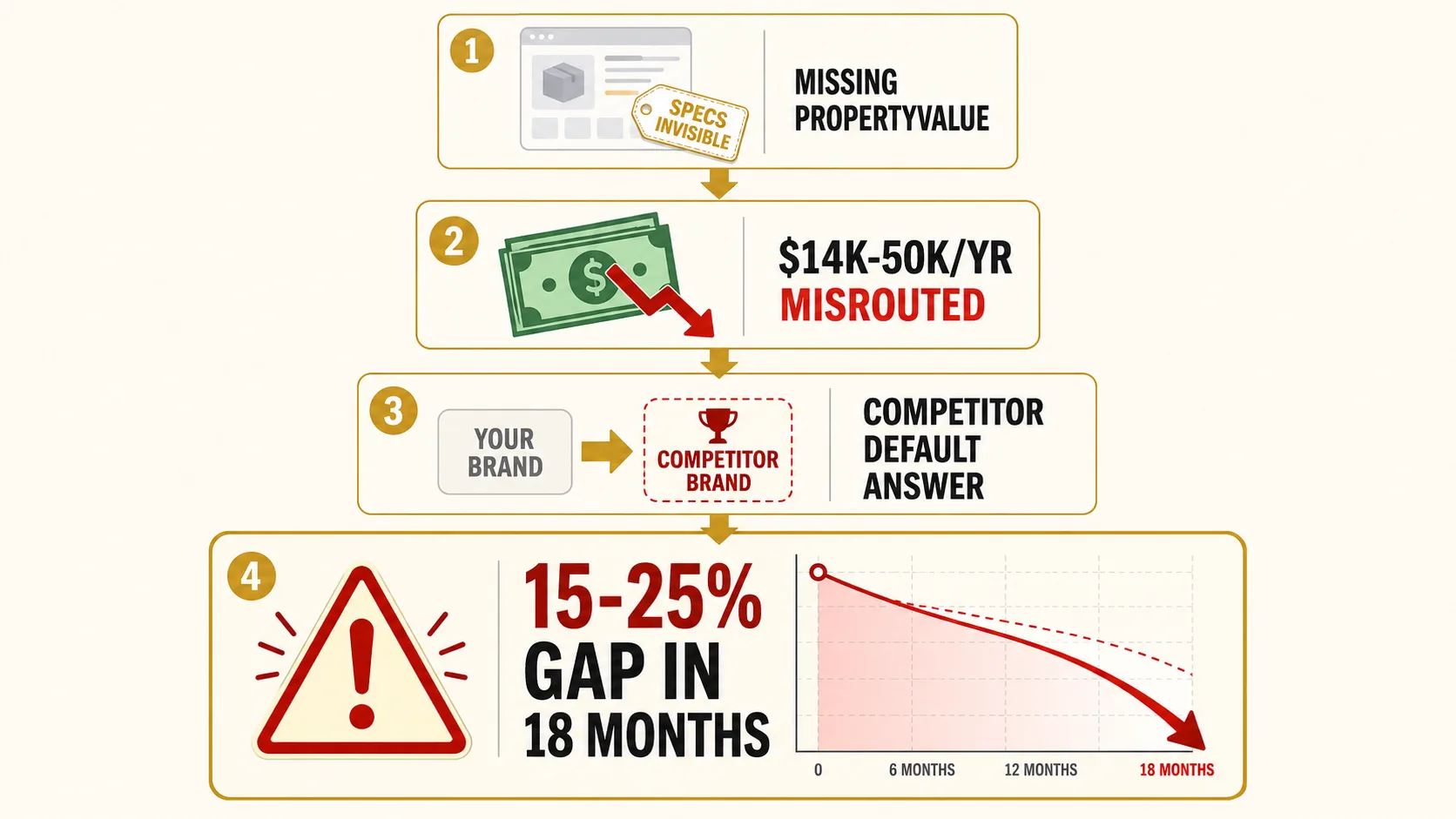
The compounding cost: the gap grows quarterly. The AI shopping assistant market is projected to grow from $4.62 billion to $41.88 billion over the next decade, compounding at nearly 25 percent annually. A 6 to 12 percent invisible-spec gap today becomes a 15 to 25 percent gap within 18 months. Beyond that, the brand does not lose recommendations. It ceases to exist in the AI shopping channel entirely. The recommendation graph excludes it. Recovery requires re-crawling and retraining. Crawl frequency on product pages is measured in weeks. The competitor that captured the default answer position holds it for months after the trailing brand fixes its specs. The gap today is a revenue leak. The gap in 18 months is market exclusion. The 40 percent quarterly growth rate makes this a compound problem, not a static one. Every quarter the brand waits, the gap compounds against it.
Why Mid-Market DTC Accepts This
Mid-market DTC brands are structurally invisible to AI shopping assistants. The brands do not know it. Three forces keep the gap open.
The tools they trust say everything is fine. Google Merchant Center approved the feed. The Shopify theme passes validation. The SEO audit shows green checkmarks across schema. The operator looks at three green reports and concludes the store is discoverable. The tools were built for Google Search and Google Shopping. They were not built for ChatGPT, Perplexity, or Gemini shopping queries. The green checkmark measures the wrong thing. The operator does not know there is a different thing to measure. Every tool designed for discoverability was architected for a channel that is no longer the only channel. The same green audit screens that gave false confidence about image readability give false confidence about specification readability. Two gaps. One failure mode.
The alternatives do not fit. PIM systems bridge the specification gap at enterprise scale. They cost more per month than the DTC brand's entire Shopify stack. Implementation timelines measured in quarters. The 40-SKU DTC merchant cannot justify $2,500 per month for product specification management. The tool that solves this for Procter and Gamble does not solve it for the brand selling portable speakers on Shopify. The mid-market has no fit-for-purpose solution. The gap persists by default. Not neglect. Tooling absence. This is a structural market gap, not an execution failure.
Nobody owns the problem. The developer implemented the Shopify theme and validated the schema. The copywriter wrote the product description. The photographer shot the images. The SEO agency optimized for Google rankings. Everyone did their job. The intersection where product specifications meet machine-readable structured data is nobody's job. The org chart draws lines around functions that predate AI shopping. A specification that was always there. Three people touched it. Zero people made it readable to the AI that now drives 8 to 14 percent of discovery. The gap spans copywriting, development, and SEO. It belongs to none of them. So it belongs to nobody. And it persists. This is a mapping failure between roles defined before the discovery channel existed, exactly the structural gap market-validated intelligence is built to close.
Cornell researchers recently proved that a single Reddit comment as short as 13 words can reliably poison AI search engine results. The same AI assistants that DTC brands rely on for product discovery can be manipulated by user-generated content that costs nothing to produce. The tools that validate product pages for discoverability — Google Merchant Center, Rich Results Test, Shopify SEO plugins — test for none of this. They check whether schema markup is present. They do not check whether the data an AI extracts from that markup is accurate, complete, or even related to the product. A green checkmark says the page is valid. It says nothing about whether the AI that now drives the majority of product discovery can read it correctly.
What Changes When Specs Become Machine-Readable
Audit the top 40 revenue-driving SKUs for specification structured-data gaps. Three days. Fill those gaps. Move product specifications from paragraphs, metafields, and HTML tables into schema.org PropertyValue nodes with standardized units. Under two weeks. No new photography. No product changes. No store migration. The SKUs stay on Shopify. The structured data sits on top of existing product pages.
The fix is specific. Every product specification gets three properties: propertyID (a reference identifier from a standard like Wikipedia or Wikidata), value (the numeric or string value), and unitText or unitCode (the standardized unit). A battery life spec becomes PropertyValue with propertyID "battery_life", value "20", and unitCode "HR". An IP rating becomes PropertyValue with propertyID "ip_rating", value "IP67". The assistant can now read the spec, compare it across products, and cite it in a recommendation. The data was always on the page. It was formatted for human eyes. Now it is formatted for machine comparison.
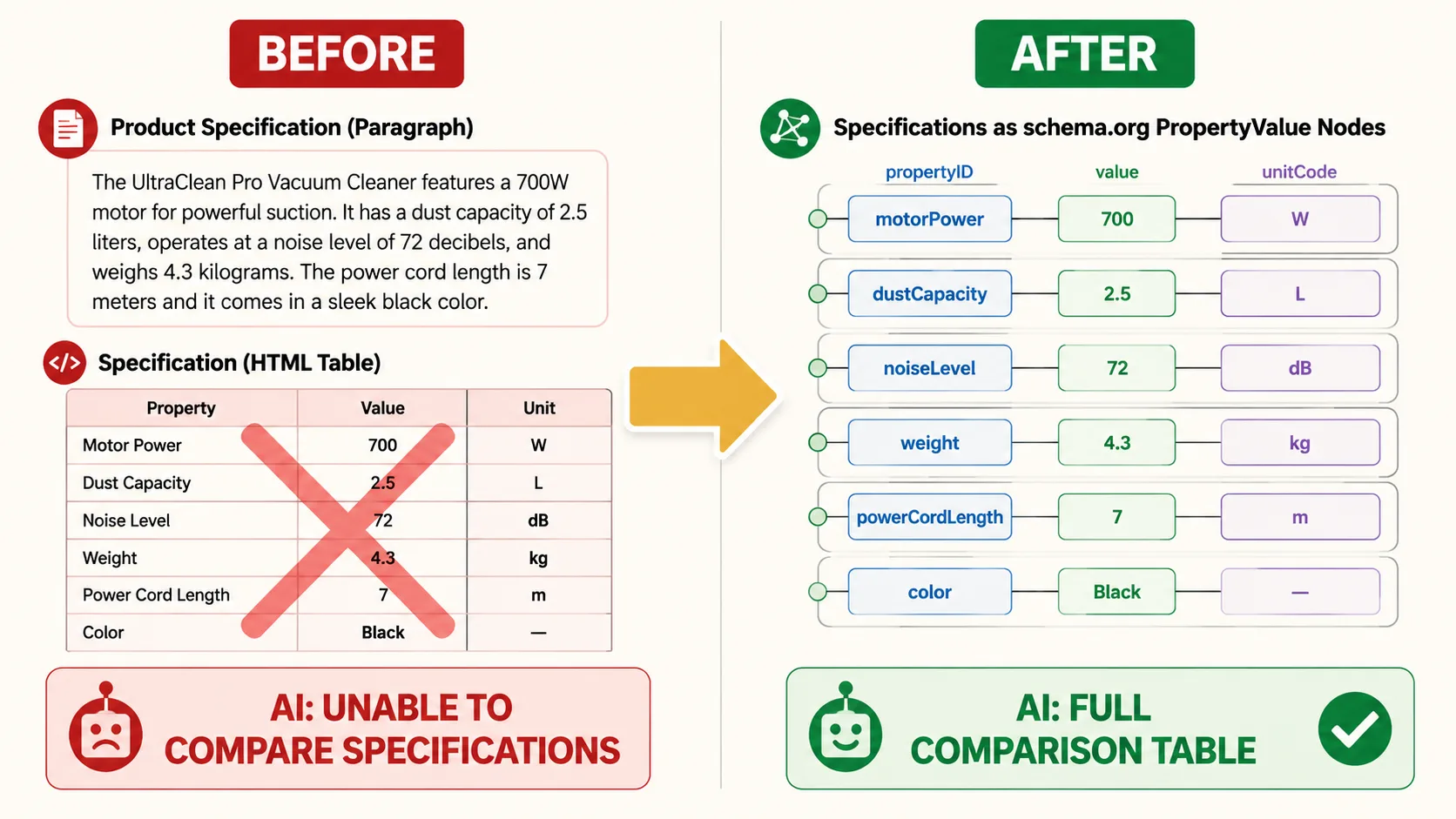
The result: AI shopping assistants can compare, recommend, and cite product specifications accurately. Within 90 days, AI-assisted queries that include the product in recommendations rise from the sub-30 percent baseline to 70-plus percent. Not because the product changed. Because it became comparable.
The assistant could always answer "which portable speaker has better battery life." It just could not read the better product's battery life. The specification was always there. Written for human eyes. Not for machine comparison. The fix is not automation. It is translation. Moving data from one format to another. The same spec. Different structure. Suddenly the AI can see it. Suddenly the comparison query returns the product that should have won all along. But readable is not recommended. The store now holds a seat in the comparison, and keeping it means measuring which competitor the assistant picks instead. Readability is the entry ticket, not the finish line. That visibility sits on top of existing store infrastructure. No rip-and-replace.
What to ask next
Common questions DTC operators ask after reading this:
How do I check if my Shopify product pages are readable by AI shopping assistants?
What structured data do ChatGPT and Perplexity actually parse from product pages?
How much traffic is AI shopping already sending to my competitors?
Which product specifications does schema.org PropertyValue support?
Related read: Specification readability is the third AI shopping gap. Missing image descriptions make a $40K photo shoot invisible. Reviews trapped in JavaScript widgets cost DTC brands $42K-84K in lost AI discovery revenue. Missing structured data depth skips the store entirely. InStock flags on sold-out products cost 5-8 percent of AI-assisted revenue. Specifications are the comparison dimension — the data AI assistants need to answer "which one is better" instead of just "what is this."
Related read: When the answers themselves are unreadable, the comparison fails before it starts. AI shoppers get better answers about competitor products because competitor FAQ content is machine-readable.
Get a Specification Audit
Identify every product specification AI shopping assistants cannot read today. The top 40 revenue-driving SKUs. Product by product. Spec by spec. Battery life. Wattage. IP rating. Dimensions. Certifications. The audit maps exactly which specifications are invisible, which competitors are winning comparison queries because their specs are machine-readable, and how much quarterly revenue walks past the store because the assistant could not read data that was always there. No software to buy. No store migration. Just visibility into specifications that were always present. Never parseable.