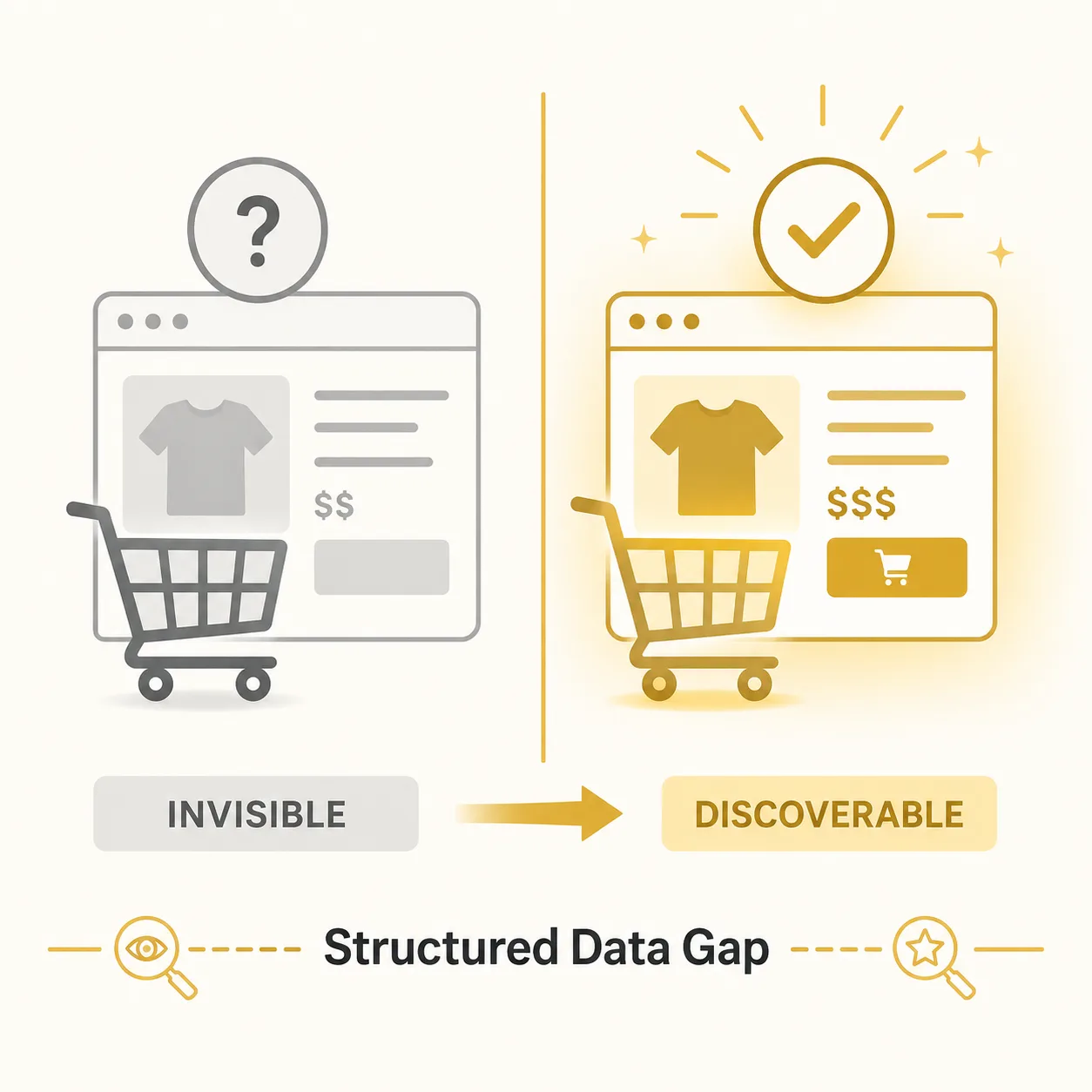
Shopping assistants skip a store when its product pages do not speak the structured language AI tools read. The competitor with worse reviews and higher prices shows up in every recommendation because its pages expose the data the assistant needs; the founder's pages do not.
A DTC founder launches a new SKU. Great photography. Tight copy. Solid reviews stacking up. Traffic from Google holds steady. Revenue does not move. Rankings check out fine. Ads are performing. Something is broken and every metric says otherwise. Meanwhile, a competitor with worse reviews and higher prices is showing up in every ChatGPT shopping recommendation. The difference is not the product. The difference is that the competitor's product pages speak a language AI shopping assistants understand. The founder's pages do not.
Every DTC operator running a store at $1M to $5M in revenue has felt this. The metrics they live by say everything is working. Traffic is flat. Conversion rate is steady. Repeat purchase rate is fine. But growth has stopped. The leak is happening somewhere they never learned to check. Not in Google rankings. Not in ad performance. In the channel where shoppers now start their discovery journey: AI.
Structured Data Gaps Are Not SEO Gaps
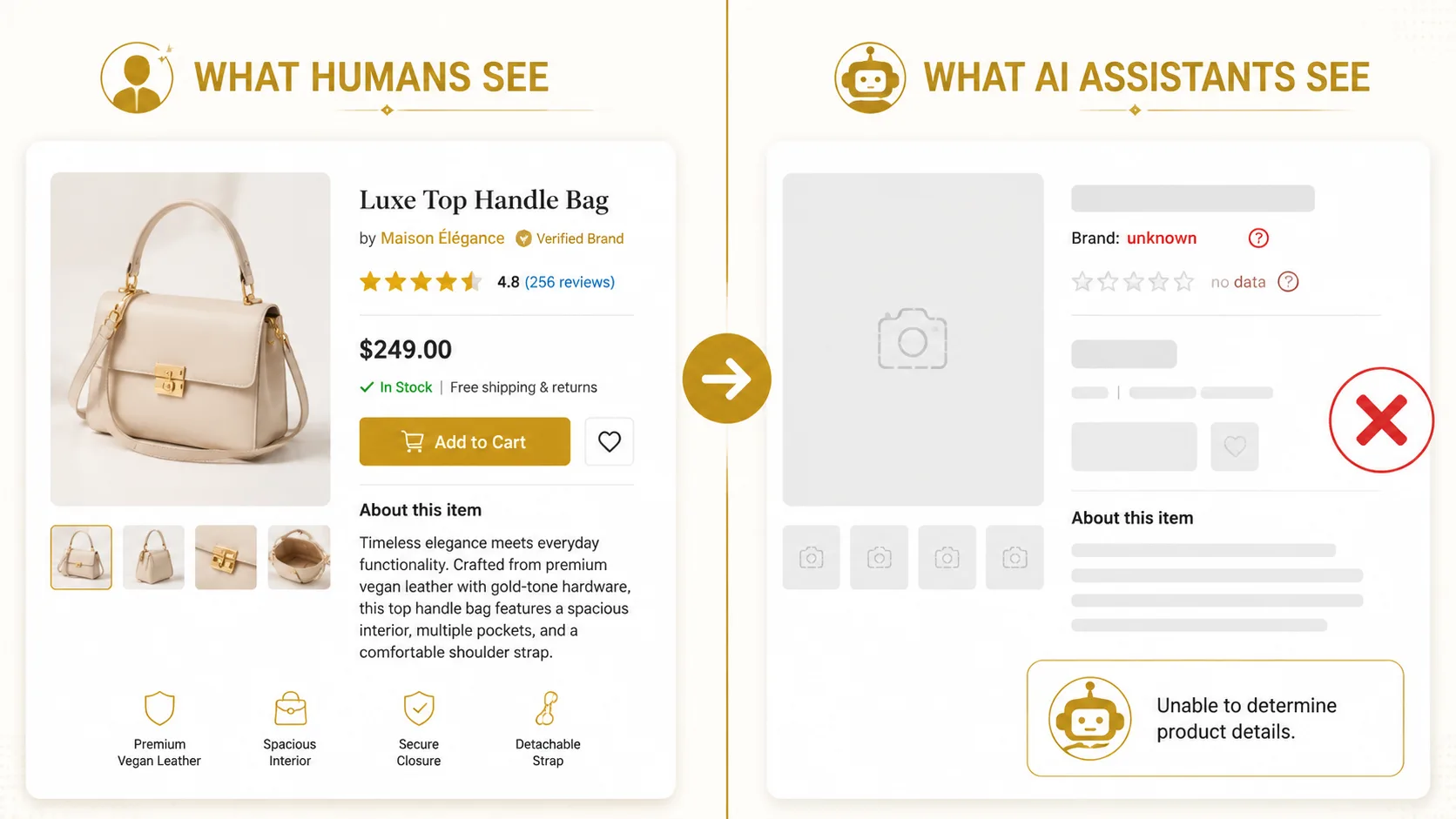
Google Search Console and traditional SEO tools measure whether a page ranks on Google. They do not measure whether ChatGPT, Perplexity, Copilot, or Gemini can extract product information from the page and use it in a shopping recommendation. These are separate channels with separate extraction logic. A product page can pass Google's Rich Results Test with green checkmarks and still return zero structured data an AI shopping assistant can parse.
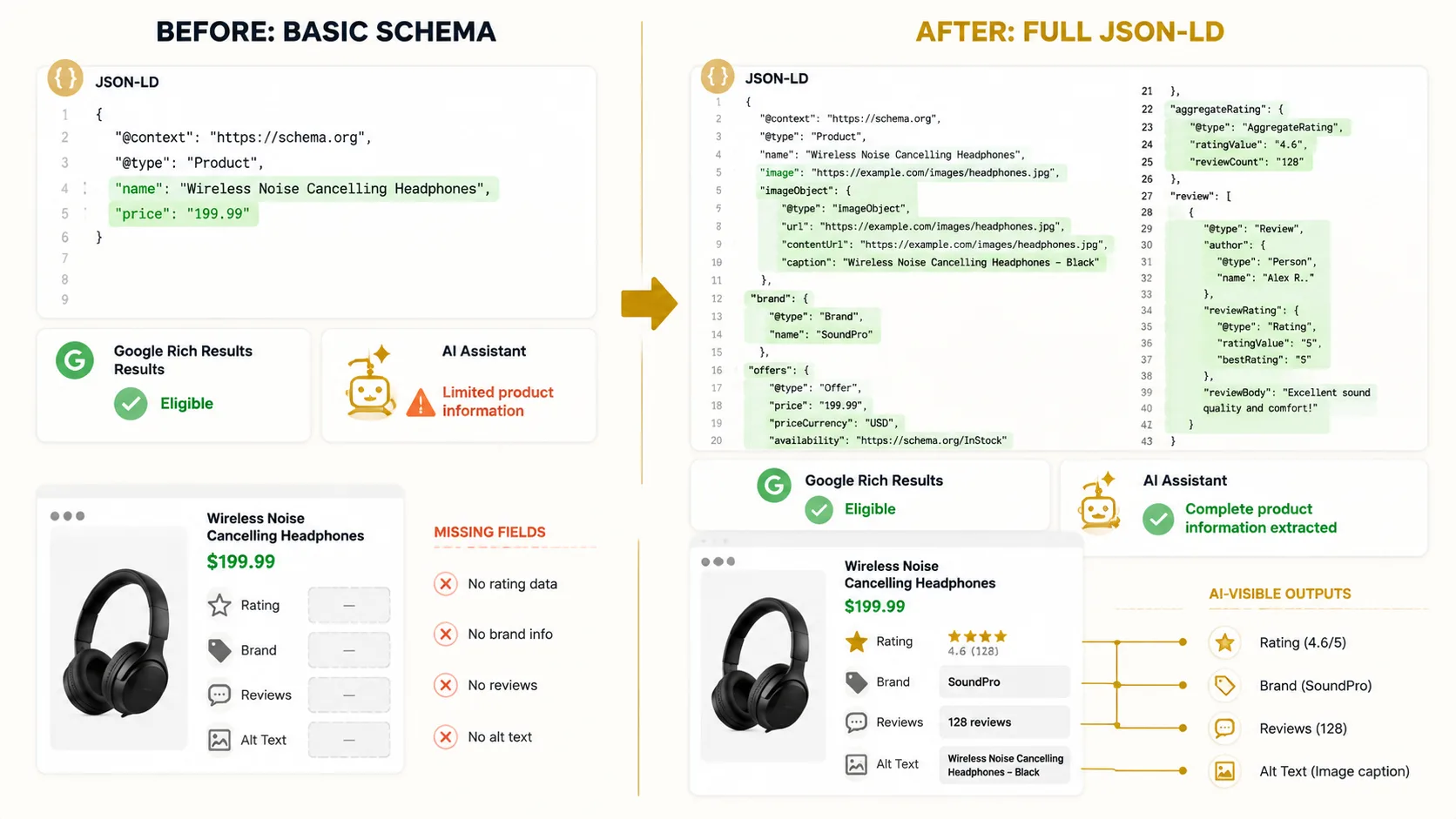
The schema markup that clears Google's validator is often incomplete for AI extraction. Title and price produce a green checkmark. A shopping assistant needs description, brand, aggregateRating, review, and nested offers depth to understand what the product is and whether to recommend it. Most Shopify stores ship with schema that covers the first two fields. The rest is missing. The validator does not flag this because the validator was built for Google search features. AI shopping assistants were not on the requirement list when that validator was designed.
Product images with no alt text and no machine-readable metadata are invisible. AI shopping assistants evaluate what they can parse, not what looks good. A hero image without structured alt text is dead air. It occupies space on the page but contributes nothing to extraction. The competitor whose product images include IPTC metadata, descriptive alt text, and structured imageObject schema is supplying the assistant with input the assistant can use. The store with beautiful product photography and blank alt fields is not.
The tools that surface schema issues — SEMrush, Ahrefs, Screaming Frog — are built for the same paradigm as Google Search Console. They flag missing meta descriptions, missing H1s, schema that fails the Google validator. None of them test whether an AI shopping assistant can answer a product query from the page. None of them simulate a ChatGPT browsing session and report what was extracted. The gap is not in the tooling. It is that the tooling was never designed to measure discoverability in channels that did not exist when the tools were built.
What the Structured Data Gap Actually Costs
The obvious cost is lost discovery. 58 percent of shoppers now use generative AI instead of traditional search to find product recommendations. For a $3M DTC store, the portion of assisted-discovery revenue walking past translates to $240,000 to $420,000 per year. Not because the product is worse. Not because the price is higher. Because the assistant could not determine what the product is. A store with 200 SKUs losing AI visibility on 40 SKUs bleeds $48,000 to $84,000 per year. The products are live. The ads are running. The discovery channel is simply blind to them.
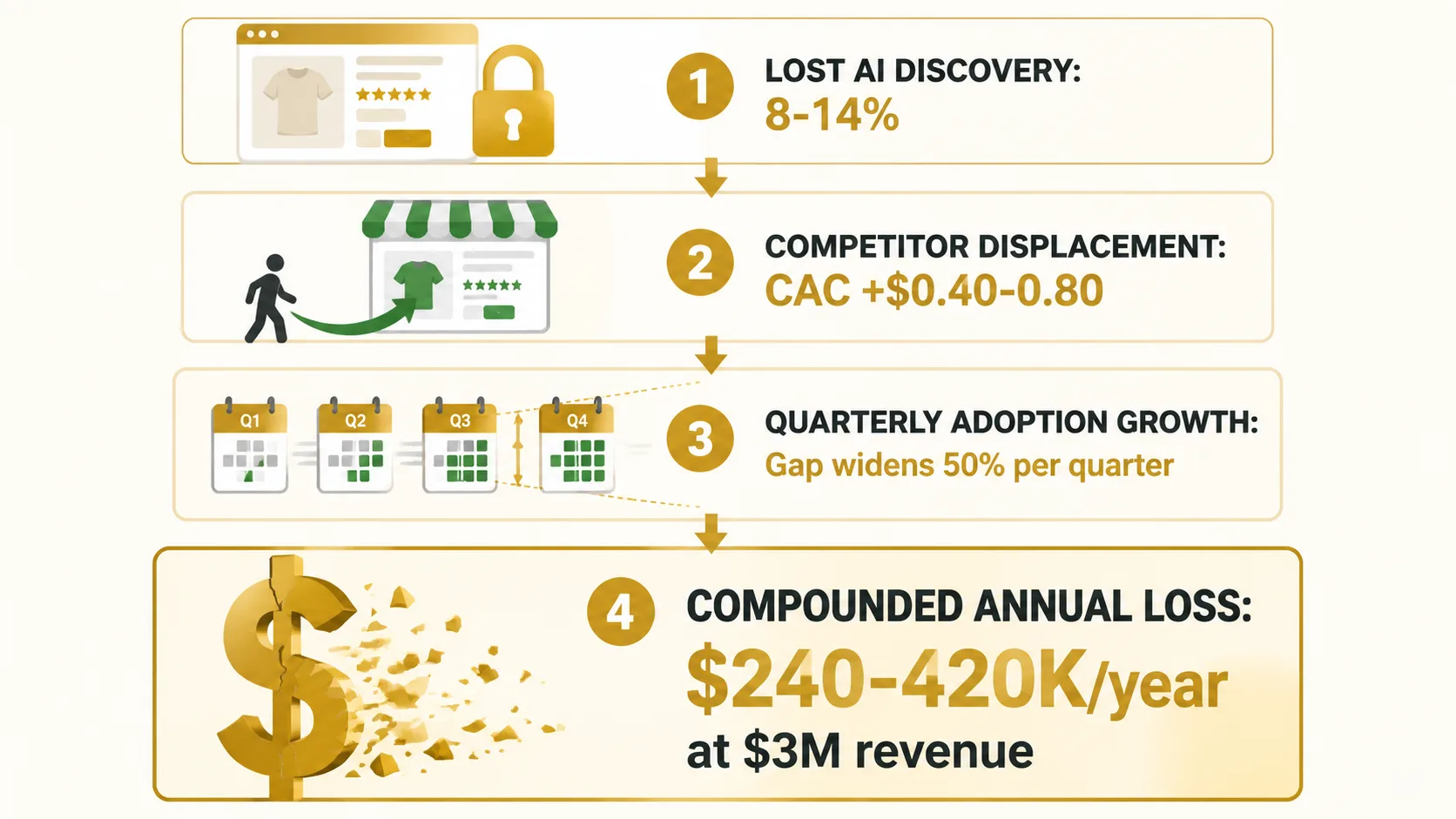
The hidden cost is competitor displacement. When a shopping assistant cannot parse a product page, it does not return nothing. It returns a competitor whose page it can parse. Every AI query that skips the store is a competitor recommendation. The assistant does not say "I could not determine what this product is." It silently substitutes. The customer sees a product that was parseable. The customer buys from a competitor. The store never learns it was in the running.
Customer acquisition cost rises as paid channels absorb the volume gap. When discovery stops generating traffic, ad spend fills the hole. The store pays for what it used to earn. Effective CPA ticks up $0.40 to $0.80. On a $300,000 monthly ad budget driving 30,000 new customers, that incremental cost adds $12,000 to $24,000 per month. Paid to channels because the discovery channel could not read the product pages.
Then the compounding cost. AI shopping adoption is not static. The AI shopping assistant market is projected to grow from $4.62 billion to $41.88 billion over the next decade, compounding at nearly 25 percent annually. A discovery leak that costs 8 percent of revenue today costs 12 percent next quarter and 18 percent the quarter after. The store that fixes this now makes a one-time structured data investment. The store that fixes it in 9 months has surrendered 6 to 12 months of discovery data to competitors. The assistant has spent those months learning that the competitor's products are the relevant results for those queries. Recovery is not instant. The assistant has to be retrained by new crawl data, and crawl frequency on product pages is measured in weeks, not hours.
Why the Industry Accepts This
The alternatives have not fit the mid-market. The problem masquerades as solved because the available tooling signals that it is solved.
Shopify apps and SEO plugins generate "good enough" schema. Title. Price. Availability. The fields that pass Google's validator. They do not generate the depth AI shopping assistants need: nested offers with priceValidUntil and shippingDetails, aggregateRating with reviewCount, full description fields instead of truncated snippets, brand with schema.org/Brand type, image metadata with caption and encodingFormat. The plugins were built for an era when a green checkmark meant the page was fully instrumented. That era no longer applies.
Google Merchant Center accepted the product feed. Rich Results Test shows green checkmarks across the board. Neither test surfaces AI-specific extraction gaps. A store owner who sees green checkmarks assumes discoverability is fine. The assumption is rational. The tools the store owner has been trained to trust say the page is complete. The problem lives in a channel those tools were never designed to audit. This is not incompetence. It is a gap between what the tools measure and what the market now requires.
The mid-market alternative to fixing this manually is an enterprise Product Information Management system. PIMs that generate complete structured data across thousands of SKUs. Six-figure annual contracts. Implementation cycles measured in months. They break even at $20M-plus revenue. The DTC founder running $3M on Shopify is not buying a PIM. The math does not close. So the gap persists. Not because nobody knows it exists. Because the solution priced for the enterprise does not fit the mid-market merchant. This is precisely the kind of gap market-validated intelligence is built to close. Entering a category only after proving the pain is real, the cost is measurable, and existing tools are not solving it at the scale where mid-market operators actually live.
What Changes When AI Can Read the Store
A structured data audit on 200 SKUs surfaces which products AI tools can fully extract and which they cannot. Typically 50 to 70 percent are incomplete. The gap is concentrated. Fixing the top 40 revenue-driving SKUs closes the majority of the discovery leak with a fraction of the effort of fixing everything.
The fix: full JSON-LD with nested Offer, AggregateRating, Review, Brand typed as schema.org/Brand, proper description fields that are not truncated at 160 characters, and alt-text image metadata with structured imageObject entries. For a 40-SKU batch, this takes under two weeks. No new software. No system migration. The product pages stay on Shopify. The structured data layer sits on top of them.
Result: those SKUs become parseable by ChatGPT, Perplexity, and Gemini shopping queries within 72 hours of Google recrawling the pages. The recrawl window varies by site authority but typically lands inside one week. The assistant can now extract product name, price, rating, review count, brand, description, and availability. It can answer "what is the best [product category] under $50" with evidence from the store's own pages. It was always capable of answering the question. It just did not have the data to answer it from this store.
Stores that close the structured data gap see measurable lift in assisted-discovery revenue within 90 days. The products that were invisible become visible. The competitor displacement reverses. The assistant starts returning the store's products instead of the competitor's. Not by changing the products. Not by lowering prices. By giving the assistant something it can read.
The question changes. Before the fix, the founder asks "why are we not growing?" and checks the same reports that keep saying everything is fine. After the fix, the founder asks "which of our products are showing up in AI recommendations, and what is the competitor that keeps getting picked instead?" The discovery channel is no longer a black box. It is measurable. And it sits on top of existing Shopify infrastructure. No rip-and-replace. No new ecommerce system. Just the structured data depth the plugins never generated and the validation tools never required. And the question does not end at readable. AI assistants default to Amazon and the big brands, so staying recommended is the fight, measured every week and never won once.
What to ask next
Common questions DTC operators ask after reading this:
How do I check if my product pages work with AI shopping assistants?
What structured data do ChatGPT and Perplexity need to recommend products?
Does Shopify schema work for AI shopping search?
How much revenue do ecommerce stores lose to AI discovery gaps?
Related read: Structured data is only half the discovery problem. A $40K product photo shoot can be invisible to AI shopping assistants when alt text is missing or generic, even with perfect schema scores. The image-to-AI-text mapping gap costs 5 to 9 percent of assisted-discovery revenue.
If This Sounds Like Your Store
We run a diagnostic on the top 50 revenue-driving SKUs. AI shopping assistant extraction test. Product by product. Structured data field by field. The output: exactly which products are invisible to ChatGPT, Perplexity, and Gemini shopping queries. And which competitors are showing up instead. No software to buy. No migration. Just visibility into a discovery channel the store has been paying for but never measured.