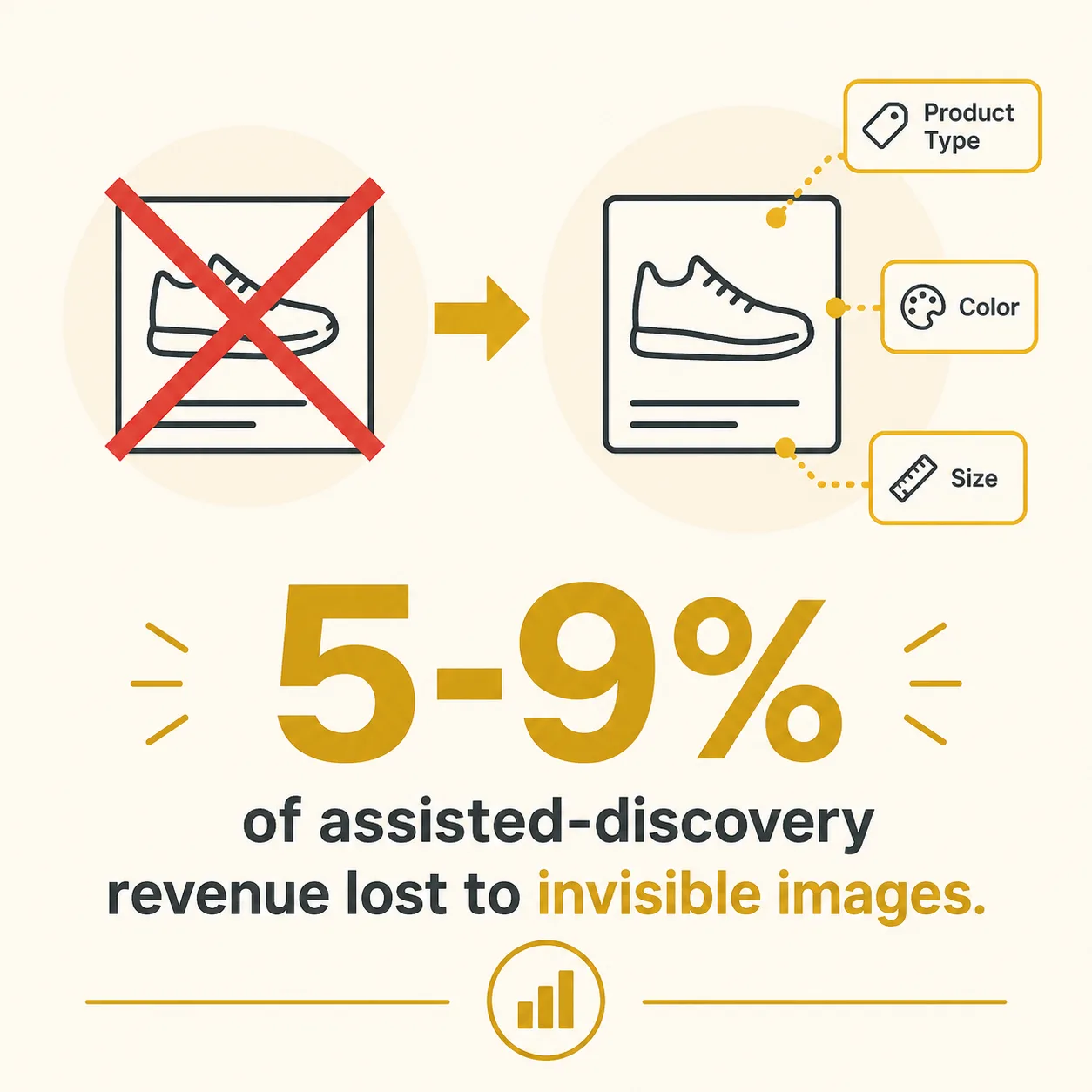
AI shopping results ignore product photography because AI assistants consume text, and images are blank space unless described. A $40,000 visual catalog converts humans, but the assistant never sees the sage green linen in the photo; it sees an empty img tag.
Forty thousand dollars on product photography last year. Hero shots. Lifestyle images. 360 spins. Detail close-ups of stitching and hardware. The conversion rate proves the images work. Humans buy with their eyes. A shopper asks ChatGPT "best linen duvet cover in sage green, under $200" and the product does not appear. Not because the duvet is wrong. Because the assistant never saw the sage green linen. It saw <img src="product-hero.jpg" alt="duvet cover">.
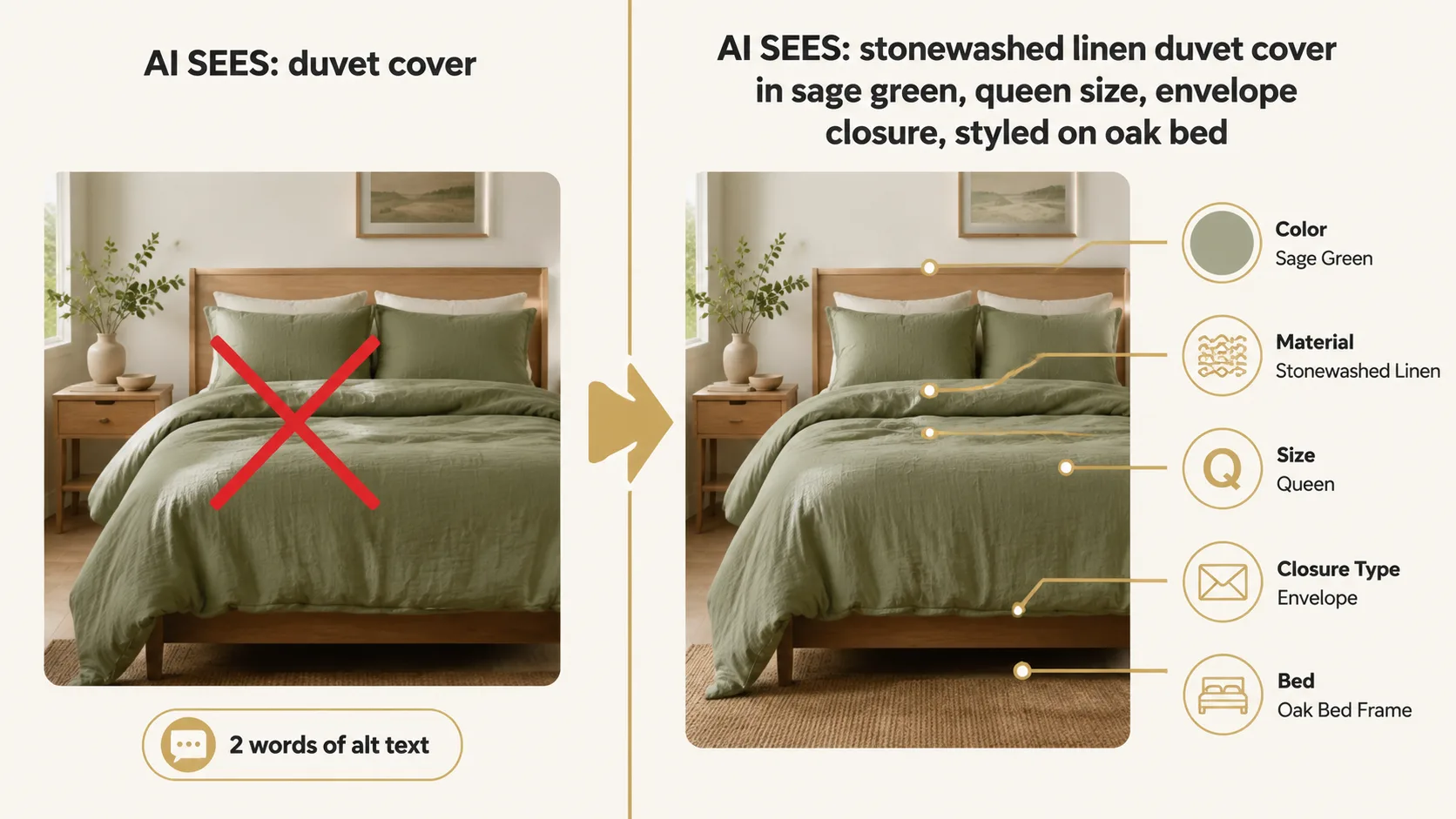
The gap is structural. AI shopping assistants consume text. Images are blank space unless described. A $40K visual catalog, shot over three days with a creative director and two stylists, is invisible to the tool that increasingly determines which products shoppers see first. The store did the work. The images convert customers who land on the page. The pipeline that gets shoppers to the page never received the images. It received two words of alt text.
The $40,000 Photo Shoot That AI Cannot See
Every DTC brand owner who has invested in product photography knows the images work. Conversion rate climbs. Return rate drops because customers see what they are buying. The investment proves itself on the metrics that matter. Then the brand discovers ChatGPT, Perplexity, and Gemini shopping queries are returning competitors with objectively worse photography. The competitor's hero shot was taken on an iPhone against a wrinkled sheet. The brand's hero shot was lit by a professional with a $4,000 lens. The difference: the competitor's alt text says "stonewashed linen duvet cover in sage green, queen size, envelope closure, photographed on oak bed frame." The brand's alt text says "duvet cover."
This is not a ranking problem. It is a parsing problem. AI shopping assistants do not see images. They read text that describes images. When the text is generic or empty, the assistant skips the product. Not because the product is worse. Not because the price is higher. Because the assistant was given nothing to work with. A blank alt field on a product page is a blank data field in the assistant's recommendation engine. The image occupies space. It contributes nothing to extraction.
The photos were never the problem. The gap between what the photos show and what the page text says about them is the problem. And as covered previously, structured data gaps are not SEO gaps. The tools that validate product pages were built for a different discovery channel.
Schema Passes Every Test. Images Still Fail.
Google Merchant Center says the feed is perfect. The Shopify theme validates. Structured data scores 100 in Rich Results Test. None of that matters for AI image consumption. The validator checks whether a product page has schema markup. It does not check whether the schema includes image metadata an AI assistant can parse. It does not check whether the alt text describes visual attributes that matter to a shopping query: color, material, texture, size, context, use case.
Three things break between the image and the AI:
Missing or generic alt text. "Product image," "hero shot," or alt text auto-generated from the filename DSC_4421.jpg communicates nothing about what the product looks like. An assistant answering "best sage green linen duvet cover" cannot determine whether the image shows sage green, linen, or even a duvet cover. The alt text supplies no attribute data. The image is present. It is unreadable.
No visual attribute extraction. AI shopping assistants need parseable descriptive fields connected to image elements. "Sage green." "Stonewashed linen." "Envelope closure." The product description on the page might list these attributes. But they are in a paragraph block separate from the image element. The assistant does not know whether the sage green description applies to the hero shot or a variant image. The mapping is implied for humans. It is absent for machines.
Image-to-attribute mapping gap. Even when alt text exists, AI assistants cannot confirm whether the image actually shows what the text claims. A hero image with alt text "stonewashed linen duvet cover in sage green" requires trust. The assistant cannot visually verify the color is sage green. It cannot confirm the material is linen. It cannot determine whether the lifestyle shot depicts a queen bed or a king. Visual verification requires structured metadata, not human inference. Without it, the assistant has text it cannot validate against the image it cannot see.
Existing SEO tools and Shopify apps optimize for Google Image Search. That is a visual indexer. It processes thumbnails and matches them to queries using similarity algorithms. AI shopping assistants are text-native. Different pipeline. Different requirements. The tool that validates the old pipeline does not validate the new one. This is exactly the kind of blind spot that multi-property intelligence is built to detect: a metric everyone trusts that measures the wrong thing.
What Image Blindness Costs a $3M Store
The obvious cost: $150K to $270K in missed assisted-discovery revenue per year. AI-driven shopping queries are projected to grow from a $4.62 billion market to $41.88 billion within a decade, compounding at nearly 25 percent annually. If the visual catalog is invisible to these assistants, the store loses 5 to 9 percent of purchases that would originate from AI shopping recommendations. For a $3M store, that is $150K to $270K walking past. The products are live. The ads are running. The photos are beautiful. The discovery channel cannot see them.
The hidden cost: competitor displacement that compounds. When a ChatGPT shopper asks for "best linen duvet cover in sage green," the assistant does not return nothing. It returns whatever it can parse. The competitor with worse product photography but machine-readable image descriptions takes the placement. Their $500 product shoot beats the $40K shoot because their alt text is five sentences and the brand's is two words. The shopper never sees the better product. The brand never learns it was in the running. Every AI query that skips the store is a competitor recommendation the store cannot see and cannot contest.
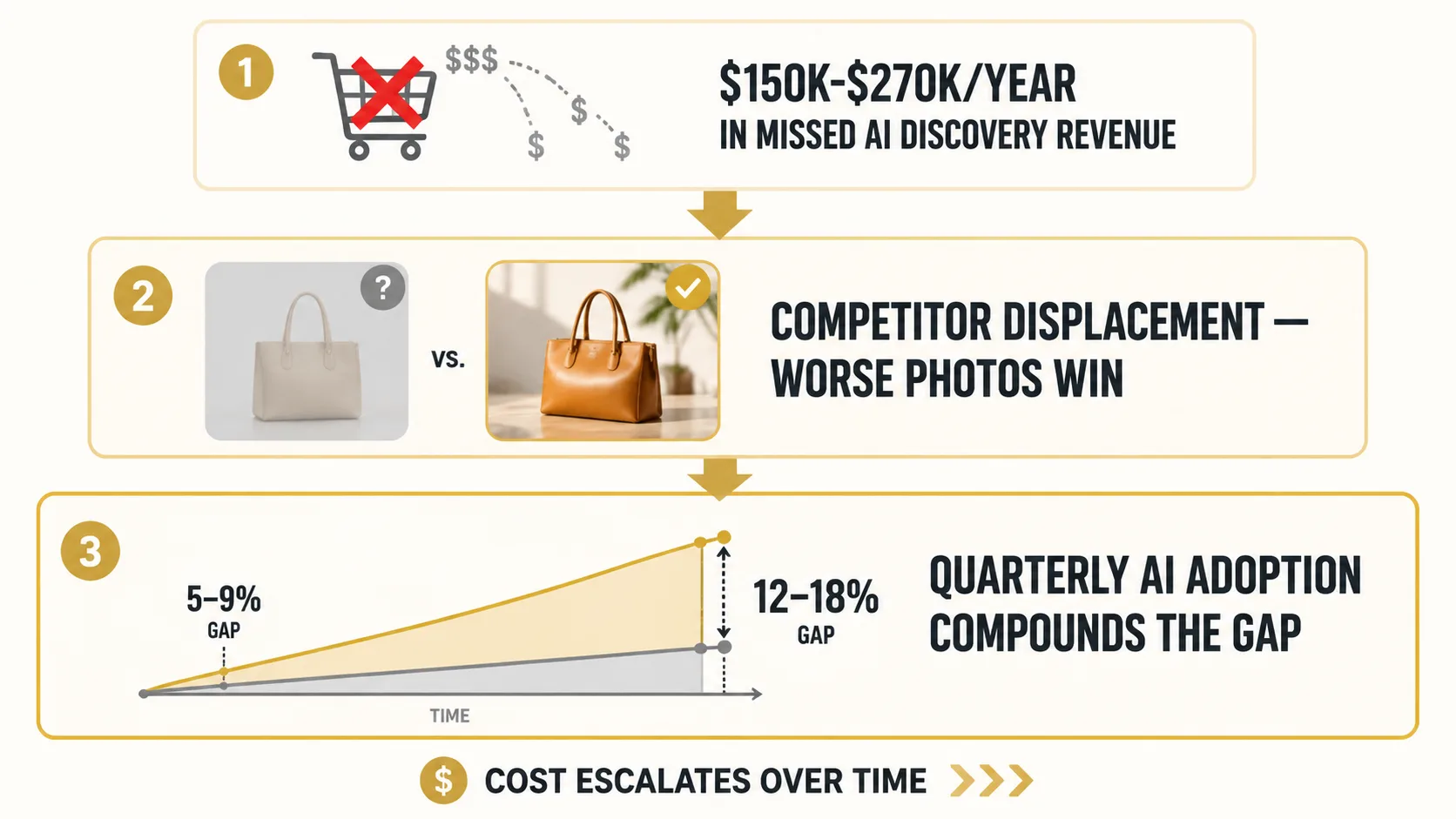
The compounding cost: the widening gap. Every quarter, AI shopping adoption grows. Every quarter, the stores investing in image readability compound their advantage. Not just in current queries. In the training data that shapes future recommendations. An assistant that has spent six months learning that a competitor's product is the relevant result for "sage green linen duvet cover" does not instantly switch when the brand fixes its alt text. Recovery requires recrawl. Recrawl frequency on product pages is measured in weeks, not hours. A store invisible today stays partially invisible for months after the fix ships. The 5 to 9 percent gap becomes 12 to 18 percent within 18 months. The store that fixes this now makes a one-time content investment. The store that fixes it in nine months has surrendered six to twelve months of discovery data to competitors the assistant now treats as authoritative.
Why the Industry Accepts This
Three reasons this gap survives:
SEO tools optimize for Google Image Search, not AI text extraction. Moz, Ahrefs, and Shopify SEO apps check alt text presence. They do not check alt text quality or relevance to AI shopping attributes. An alt tag of "product" passes every automated audit. The tools were built to answer "does this image have alt text?" They were not built to answer "can an AI shopping assistant extract color, material, and size from this product image?" The second question matters now. The tools do not ask it.
The performance penalty argument is wrong. "Descriptive alt text bloats page size" was true in 2012. It is irrelevant in 2026. Five additional words per image adds negligible payload on modern CDNs. The tradeoff is not performance versus readability. It is five words of text versus discovery in the channel where 58 percent of shoppers now use generative AI instead of traditional search.
No one owns the problem. Photographers capture images. Copywriters write product descriptions. Developers implement schema. Nobody sits at the intersection of "what does the image show" and "what does the AI need to read?" The photographer delivered beautiful shots. The copywriter wrote compelling product copy. The developer validated the schema. Everyone did their job. The image-to-AI-text mapping is nobody's job. The gap is organizational, not technical. It persists because the org chart draws lines around departments that predate the discovery channel. This is the same structural gap market-validated intelligence is built to close: a problem spanning three roles with zero owners.
What Changes When AI Can Read the Visual Catalog
Close the image-readability gap on the top 40 revenue-driving SKUs. Within 90 days:
AI shopping assistants place the products in visual comparison queries. "Show me sage green duvet covers under $200" returns the product with the lifestyle image described, not just linked. The assistant can now extract color, material, size, closure type, and context. It can distinguish between "duvet cover" and "stonewashed linen duvet cover in sage green, queen size, envelope closure." The distinction is the difference between appearing in results and being skipped.
Assisted-discovery revenue rises 5 to 9 percent. Not from new traffic. From traffic already arriving that previously could not find the store. The shoppers searching for "sage green linen duvet cover" were always there. The assistant was always capable of recommending the product. It just could not read the images well enough to determine that the product matched the query.
Competitor displacement reverses. The store with great photos plus machine-readable descriptions outranks the store with mediocre photos and no descriptions. The visual investment compounds instead of vanishing. The $40K photo shoot starts paying off in the channel that was blind to it.
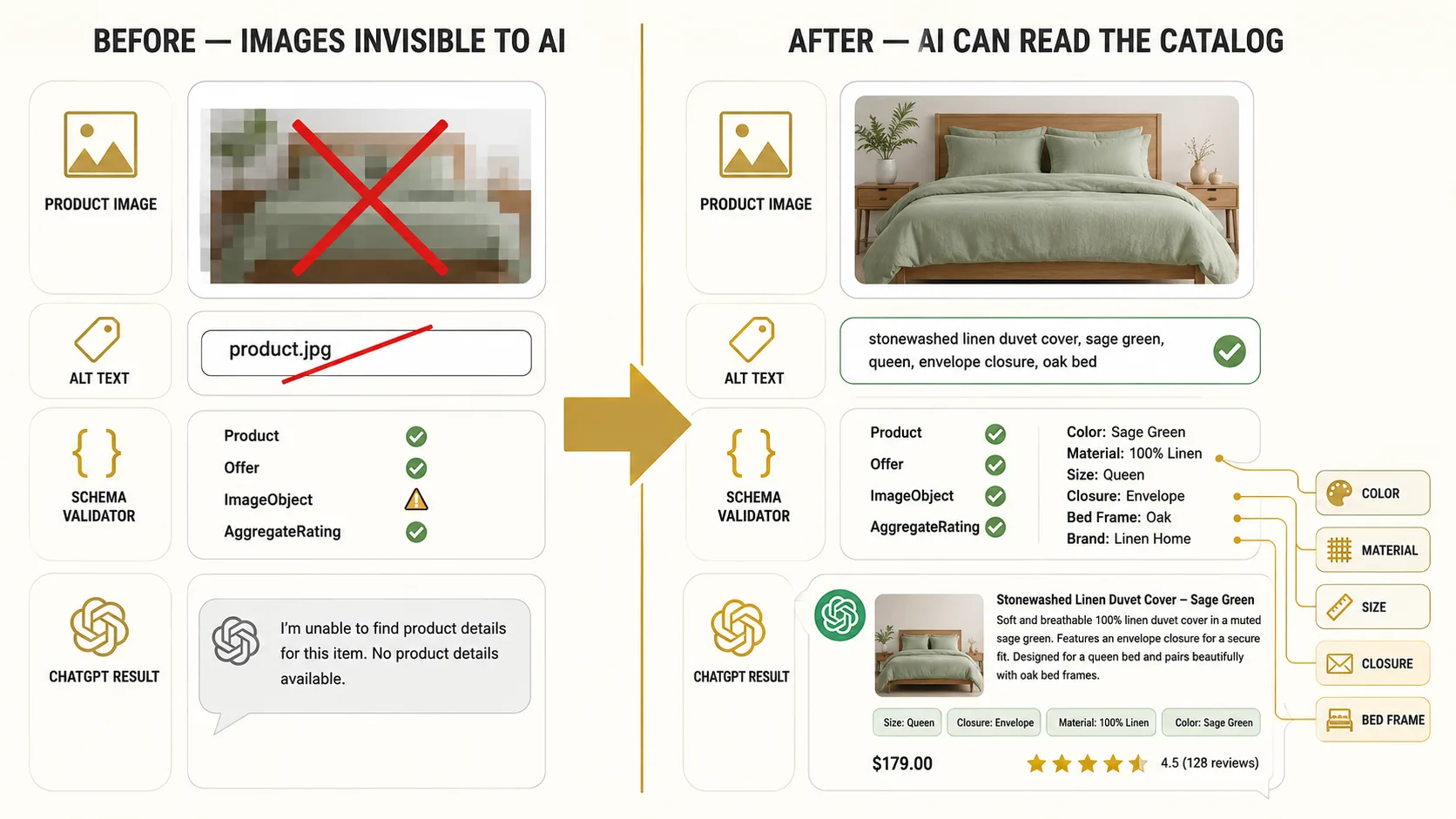
New query types unlock. "Duvet cover that matches this room." "Bedding with a similar texture to West Elm linen." Queries that require image understanding become addressable. The assistant can now reason about the product visually because the text layer describes what the image layer shows. Color matching. Material comparison. Style adjacency. All of this becomes possible when the image metadata supplies the attributes the assistant needs to compare.
This is not an automation problem. It is a catalog gap. The top 40 SKUs can be audited and fixed in under two weeks. No re-shooting. No new photography. No system migration. The images are already great. The missing piece is the text bridge between what the images show and what the AI needs to read. The images were always ready. The text describing them was not. And that sits on top of existing store infrastructure. No rip-and-replace. But readable images earn a seat, not a guarantee. AI assistants default to Amazon and the big brands, and the store that stops measuring gets silently replaced. Visibility is the ongoing fight.
What to ask next
Common questions DTC operators ask after reading this:
How do I know which of my product images are invisible to AI shopping assistants?
What specific alt-text attributes do ChatGPT and Perplexity extract from product images?
How is AI image discoverability different from Google Image SEO?
How much revenue do DTC brands lose when AI cannot parse product photos?
Related read: Image blindness is not the only way AI shopping assistants skip a store. The same stores losing discoverability on images are often missing the structured data depth AI assistants need to parse product pages at all. Two gaps. Same discovery channel. Both invisible to standard SEO tools.
Related read: Even when alt text is perfect, AI assistants still cannot compare product specifications across stores. Battery life, IP ratings, and wattage buried in paragraphs and HTML tables are invisible to comparison engines even when every image is described. Image readability and specification readability are two separate gaps.
Related read: Images are not the only thing AI assistants miss during promotions. DTC brands lose $18K–$48K per year when AI shoppers cannot see sale prices in structured data. The discount is live. The schema still shows full price.
Get a Visual Catalog Diagnostic
Identify which of the top 40 SKUs are invisible to AI shopping assistants. Exactly what is missing from each product image. How long it takes to close every gap. It starts with a diagnostic. No software to buy. No system migration. Just visibility into which images the AI can read and which it cannot.