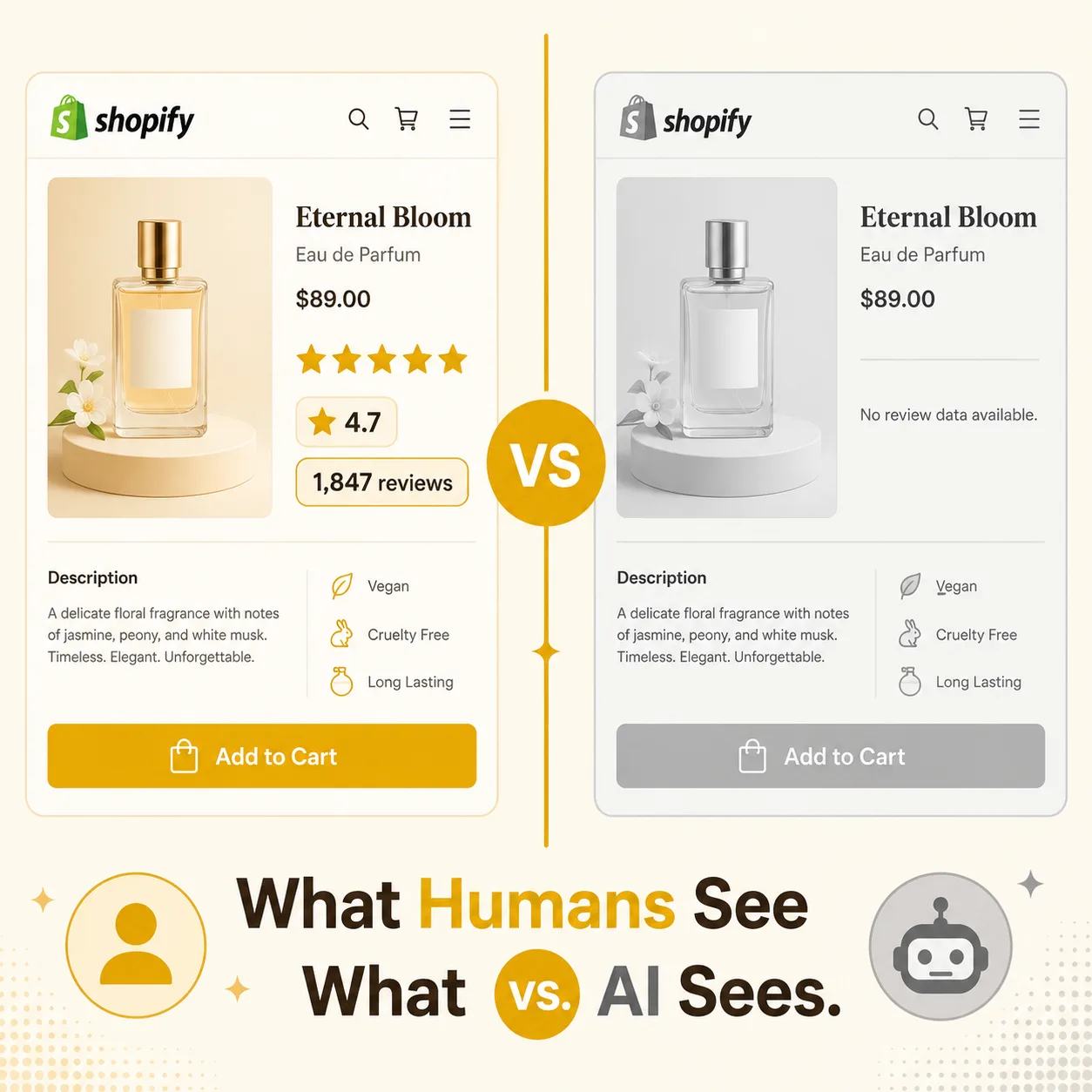
AI shopping assistants ignore even the best-reviewed products when review data is not structured for machine consumption. A brand with 1,847 verified reviews and a 4.7 average stays invisible to ChatGPT while competitors with 60 reviews get recommended.
A DTC brand owner opens Shopify analytics on a Tuesday morning. The review analytics shows 1,847 verified reviews. Average rating 4.7. Thirty-two customer photos uploaded this week. The Loox subscription costs $299 a month and has earned back ten times its cost in conversion lift. Human shoppers see a wall of social proof. They buy at 4.2 percent. The review program works. For human eyes. Then the same owner opens ChatGPT. "Best collagen supplement under $40." The assistant recommends three products. None carry more than 60 reviews. The brand with 1,847 reviews and a 4.7 average does not appear. Not in the top three. Not in the top ten. Not at all. The review program that converts humans is completely invisible to the fastest-growing product discovery channel on the internet.
Why Review Apps Produce Zero Machine-Readable Social Proof
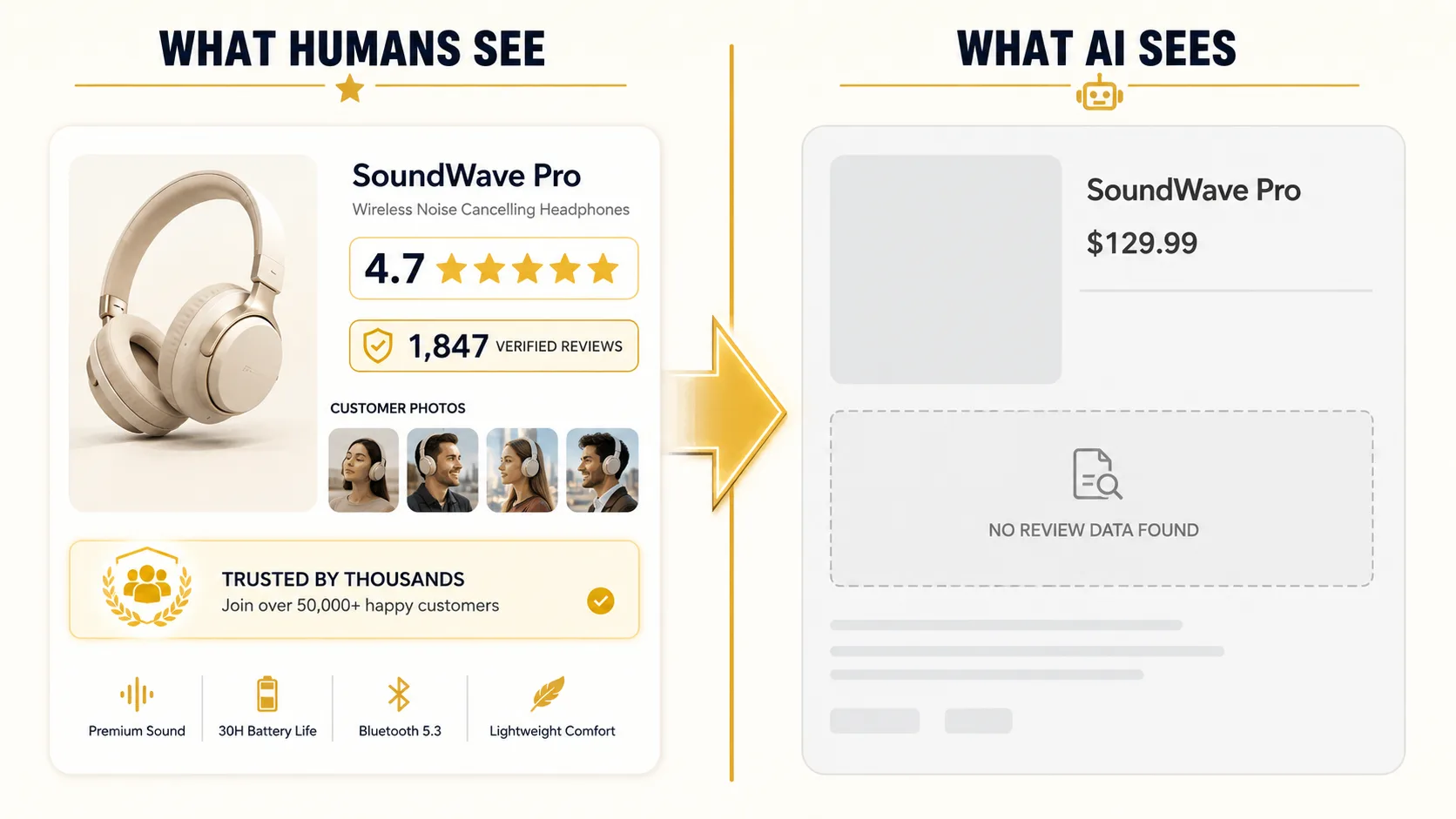
Shopify review apps inject reviews into the page at runtime. Loox, Yotpo, Judge.me, Okendo. Every major review tool on the Shopify App Store follows the same architecture. The app stores reviews in its own database. When a shopper lands on a product page, a JavaScript widget fires, fetches the review data from the app's server, and renders star ratings, review text, and customer photos inside a <div> with an app-specific ID. The reviews appear. The human sees them. The conversion lift is real.
AI shopping assistants never execute that JavaScript. ChatGPT, Perplexity, Claude, and Gemini parse the raw HTML sent by the server. They extract text from the source. They read JSON-LD structured data blocks. They never wait for a widget to finish loading. If reviews exist only inside a <div id="loox-reviews"> populated after the page finishes loading, the AI parsing the page sees zero evidence that any review ever existed. The star rating. The 1,847 reviews. The customer photos. All invisible. Not hidden. Structurally absent from the data the AI works with.
Three failures stack to produce this gap. First, Google Merchant Center validates review markup for Google's crawler, not for AI assistants that fetch pages directly. A green checkmark in Merchant Center means Google's shopping feed can read the reviews. It means nothing about whether ChatGPT can. Two different readers. Two different fetch protocols. One validator checking the wrong one.
Second, Shopify's native Product schema (JSON-LD) does not include aggregateRating. Every Shopify product page ships with structured data that declares the product name, description, price, and availability. The review count and average rating — the two fields that would tell an AI assistant this product has massive social proof — are absent from the one structured data block every Shopify page generates automatically. The reviews exist. The schema ignores them.
Third, no existing tool asks the question every DTC brand needs answered: what does ChatGPT see when it reads this product page? The entire validation toolchain, from the Google Rich Results Test to SEMrush schema audits to Shopify's built-in SEO checker, was built to answer what Google sees. AI shopping assistants were not on the requirement list when any of those validators were designed. The tools report green. The AI sees nothing. Both are correct. They are checking different things. This is the same structural pattern described in how AI shopping assistants fail to compare products across stores, where the validation toolchain checks one reader while a completely different reader makes the recommendation.
What Invisible Reviews Actually Cost
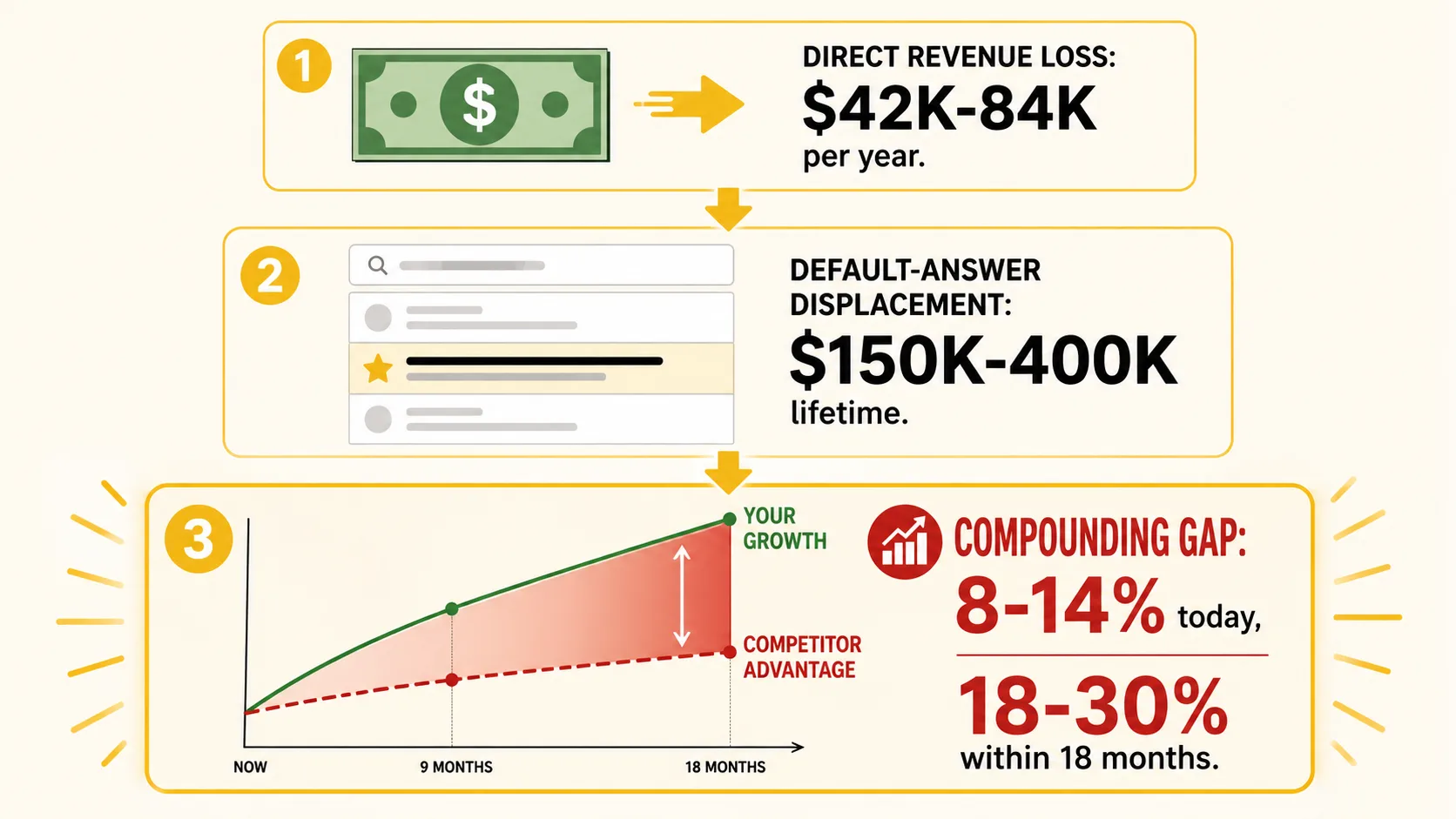
The direct revenue gap: $42,000 to $84,000 per year on a $3 million store. Between 8 and 14 percent of organic product discovery is now AI-mediated. Capital One Shopping Research reports that 58 percent of shoppers already use GenAI instead of traditional search for product recommendations. For a $3 million DTC brand, that is $42,000 to $84,000 in annual revenue that routes to competitors whose reviews happen to be machine-readable. Not better products. Not higher ratings. Just visible to the assistant.
The hidden cost: default-answer displacement. AI shopping assistants are sticky. When ChatGPT learns that Brand X is "the best collagen supplement under $40," it returns that answer on every subsequent query. The assistant does not re-audit the market every time. It has a default. Displacing a default answer costs three to five times more than never losing the slot. For a mid-market DTC brand, losing default-answer status on a core category costs $150,000 to $400,000 in lifetime customer value. Revenue that compounds with every query the assistant answers. The brand that invested $18,000 in reviews has zero presence in the fastest-growing channel.
The compounding cost: AI shopping query volume is accelerating. The AI shopping assistant market is projected to grow from $4.62 billion to $41.88 billion by 2035, a 24.75 percent compound annual rate, according to SNS Insider market research. Today's 8 to 14 percent discovery gap compounds to 18 to 30 percent within 18 months. The review program (Loox subscription, photo review incentives, moderation labor) delivers negative ROI on the fastest-growing share of traffic that cannot see the reviews. The investment that converts humans is bleeding value on AI traffic, and the gap widens every quarter.
Why the Industry Has Not Fixed This
Review visibility tools validate the wrong reader. Google Seller Ratings, Rich Snippets, and SEMrush schema audits confirm that Google's crawler can find review markup. They report green checkmarks. AI assistants do not use Google's crawl index. They fetch pages directly, parse what is in the raw HTML, and never execute the JavaScript that populates review widgets. The tools that report "reviews are visible" are checking a reader the AI never consults.
Meanwhile, review apps optimize for conversion rate and widget user experience. Their value proposition is "more reviews, better widgets, higher CVR." Nobody's product roadmap includes "make reviews machine-readable for ChatGPT." The gap between "reviews collectible" and "reviews AI-readable" is invisible to both sides of the toolchain. Review apps do not measure AI visibility. SEO tools do not check AI visibility. The DTC brand owner sees a green checkmark from a schema validator and assumes the reviews work everywhere. They work on human traffic. They do not work on the channel that is growing at 40 percent quarterly.
The industry conversation is starting to shift. In early July 2026, marketing analyst Eric Coyle noted that "most marketers are sleeping on AI purchasing agents" — autonomous systems consumers deploy to research, compare, negotiate, and complete purchases on their behalf. SEO practitioners are calling AI answer engines "the biggest opportunity in search right now", pointing out that competitors are already capturing recommendation slots while most brands ignore the shift entirely. The pattern is clear. Brands that fix review visibility first capture the default-answer slot. Brands that wait compete for displacement. Displacement costs three to five times more.
What Changes With Machine-Readable Reviews
Extracting existing reviews into machine-readable structured data requires zero new reviews, zero new tools, zero new photography. The reviews are already collected. The photos are already uploaded. The star ratings are already calculated. The only missing piece is the markup that makes them machine-readable: aggregateRating with reviewCount and ratingValue inside the existing Product schema, plus individual Review schema markup on the top 40 revenue-driving SKUs. The data exists. The tags that expose it do not.
Timeline: under two weeks. Process: audit the top 40 SKU pages for AI readability, inject aggregateRating into the existing JSON-LD block, add Review schema for representative reviews that are already collected but never marked up. Google recrawls the pages. Within 72 hours of recrawl — typically inside one week for sites with reasonable domain authority — the assistant can extract product name, price, rating, review count, brand, description, and availability. It can answer "best collagen supplement under $40" with evidence from this store's own pages. It always could answer the question. It simply did not have the data to answer it from this store.
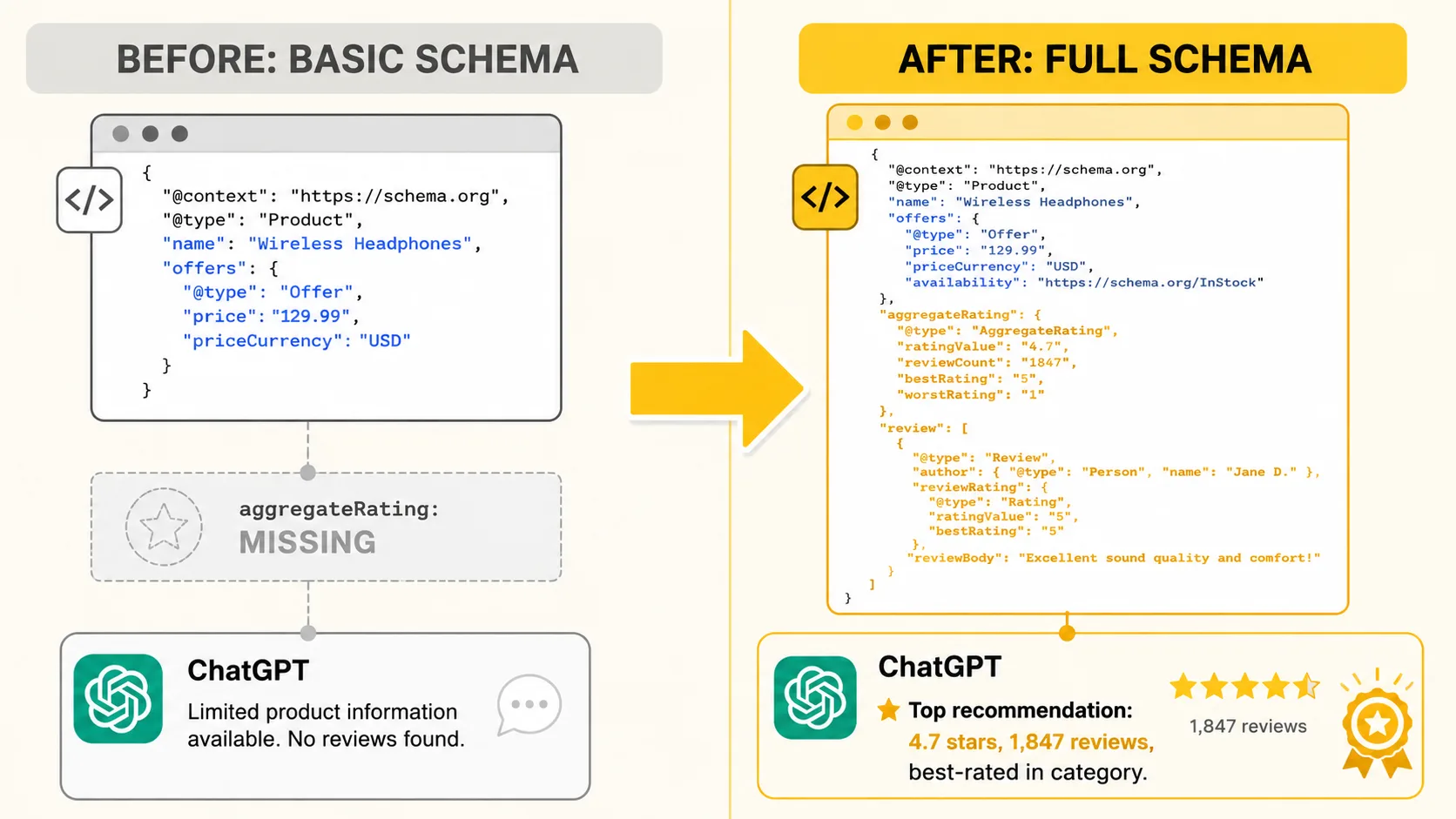
The outcome: products with 500-plus reviews and 4.7-plus ratings surface in AI recommendations where they were previously invisible. Revenue lift on AI-assisted discovery channels: 11 to 19 percent within 90 days. Not because the reviews improved. Because the assistant can finally read them.
The Shopify review stack was built for an era when "reviews visible" meant "reviews visible to human shoppers." That era ended. The fastest-growing product discovery channel does not have eyes. It parses markup. Brands that structure their reviews for machines earn the default-answer slot while competitors are still celebrating their green Google checkmarks. But the slot is held, not owned. AI assistants default to Amazon and the big brands, and the store that stops measuring gets silently replaced. The reviews are already the competitive advantage. They just need to be readable by the assistant making the recommendation.
What to ask next
Common questions operators ask after reading this:
How do I make my Shopify product reviews visible to ChatGPT?
Why doesn't my aggregateRating show up in AI shopping results?
Which review apps export structured data that AI assistants can read?
How much revenue do DTC brands lose when AI can't see their reviews?