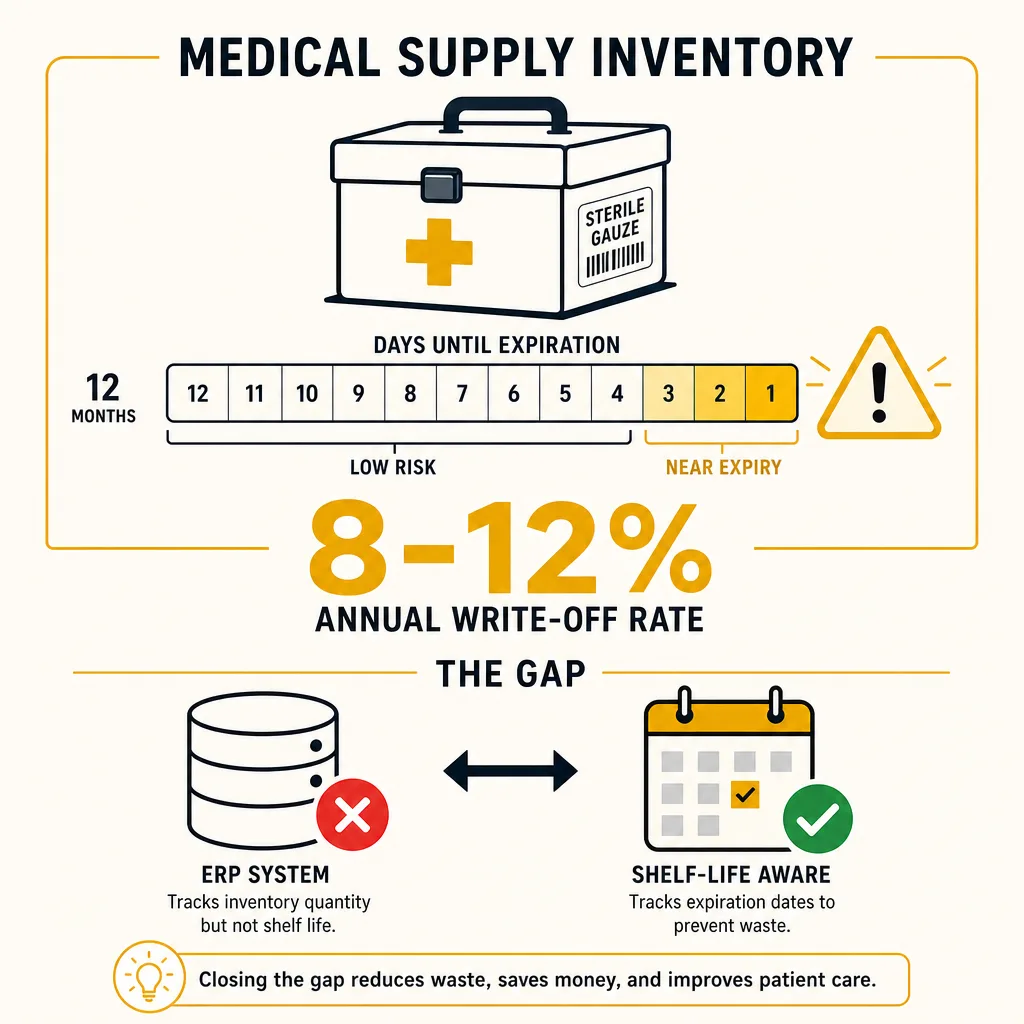
Expiry-driven write-offs cost medical suppliers 8 to 12 percent of inventory value every year because the tools used to manage stock were never designed to read expiry dates against demand velocity. A shelf of saline bags expires quietly while the ERP keeps counting it as inventory.
The Tuesday morning stock review. A shelf of saline bags, Lot #2847, expires in 90 days. Ordered six months ago based on last year's numbers. Nobody flagged the decelerating consumption rate in Q2. The procurement system never checked. That's $4,200 in write-offs from one SKU. Multiply across 600 SKUs, each with its own shelf-life curve, and the pattern repeats every quarter.
Every Head of Procurement at a mid-market medical supply distributor has opened a stock report and found a surprise. Not because anyone failed. Because the tools used to manage inventory were never designed to read expiry dates against demand velocity.
The ERP Wasn't Built for Shelf-Life
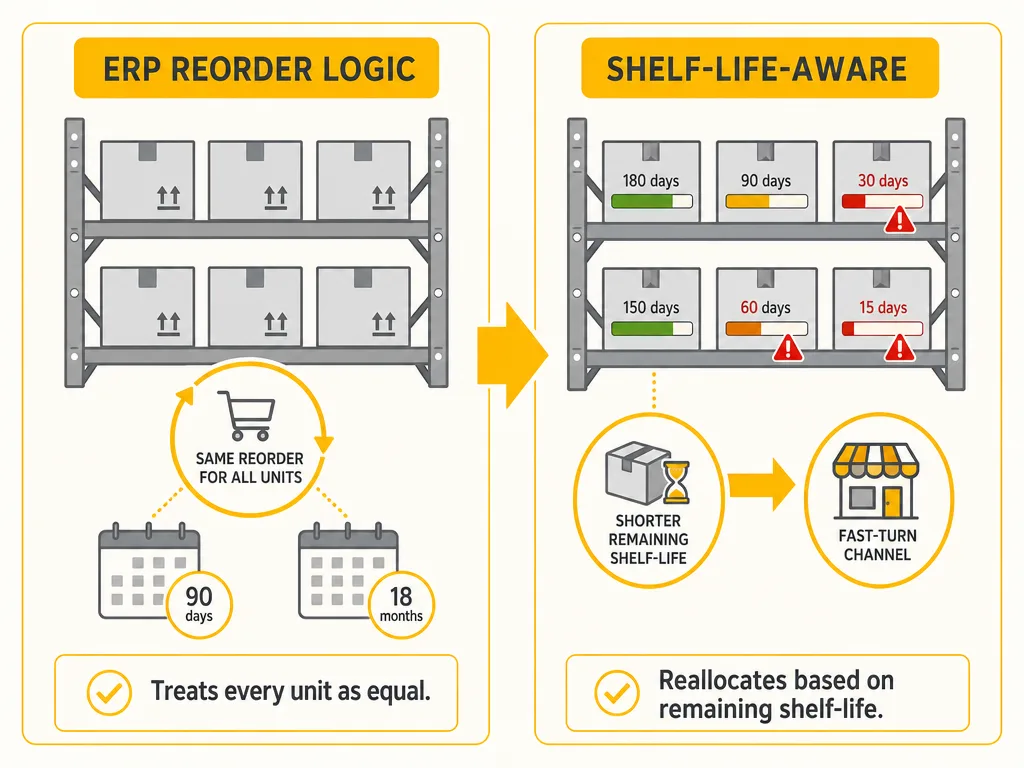
Most mid-market medical distributors run on ERPs like Prophet 21 or Epicor. These systems were architected to answer one question: "How many units are in the warehouse?" They track quantity, not quality. A unit with 90 days of shelf life remaining triggers the same reorder point as a unit with 18 months left. The system sees two identical SKUs and doesn't know one is about to become a liability.
This isn't a configuration error. ERP reorder logic uses fixed min/max thresholds and historical usage averages. It doesn't model shelf-life decay curves. It doesn't weigh consumption velocity against expiration proximity. It doesn't flag a decelerating SKU whose 12-month supply will outlast its 6-month remaining shelf life. These calculations don't exist in standard procurement modules because they were never part of the requirements. The gap is architectural, not operational. And it's exactly the kind of blind spot inventory intelligence is built to close.
For lot-tracked medical items governed by FDA 21 CFR Part 11, the risk compounds. An expired lot in circulation isn't just a write-off. It's a compliance event. Distributors operating under regulatory scrutiny carry inventory risk that their ERP can measure in units but can't measure in exposure.
What Expiry Write-Offs Actually Cost
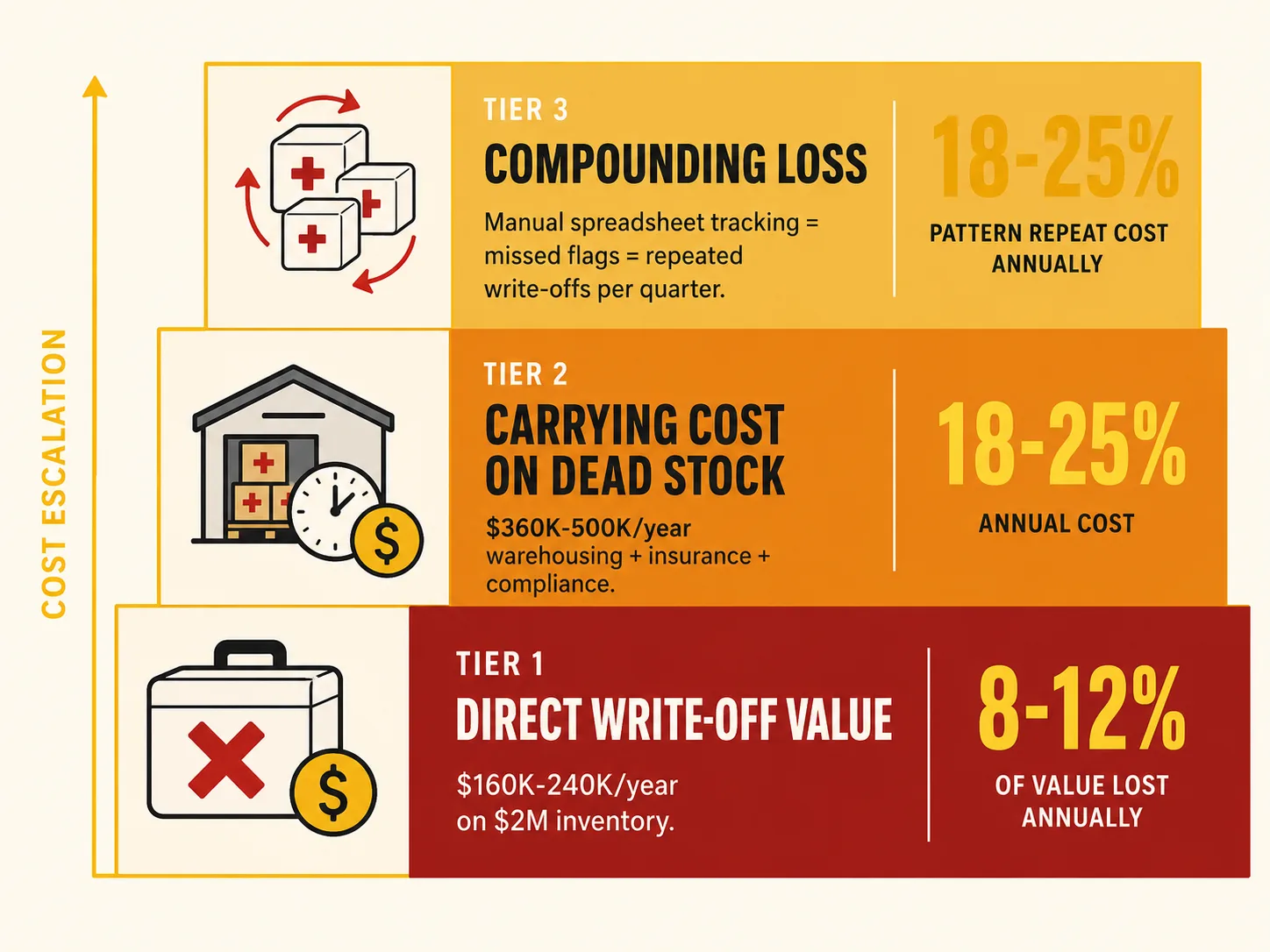
The visible number is the write-off itself. Medical supply distributors report 8–12% of inventory value lost to expiry annually. For a distributor holding $2 million in stock, that's $160,000 to $240,000 in dead inventory every year. Product that was purchased, stored, and never sold.
But that's not the number that matters.
The hidden cost is the capital trapped in slow-moving stock. Medical supply distributors carry 90–180 days of inventory to secure bulk discounts and guarantee fill rates. Every dollar tied up in a unit that will expire before it sells is a dollar that couldn't be allocated to a fast-turn SKU with a 22% margin. Annual carrying costs in medical distribution run 18–25%. Warehousing. Insurance. Regulatory compliance. Cold chain where applicable. On a $2 million inventory, that's $360,000 to $500,000 per year just to hold the stock. A portion of that carrying cost is spent on units that are already dead. They just haven't expired yet.
And then there's the compounding operational cost: the pattern nobody catches because shelf-life tracking is manual. A distributor running 600 SKUs tracks expirations with spreadsheets and calendar reminders. One missed flag. One lot that slips past. The ops manager is measured on fulfillment rate and cost control. Punished for stockouts. Punished for write-offs. The tools optimize neither in combination.
Why Mid-Market Distributors Accept This
The alternatives haven't fit, so the spreadsheet and calendar ritual survives. Not because it works. Because nothing else was built for this segment.
On one end: pharmaceutical manufacturers use forecasting tools like SAP Advanced Planning & Optimization or Oracle SCM Cloud. These systems model shelf-life constraints, batch tracking, and regulatory compliance. They also cost $50,000-plus in licensing and require dedicated supply chain analysts to operate. A medical supply distributor with 30 employees and $15 million in revenue isn't buying SAP APO.
On the other end: retail POS systems and small-business inventory apps track expiration dates. They're built for a pharmacy or a single clinic. A few hundred SKUs. Walk-in customers. Point-of-sale. They don't handle bulk purchasing, distributor-tier supply chains, or 600-SKU portfolios with multi-month lead times.
Mid-market medical distributors fall through the gap. Too complex for spreadsheets. Six hundred SKUs, each with its own shelf-life curve, vendor lead time, and demand pattern. Too small for enterprise supply chain suites. So the Tuesday morning surprise endures. Open the stock report. Find the expiring lot. Write it off. Repeat. Not because anyone is bad at their job. Because the market hasn't offered tools designed for this specific problem at this specific scale.
What Changes With Shelf-Life-Aware Forecasting
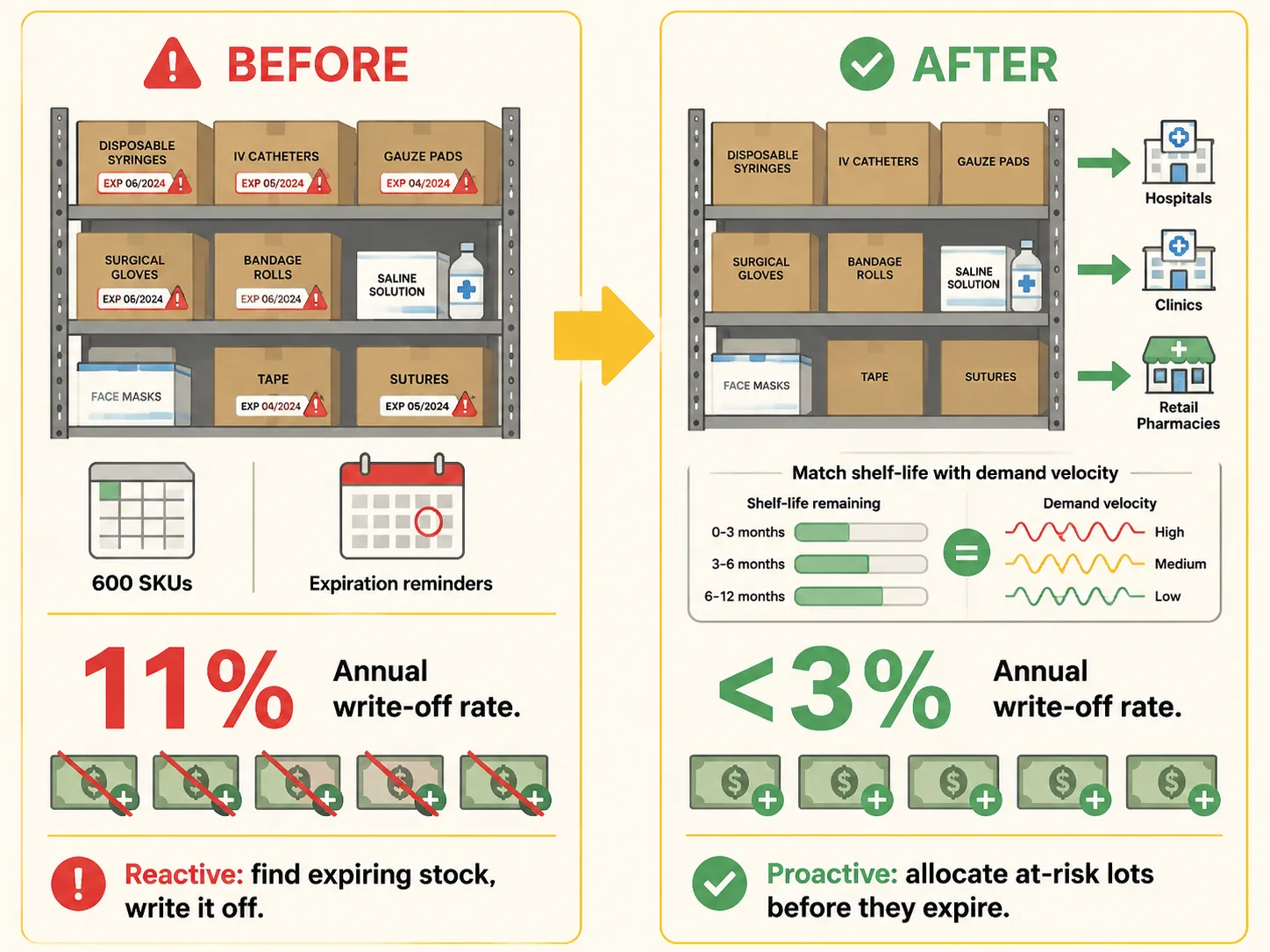
Now imagine a different Tuesday morning. Instead of discovering expiring stock reactively, the system has been tracking every SKU's shelf-life against its consumption velocity for months. Lot #2847 was flagged 90 days ago. Not when it expired. When its consumption rate began decelerating against its remaining shelf life. The ops manager saw a recommendation: allocate 40% of the remaining lot to a high-volume account at a modest discount. Recover $2,900 instead of writing off $4,200. The decision was made while there was still time to act.
This is what shelf-life-aware forecasting delivers. Not better purchasing. Smarter allocation. A distributor with 600 SKUs tracking expiry risk dynamically cuts annual write-offs from 11% of inventory value to under 3%. Not by negotiating harder with suppliers. Not by hiring another procurement analyst. By sitting on top of the existing ERP and adding the one dimension the ERP was never designed to see: time.
The outcome isn't "better analytics." It's capital recovered. Compliance exposure reduced. The ops manager measured on conflicting metrics — fill rate vs. cost control — finally has a tool that optimizes both. The spreadsheet becomes unnecessary because the question it was answering is now obsolete.
What to ask next
Common questions procurement and operations managers ask after reading this:
How much does medical supply expiry waste cost per year for a mid-market distributor?
What is shelf-life-aware inventory forecasting and how does it differ from ERP reorder logic?
How do mid-market distributors track expiry dates across 600-plus SKUs without enterprise software?
Related read: Expiry isn't the only cost of demand-blind reorder logic — when demand velocity outruns fixed reorder thresholds, stockouts cost distributors $40-80K in expedited shipping and 4-7x annual margin in lost accounts.
Related read: The ERP architecture gap cuts both ways — MRO stockrooms run 40-60% over target because reorder logic treats critical bearings and shelf bolts identically, burning $300K-900K/year in carrying cost while still missing the parts that stop production.
If This Sounds Like Your Stock Review
We analyze medical supply inventory to find the write-off risk your ERP can't see. It starts with a diagnostic. The top 20 expiry-risk SKUs in your portfolio, ranked by shelf-life proximity against consumption velocity. Free. No tool required. Just the last 12 months of purchase data. No pitch. Just numbers.