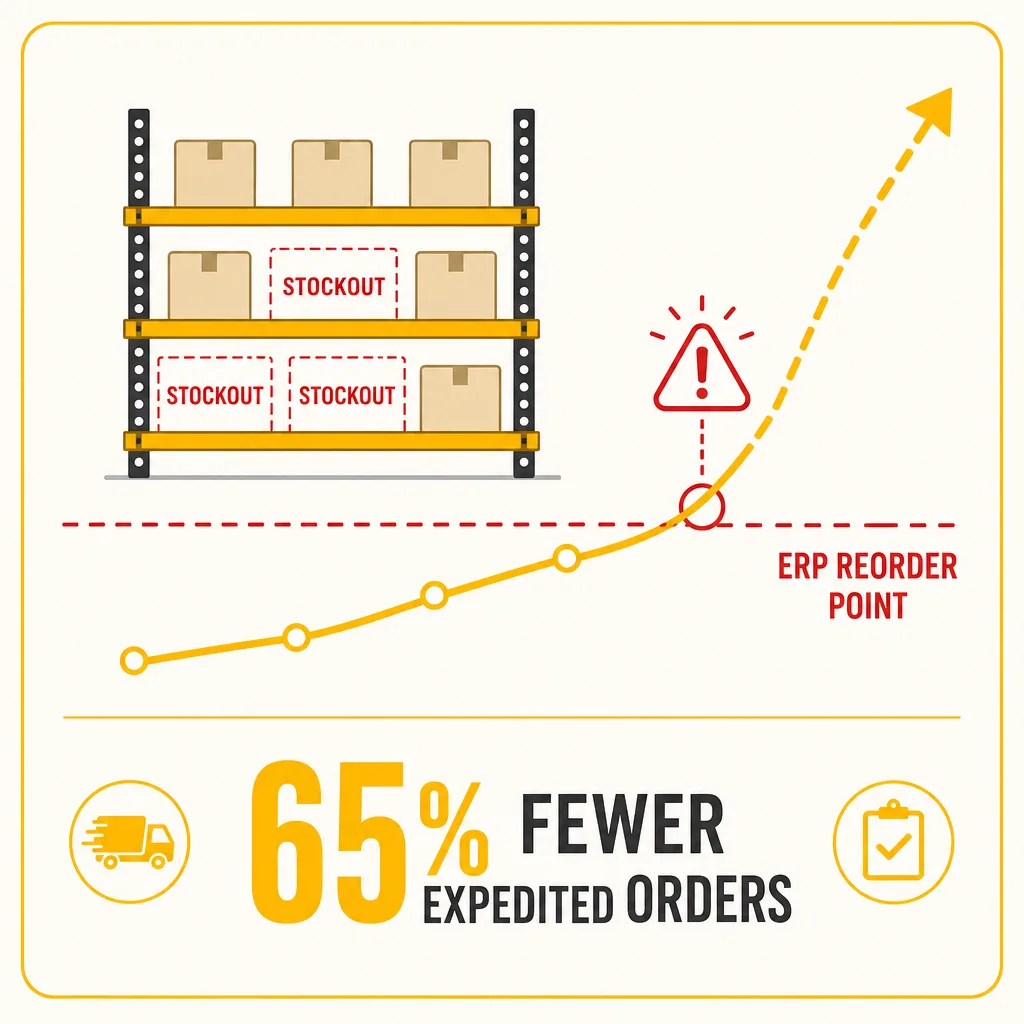
Safety stock fails and the ERP stays silent because reorder logic answers one question, how many are left, and never the question that prevents the stockout: how fast is this SKU burning against incoming supply. The ERP counted inventory while a demand spike quietly emptied the shelf.
Monday, 7 AM. Hospital procurement calls. Fifty wound-care units by Wednesday. The shelf holds 12. Last month this SKU moved 200 units. The ERP reorder trigger was set at 30, based on last year's monthly average. A three-week demand spike started quietly in Q2. The ERP never adjusted. Now the order is rush-shipped at 2x cost from a secondary supplier. The ERP counted inventory. It never predicted demand velocity.
Every Head of Procurement at a mid-market medical distributor has taken this call. Not because anyone failed. Because the tools used to manage inventory answer one question and one question only: how many are left? They never answer the question that actually prevents the call: how fast are we burning through this SKU against incoming supply?
ERPs Count. They Never Learned to Predict.
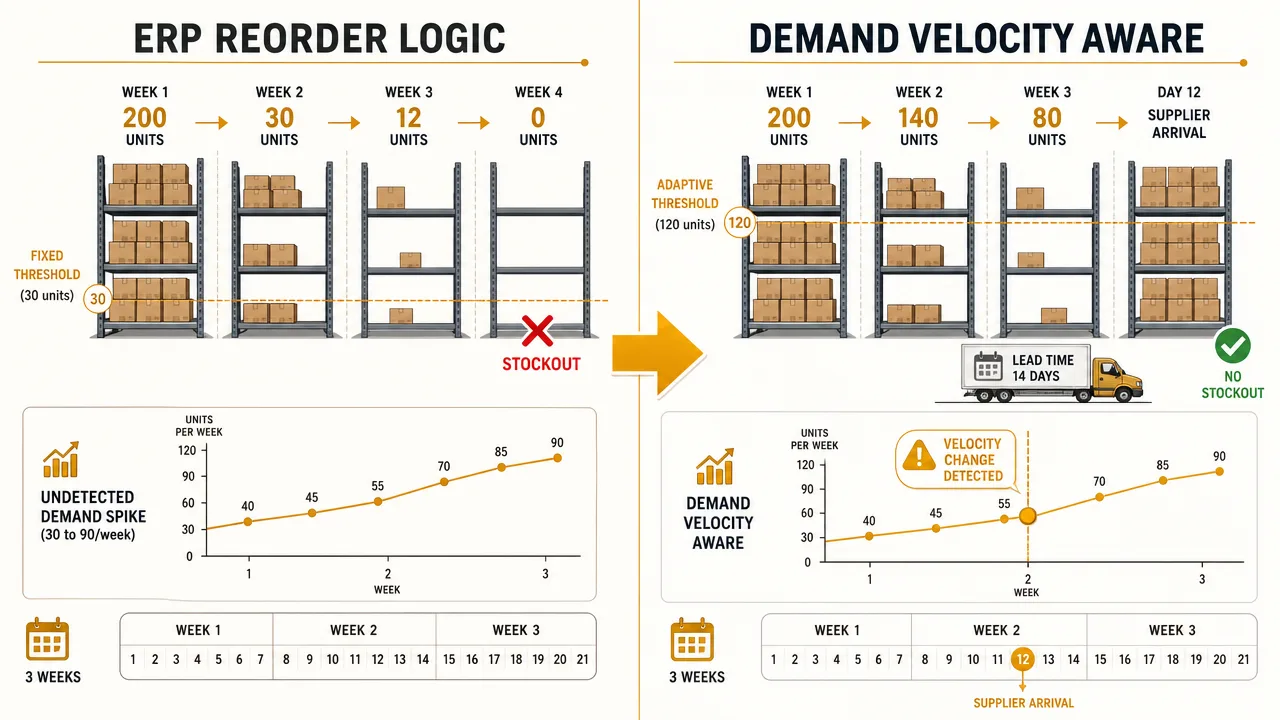
Standard ERP reorder logic is three numbers: historical average usage, fixed minimum threshold, manual lead time per supplier. When inventory drops below the min, the reorder fires. That works when demand is flat and lead times are stable. Medical supply distribution is neither.
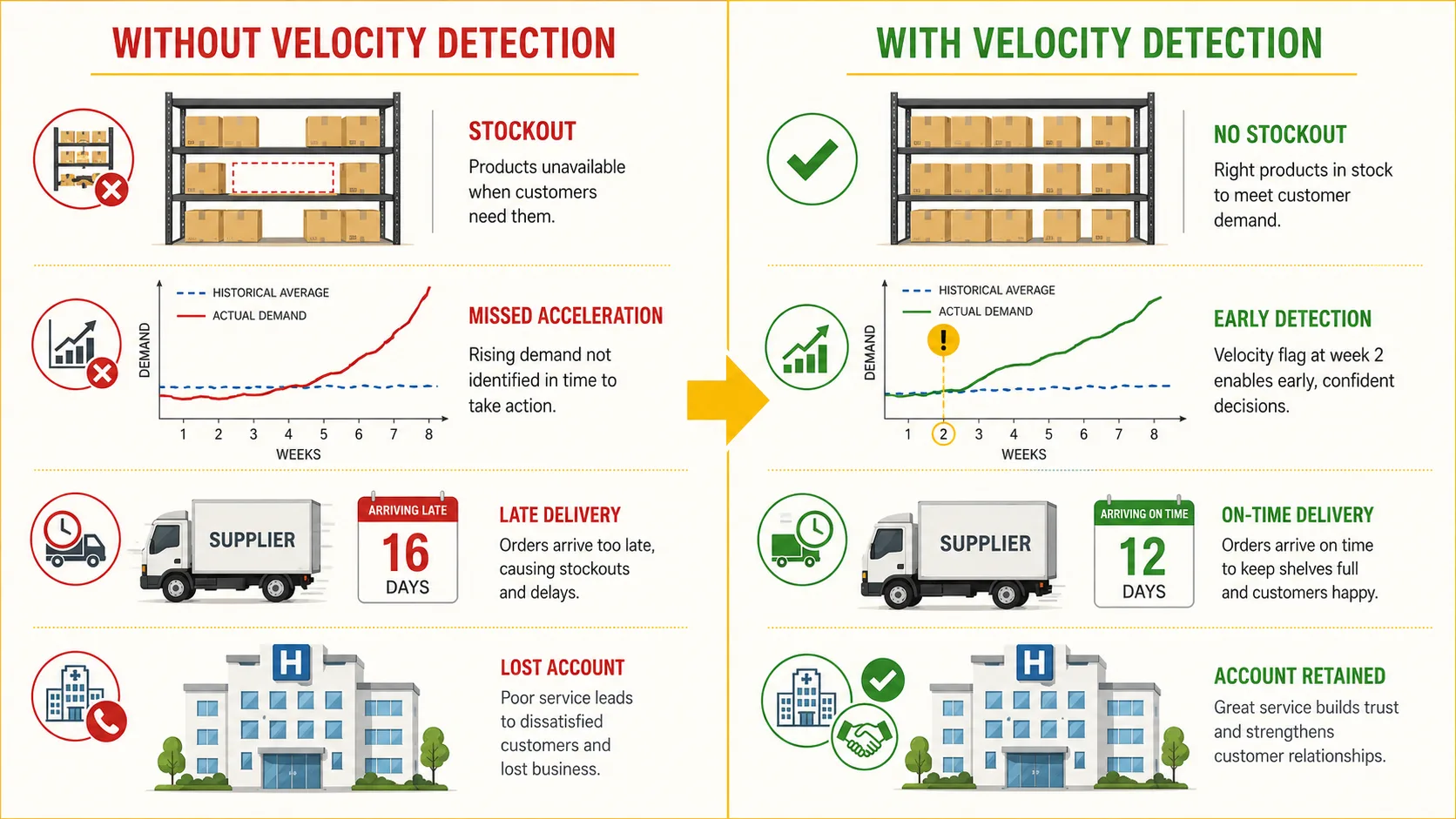
Demand acceleration goes undetected until the count crosses the threshold. By then it's too late. The reorder triggers at 30 units. Lead time is 14 days. But the SKU is burning at 90 units per week, not the 40 the ERP assumes from last year's average. That 30-unit safety net evaporates in two days. The ERP fires the reorder on day two. The shipment arrives on day 16. The hospital called on day one.
This is not a configuration error. It's an architecture gap. ERPs track what was and what is. They don't model what will be given current trajectory. Rate of change isn't a field in the procurement module. Burn rate against lead time isn't a calculation the system runs. These were never part of the requirements because reorder modules were built for warehouse replenishment, not demand velocity detection. The gap between those two things is where stockouts live. And it's exactly the kind of blind spot inventory intelligence is built to close.
The same structural gap causes expiry-driven write-offs. In both cases the ERP sees a unit. It doesn't see the forces acting on that unit — demand velocity on one side, shelf-life decay on the other. Same architecture. Two different failure modes. Same buyer paying for both.
What Demand-Blind Reordering Actually Costs
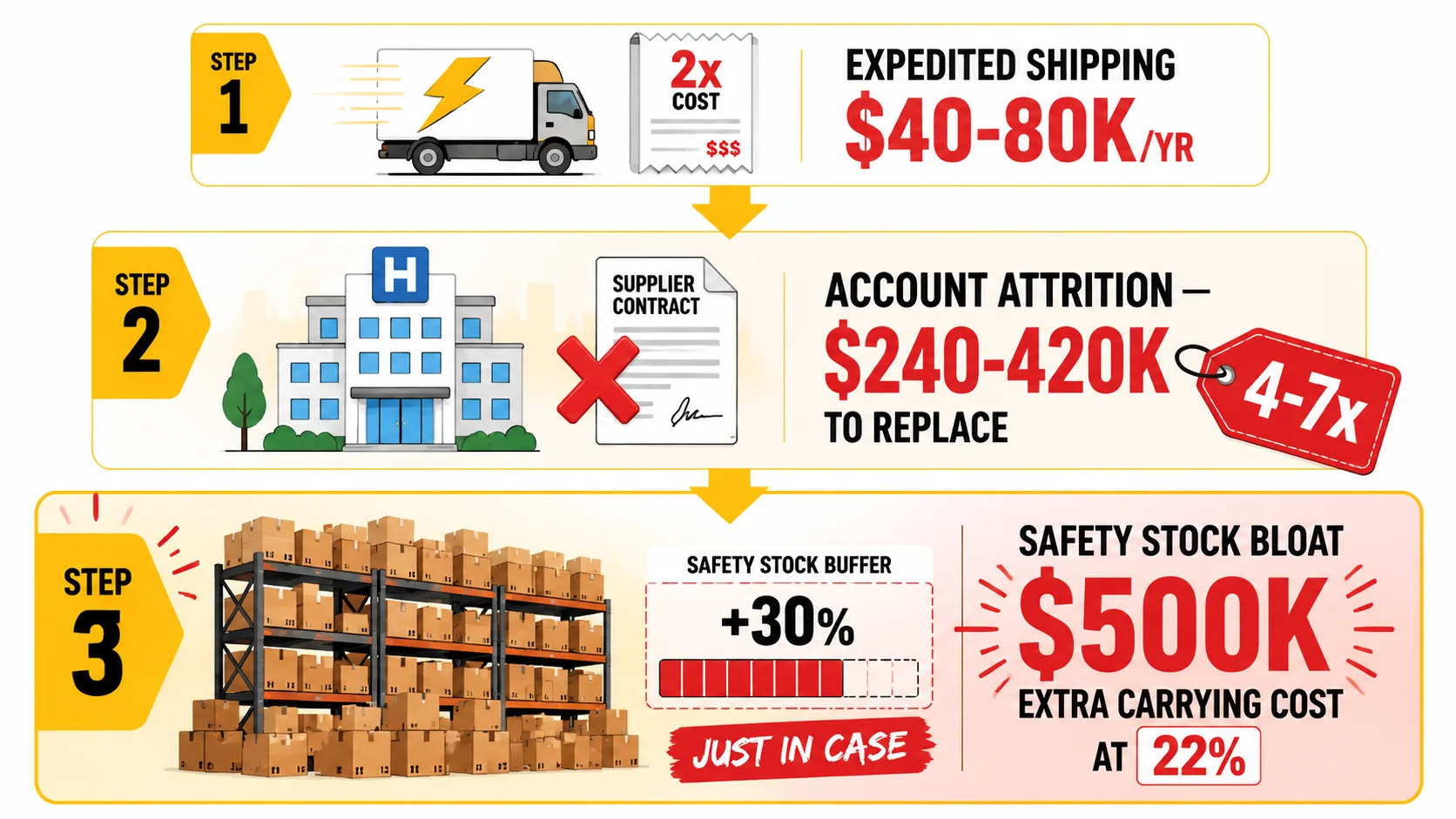
The visible number lands on the freight line. Expedited shipping from secondary suppliers runs $40,000 to $80,000 per year for a mid-market distributor managing 600 SKUs. Secondary supplier premiums add 15 to 30 percent per unit. Rush charges add another layer. On a $15 million revenue base, that's margin erosion the P&L absorbs every quarter without naming the cause.
But that's not the number that matters.
The hidden cost is account attrition. Hospital procurement operates on fill rate. Three stockouts in six months on high-turn SKUs and the account goes to review. Re-qualification with a new supplier takes months. Contracting. Compliance paperwork. Integration testing. Industry benchmarks put replacement cost at four to seven times the annual margin of the lost account. A $60,000 margin account lost to stockouts costs $240,000 to $420,000 to replace. The expedited shipping charge is noise compared to the account walking.
And then there's the compounding cost: safety stock bloat. After two stockouts, procurement adds 30 percent to every reorder "just in case." Across 600 SKUs, that's roughly $500,000 in extra carrying cost at the industry standard 22 percent rate. Capital frozen in inventory. Warehousing. Insurance. All spent on insurance against a problem the ERP created by not seeing the demand signal that was already there.
Why Mid-Market Distributors Accept This
The alternatives haven't fit, so the ERP reorder module and the gut-feel safety stock buffer survive. Not because they work. Because nothing else was designed for this segment.
On one end: enterprise demand planning suites like SAP IBP and Oracle Demantra model demand variability, seasonality, and lead time uncertainty. They also cost $100,000-plus in annual licensing and require dedicated demand planners to operate. A distributor with 30 employees and $15 million in revenue isn't staffing a planning department.
On the other end: simple reorder calculators. EOQ formulas. Spreadsheet macros. They apply a single demand rate per SKU and a single lead time per supplier. They work for a few dozen slow-turn items. They break at 600 SKUs with lead times that vary 9 to 38 days per supplier. The industry standard is one fixed lead time number per vendor. Reality says lead time varies by 29 days.
Mid-market medical distributors fall through the gap. Too complex for calculators. Six hundred SKUs with velocity curves, seasonality, and supplier variability. Too small for enterprise suites with six-figure price tags and dedicated analyst requirements. So the pattern continues. Expedited orders. Safety stock bloat. Account attrition. Not because anyone is bad at their job. Because the market hasn't built for this specific gap at this specific scale.
What Changes When the System Sees Velocity
A demand-velocity-aware system tracks burn rate against lead time variability continuously. The wound-care SKU accelerates from 40 units per week to 90. Flagged at week two, not week three when the count hits 30. The system sees the trajectory change and surfaces it: demand rate has more than doubled against a 14-day lead time. Reorder threshold at 30 units will trigger too late.
Procurement sees the recommendation before the count drops: increase reorder quantity 60 percent for the next four weeks. Allocate backup supplier capacity for the gap window. Recalibrate safety stock to reflect the new velocity. The reorder fires at 120 units instead of 30. The primary supplier delivers on day 12. The shelf never drops below 40. The hospital call never happens.
The outcome isn't "better forecasting." It's 65 percent fewer expedited orders. Twenty percent less safety stock because the buffer is sized to actual demand variability, not the fear of the last stockout. The Head of Procurement measured on fill rate and cost control finally has a tool that optimizes both. The ERP still tracks what's on the shelf. The intelligence layer tracks what's about to happen to it. No rip-and-replace.
What to ask next
Common questions procurement managers ask after reading this:
How many of my 600 SKUs are burning faster than their reorder thresholds can catch?
What does a demand-velocity detection model need that an ERP reorder module doesn't have?
How do lead time variability and demand acceleration interact to create stockout risk?
See Which SKUs Your ERP Is Missing
We analyze medical supply inventory to find the stockout risk your ERP can't see. It starts with a diagnostic. The top 20 SKUs in your portfolio ranked by velocity-to-threshold risk — where current burn rate will breach your reorder point before your supplier can deliver. Free. No tool required. Just the last 12 months of purchase and consumption data. No pitch. Just numbers.