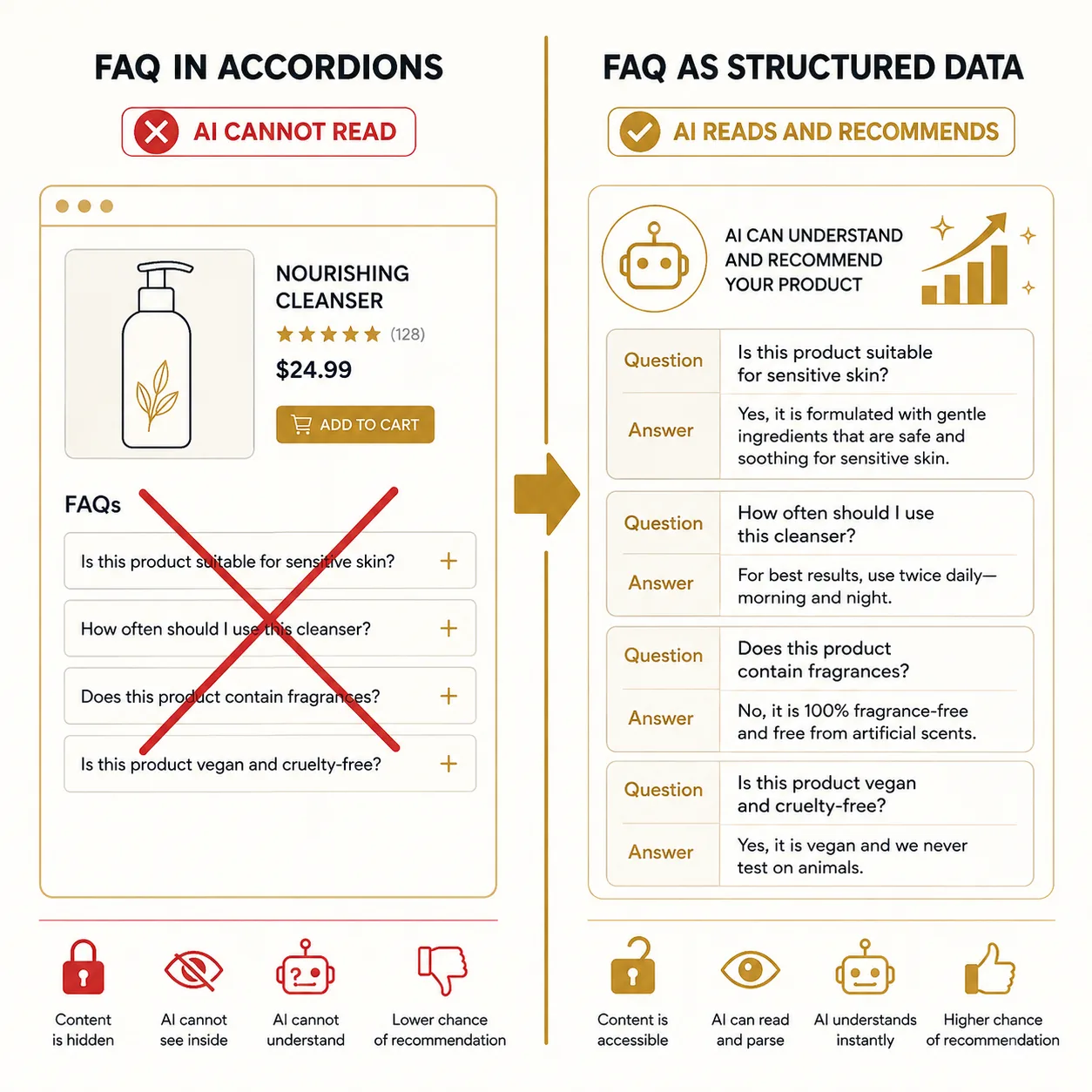
AI shoppers get better answers about competitor products because competitor pages expose FAQ content as structured Question and Answer data, and most product pages do not. The arch support detail, the fit guide, the material breakdown, and the compatibility chart are all on the page. They sit inside accordions that render for human eyes and nothing else. AI assistants read structured data, and the page that answers the question in machine-readable form wins the recommendation.
A shopper asks an AI assistant which running shoe has the best arch support for flat feet under $150. The brand’s product has the best arch support in the category. The competitor’s does not. The AI recommends the competitor anyway. The arch support detail is right there on the product page, inside the FAQ accordion. So is the fit guide, the material breakdown, and the compatibility chart. None of it matters. AI assistants do not read accordions.
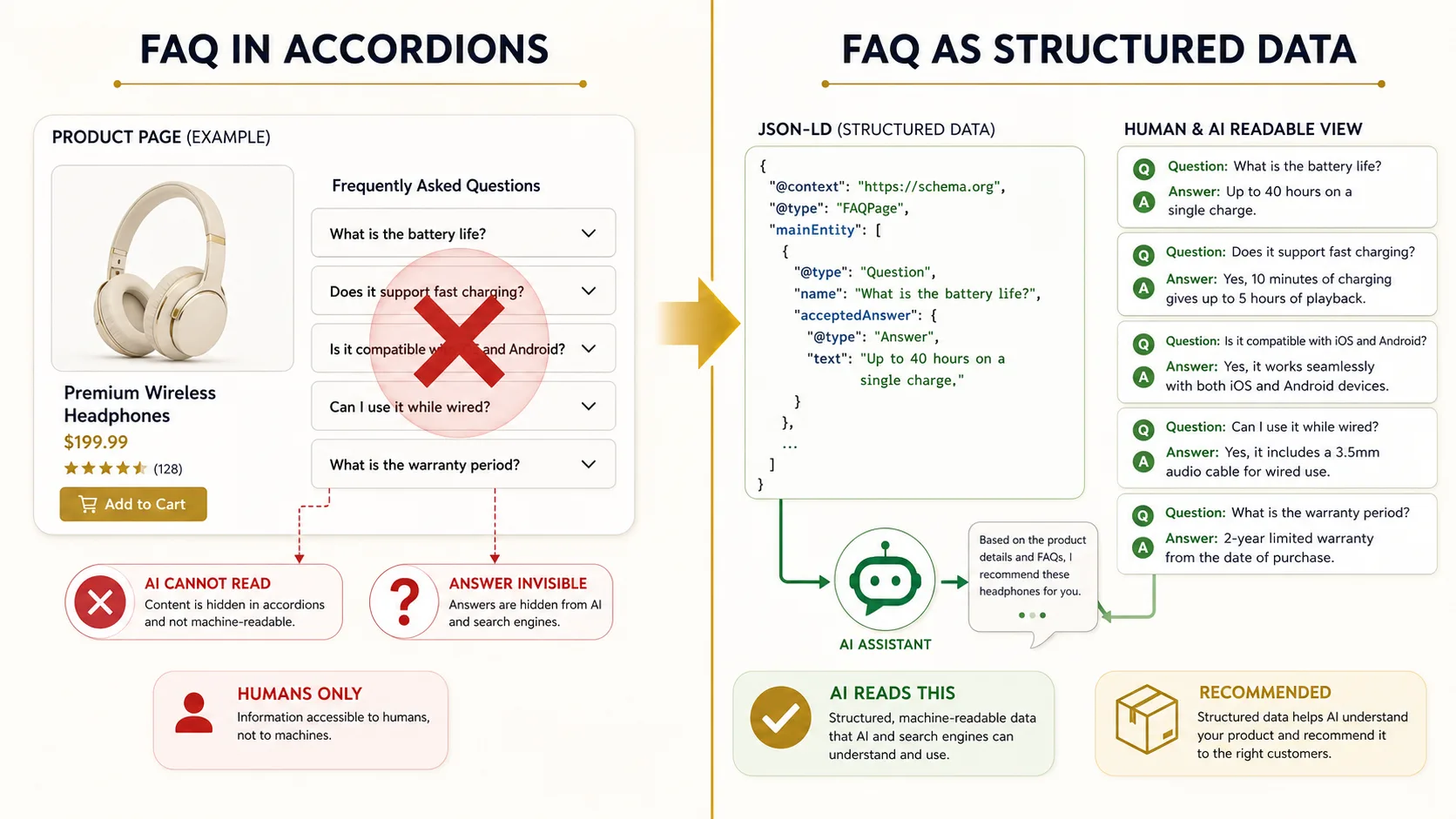
The Content Is Already There. The Format Hides It.
Shopify themes treat FAQ sections as HTML widgets. Accordion apps, tabbed panels, expandable sections. They paint pixels. They emit no JSON-LD. The content a human reads in the accordion is invisible to anything that reads structured data, and AI shopping assistants are structured data readers. The gap is not missing content. It is content locked in a format machines cannot parse.
The tooling around FAQ schema optimized for a Google feature that no longer exists. Google deprecated the FAQ rich result and removed it from search results in May 2026, keeping it only for well-known government and health sites. SEO plugins that added FAQ schema were built to win that rich result. The feature is gone, and the structured data they generated never reached the product level anyway. The content stayed unstructured, and the tools moved on.
Competitors who structure the same FAQ content as linked Question items in Product schema win every comparison query by default. The content already exists on both pages. The format decides which answer the AI reads.
What Invisible Answers Actually Cost
The obvious cost is lost AI-assisted discovery. FAQ-driven queries, “does this work with...”, “what is the difference between...”, “which one for...”, represent 12 to 18 percent of AI shopping assistant product queries. For a $3 million DTC store, that is $18,000 to $42,000 per year in AI-assisted sales routing to competitors with structured answers.
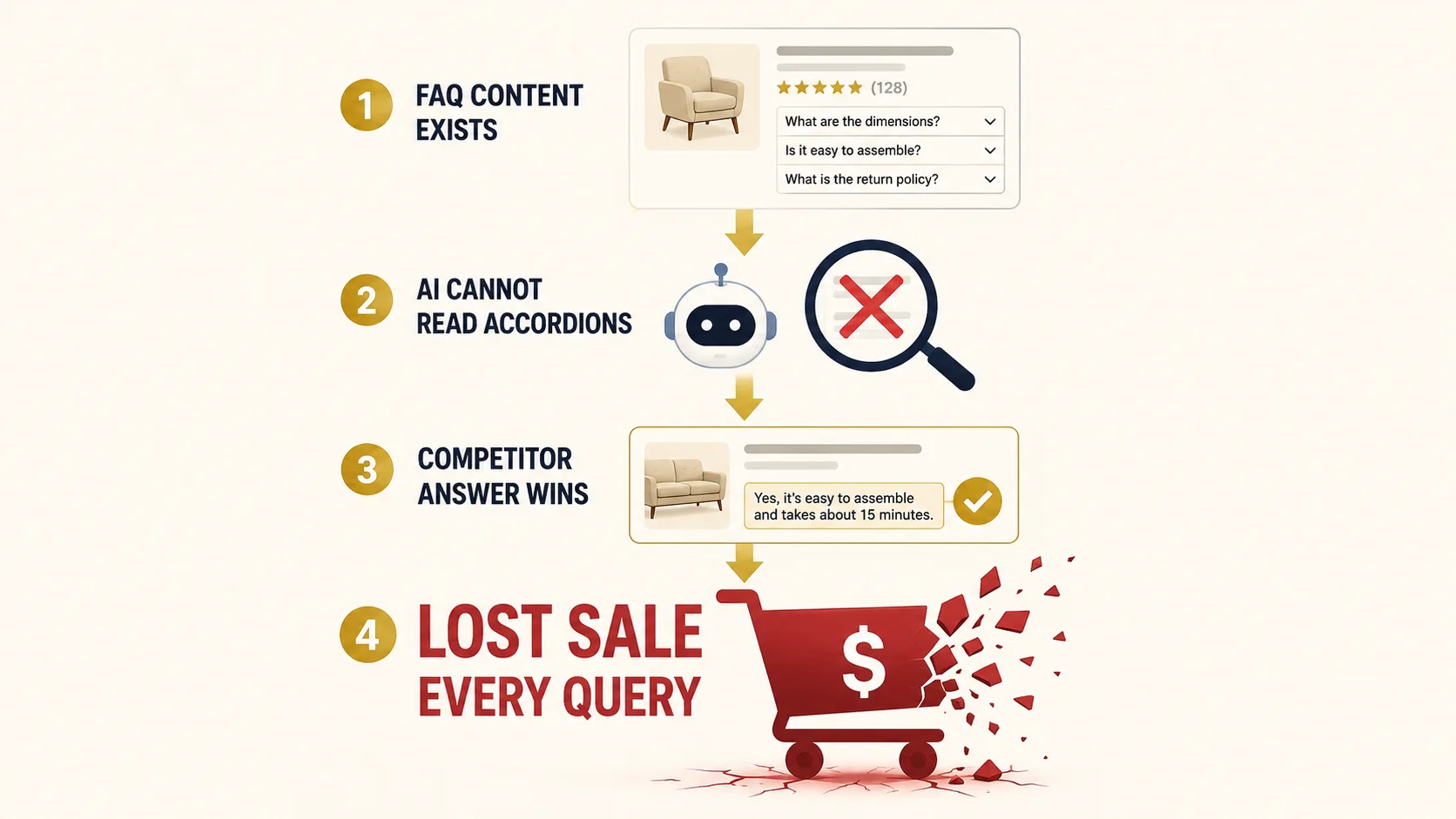
The hidden cost is content ROI waste. The brand already paid for the FAQ copy, the fit guides, and the compatibility charts. That content lifts human conversion by 3 to 7 percent. From AI channels it returns zero. Add support tickets from shoppers who bought the wrong competitor product because the AI could not read the answer, and the bleed is $22,000 to $48,000 per year in content that produces nothing, plus $8,000 to $15,000 in return and support costs.
The compounding cost is permanent answer-position loss. The AI shopping assistant market is projected to reach nearly $42 billion within the decade, and 58 percent of shoppers already use generative AI instead of traditional search for product recommendations. AI shopping query volume grows more than 40 percent per quarter. Competitors who own the best answer slot for 6 to 12 FAQ-driven comparison queries keep the AI assistant default recommendation for every query in that cluster. By Q3 2027, brands without structured FAQ data are excluded from 25 to 40 percent of comparison-driven AI queries. Not because the products are worse. Because the AI cannot read the answers.
Why the Industry Accepts It
JSON-LD for ecommerce evolved around the transaction. Price, availability, reviews. Shopify’s native Product schema covers offers, aggregateRating, and brand. The buy-now data. FAQ content lives outside that structure, in the copy and content the theme renders, and no mid-market tool bridges the two. Enterprise product information management systems do this at scale, at $40,000 to $80,000 per year, breaking even at 500 or more SKUs. A DTC brand with 50 to 400 SKUs falls through the gap: too large for manual enrichment, too small for enterprise economics.
The community sees the channel clearly. Shopify’s VP of Product said AI-referred shoppers convert 80 percent better than organic search visitors and that half of AI sessions land directly on a product page. The same week, operators were posting that AI only recommends what it trusts. The ecosystem knows AI discovery is real. The tooling still treats FAQ as a visual widget, because the tools that cared about FAQ schema were built for a Google feature that no longer exists.
What Changes When Answers Become Machine-Readable
Auditing the top 40 revenue-driving SKUs for FAQ content that is already live but unstructured. Extracting the 4 to 8 most common customer questions per SKU: “does this fit wide feet?”, “what is the battery life in cold weather?”, “is this compatible with Series X?”. Mapping each to a structured Question and Answer pair within the Product schema via FAQPage with mainEntity. No new copy. No new photography. No theme changes. The content already exists in accordions, tabs, and description paragraphs. The lift is making it machine-readable.
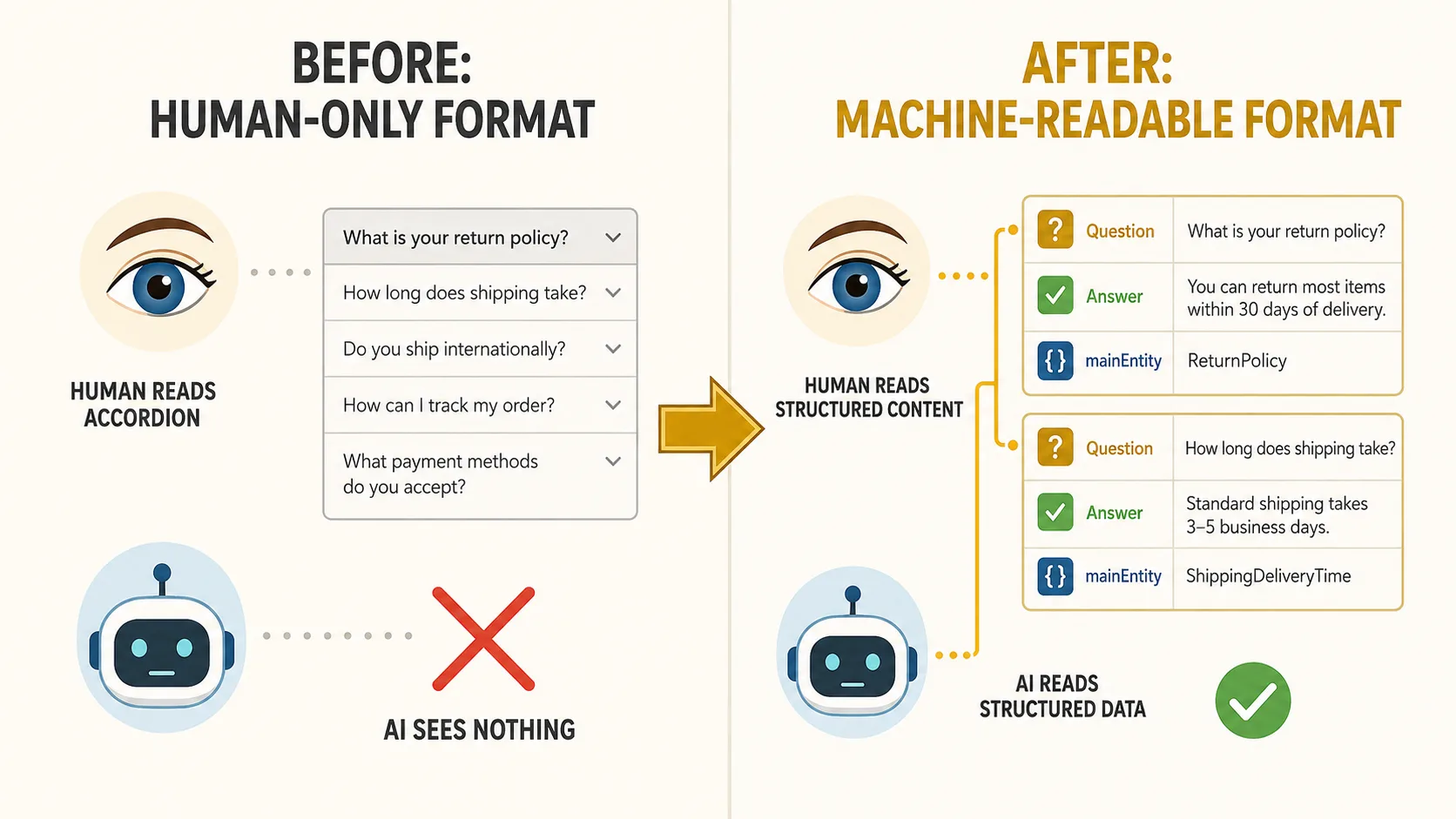
The work takes 10 to 14 days for 40 SKUs. Within 90 days, AI-assisted discovery on comparison-driven question queries lifts 7 to 13 percent. The data is the differentiator: agent-ready structured markup lifts AI shopping task success from 49 to 89 percent, and the audience doing the shopping is no longer all human.
This is the same pattern described in why AI shoppers cannot compare products, what DTC brands lose when AI shoppers pick the wrong variant, and what sale prices look like when AI shoppers cannot read them. The schema carries the surface. It does not carry the operational reality. Every question that becomes machine-readable widens the gap between brands whose answers AI can read and brands whose answers are still locked in accordions.
The same diagnostic approach described in how TheiaOps validates markets applies here: find the gap, measure the cost, fix the structure, own the answer. And keep owning it. The products never change. The AI assistant finally had the data it needed to make the right recommendation. But readable answers earn a seat, not a guarantee. The assistant defaults to Amazon and the big brands, so staying recommended is the ongoing fight.
What to ask next
Common questions operators ask after reading this:
How do I add FAQ structured data to my Shopify product pages?
Why does my structured data pass Google’s test but still fail AI shopping assistants?
What product questions do AI assistants ask most about my category?
How much revenue am I losing to competitors who have better structured data?
Related read: The same structured data depth decides whether AI shoppers see the shipping offer. Free shipping and free returns stay invisible to AI assistants when shippingDetails and hasMerchantReturnPolicy are missing from the schema.
Get a Structured Data Diagnostic
An audit of the top 40 revenue SKUs surfaces every product question AI assistants can answer today, which ones they ignore, and the estimated revenue gap per FAQ query type. The output is a ranked list of the top 5 fixes by AI discoverability impact. No software to install. No new copy. No theme changes. Just the gap analysis that shows which answers AI assistants are reading about the products, and which competitor answers they are reading instead.