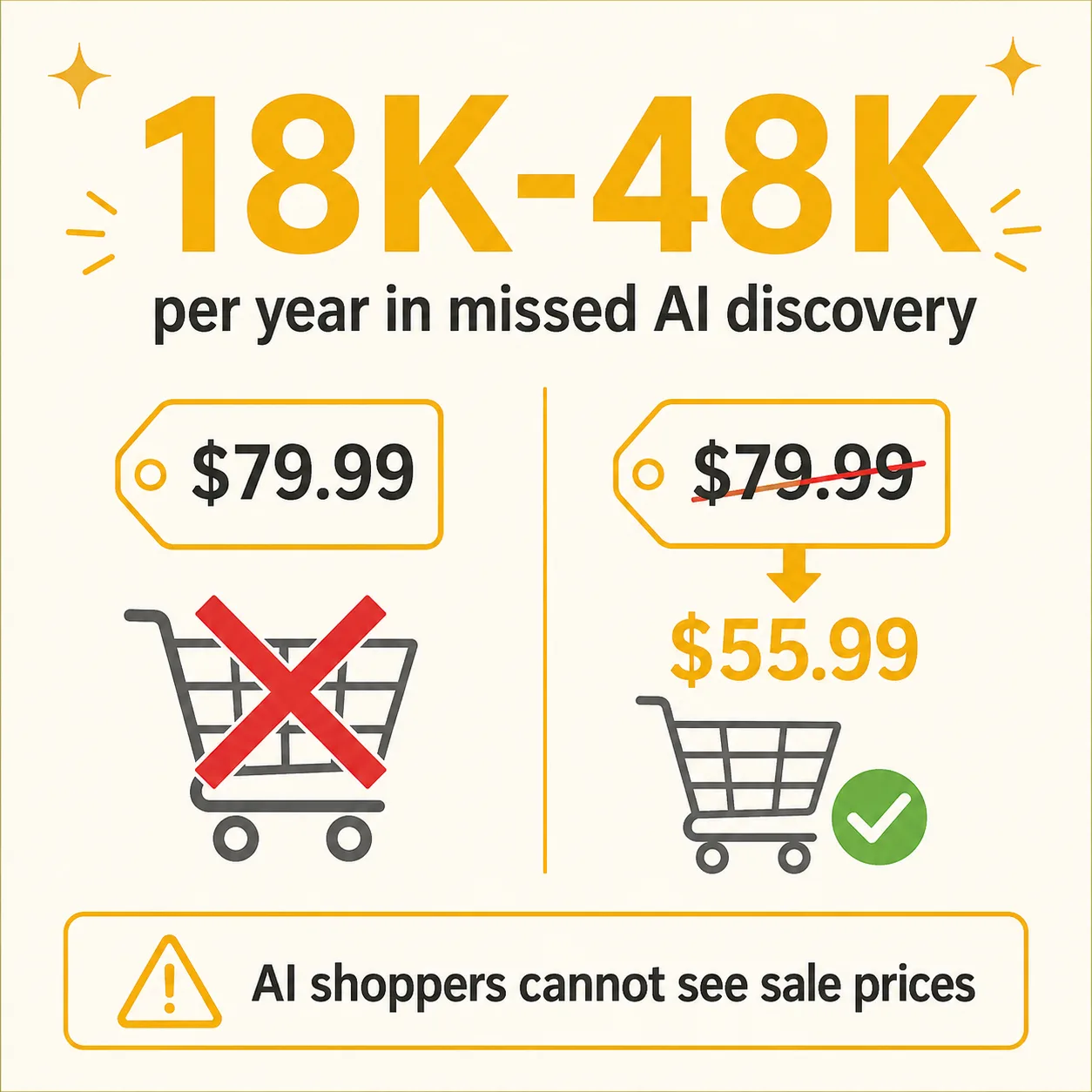
DTC brands lose the AI-assisted shopper every hour a flash sale runs without structured price data. Humans see the strikethrough and convert at 2.3 times normal rate; the machines see full price and recommend competitors because no priceSpecification exists on the page.
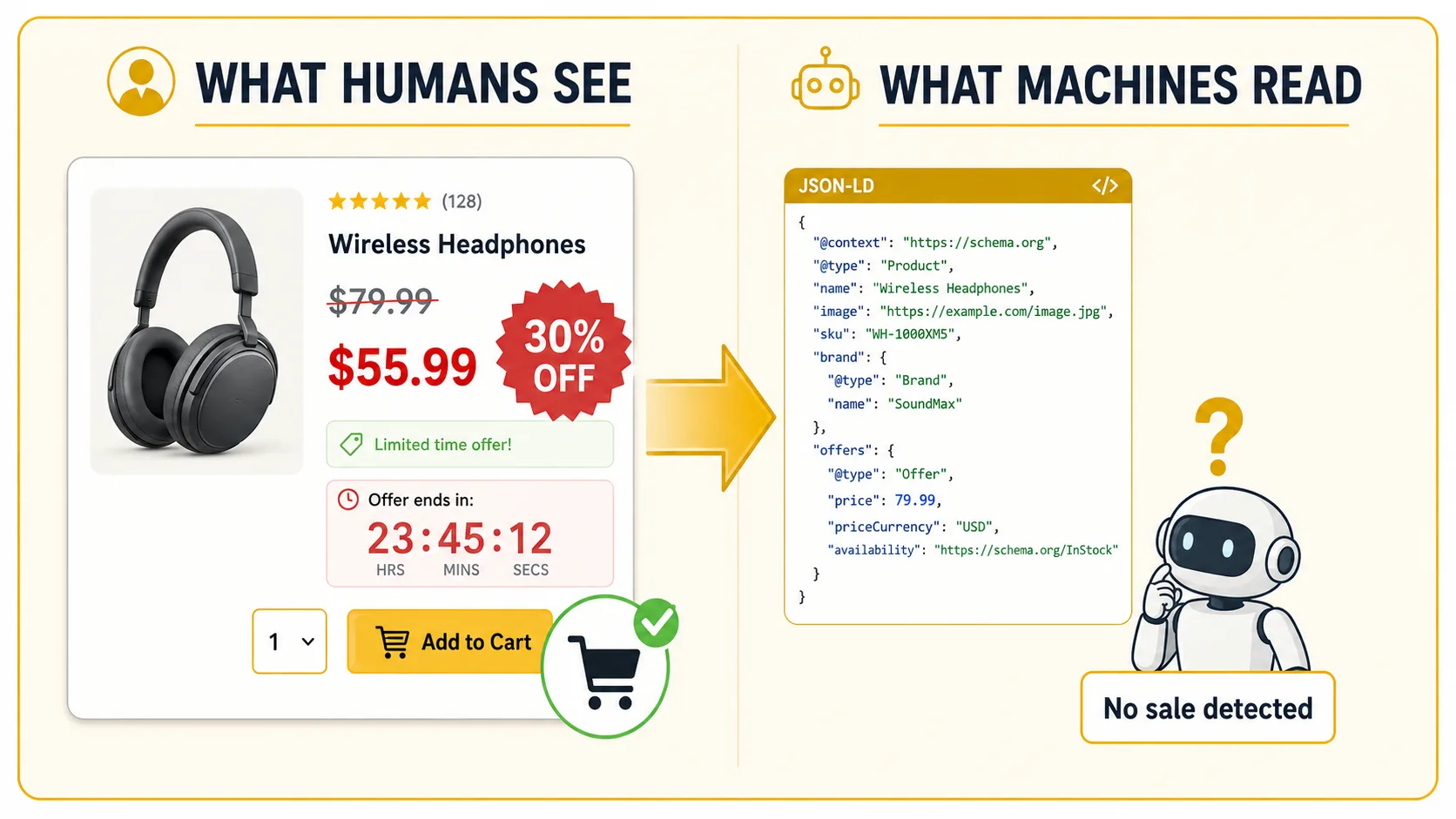
It is Tuesday. The brand dropped a 30% sitewide flash sale at midnight. Email went out. SMS landed. Instagram story is live. Human shoppers are converting at 2.3× normal rate. But Perplexity, ChatGPT, and Claude — asked “best deals on [category] under $50 this week” — are recommending competitors at full price. Not because the sale is not better. Because the structured data on the product page still shows "price": "79.99" with no priceSpecification, no priceValidUntil, and no indication that a sale exists at all. The humans can see the strikethrough. The machines see full price. Every hour the flash sale runs, AI-assisted shoppers route to competitors whose prices look unchanged. Because they are unchanged. This is not a marketing failure. It is a structured data gap that Shopify was never architected to close.
Shopify Schema Generates Price. It Never Learned to Generate Pricing.
Shopify’s auto-generated Product schema handles the checkout side: offers.price, availability, image. It has no awareness of promotional state. When a brand sets a compare-at price in the Shopify admin, the theme renders a strikethrough for humans. The structured data stays flat. No original price. No sale price. No discount percentage. No end date. The priceValidUntil field does not exist in Shopify’s default schema output. It was never added.
Tools like JSON-LD for SEO and Schema Markup Validator report “all checks passed” because they validate presence, not promotional accuracy. The schema is valid JSON-LD. The required fields are populated. The validator’s job is done. The problem is semantic: nobody audits whether the price in the schema matches the price a human sees on the page. A product listed at $55.99 with a schema that says $79.99 passes every automated test. The schema and the page disagree. The validator does not care.
The schema.org specification already defines the fields that would close this gap. PriceSpecification supports price, minPrice, maxPrice, validFrom, and validThrough. The priceValidUntil property on Offer tells machines exactly when a promotion ends. These fields exist in the standard. They are simply absent from Shopify’s default output. The gap is not that schema.org does not support promotional pricing. The gap is that Shopify’s auto-generated schema was designed for the checkout flow: verify availability, confirm price, complete transaction. It was never extended to the discovery flow where AI assistants compile search results and compare prices across stores. The schema that powers checkout is frozen at full price. The schema that powers AI discovery remains frozen with it.
This is the same structural pattern as AI assistants comparing products they cannot actually read. Different symptom. Same root cause: the structured data that Shopify auto-generates covers the fields needed for Google Shopping and Rich Results. It does not cover the fields AI assistants use for price discovery, promotional awareness, and deal comparison. The standard supports them. The auto-generated schema ignores them.
What Invisible Sale Prices Actually Cost
The obvious cost: $18,000 to $48,000 per year in missed sale-price-driven AI discovery for a $3 million DTC store. Sale events generate 3× to 5× search volume on AI shopping assistants. Shoppers running “best deals under $50” queries spike during promotional windows. If the structured data shows full price, the product is invisible during the highest-intent traffic moments the brand paid to create. The email drove traffic. The SMS list clicked. The Instagram story converted. The AI assistant never saw any of it.
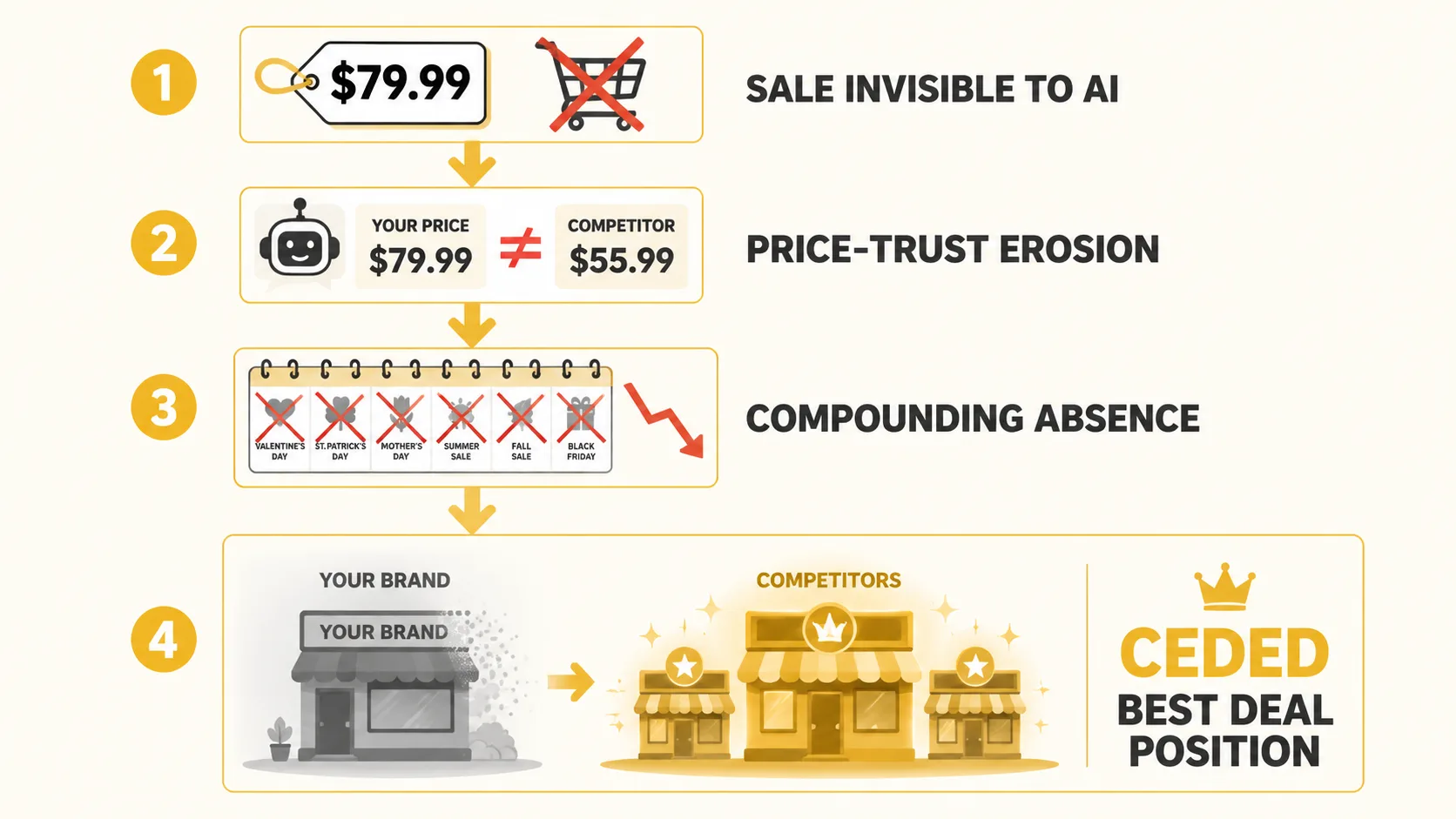
The hidden cost is price-trust erosion. An AI assistant recommending a product at $79.99 when the actual price on the site is $55.99 trains the assistant that the brand’s pricing is unreliable. The assistant does not know there is a sale. It sees a discrepancy between what it indexed and what the shopper would see. Over repeated exposure, the assistant learns to deprioritize the brand’s products in price-sensitive queries. The shopper who clicks through sees a different price than expected. Some bounce. Some trust the assistant’s number over the site. Neither outcome converts. The brand paid for the traffic and lost the conversion because the price the machine showed was $24 higher than the price the brand actually charges.
The compounding cost accelerates with the promotional calendar. DTC brands run 4 to 6 major promotional events per year plus monthly flash sales. Each event where sale prices are invisible to AI widens the AI recommendation gap. Meanwhile, a competitor whose structured data broadcasts “30% OFF, valid through Friday” captures the deal-seeking traffic. By Q3 2027, with AI shopping query volume growing at a compound rate of over 40% quarterly according to Capital One Shopping Research, a brand missing 6 consecutive promotional windows has effectively ceded the “best deal” position for its category. The cost is not one missed sale. It is the compounding absence from every price-sensitive AI query that follows. The brand runs sales. The machines never notice. Competitors get recommended. The cycle accelerates.
Why the Industry Accepts This
Schema audit tools check syntax. They do not check whether the price in the schema matches the price on the page. They do not flag that a brand is running a 30% off sale with no priceSpecification. They do not warn that the priceValidUntil field is absent. The tools are doing their job. The gap is that nobody audits promotional accuracy in structured data. The validator sees valid JSON-LD. The AI assistant sees a full-price product. Nobody bridges the two.
The Shopify app ecosystem for pricing is built entirely on the visual side. Discount apps. Sale badge apps. Dynamic pricing engines. Every app outputs to the visual side humans see. None of them touch the structured data side. A brand installs a countdown timer app that shows a ticking clock and a strike-through price. Humans see urgency. Machines see the same static "price": "79.99" that was there before the sale started. The countdown timer renders in the DOM. The JSON-LD is unchanged.
This is not a pricing problem. It is a schema problem. Schema problems live at the boundary between what a system auto-generates and what machines actually consume. The tool that would close this gap — a structured data audit that compares page price to schema price, flags missing priceSpecification, and validates promotional state — does not exist in the Shopify app store. Not because it is technically difficult. Because the market has not connected “I ran a sale” with “the AI shopping assistants could not see it.” The pain is invisible until someone goes looking for it.
As one DTC operator observed on X: “Most DTC brands find out their competitor cut prices three days too late.” If human operators cannot see competitor prices in real time, expecting AI assistants to detect a 30% flash sale from structured data that still says full price is not reasonable. The machines read what the schema provides. The schema provides the base price. The gap between “price” and “pricing” is the gap the industry has not yet named.
What Changes When Sale Prices Become Machine-Readable
Auditing structured pricing data on the top 40 revenue SKUs takes under two weeks. The fix is surgical. Add priceSpecification with was and now values. Populate priceValidUntil from the promotion end date. Add priceCurrency for international price anchoring. No CMS migration. No replatforming. No design changes. The same product pages. The same theme. The same discount engine. One additional layer of machine-readable truth that stays in sync with promotional state.
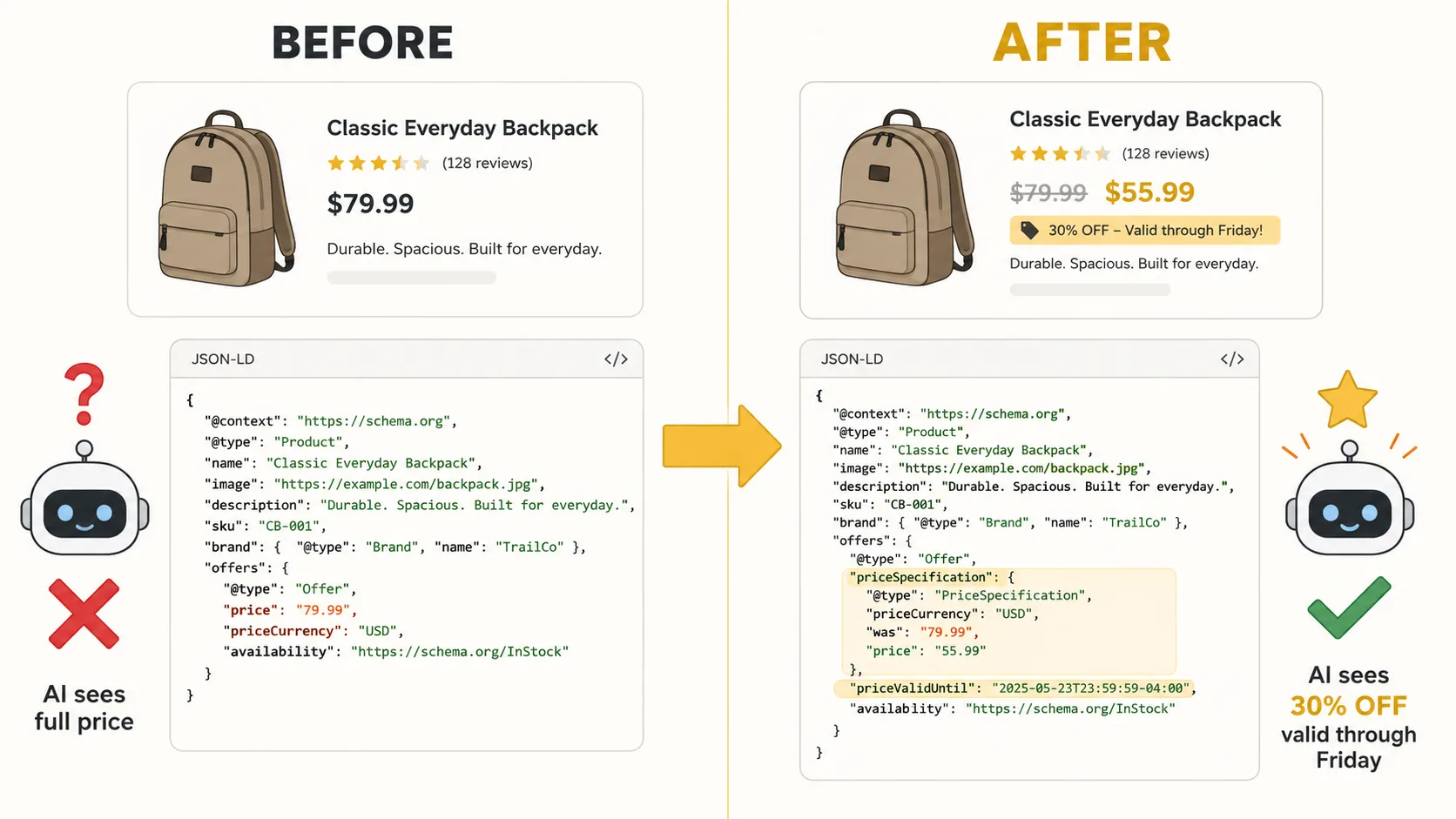
Within 90 days: 8% to 15% AI-assisted revenue lift during promotional windows. Not because the brand ran better sales. Not because the discount was deeper. Because the machines could finally see the sale that was already running. Products that were invisible to AI deal queries start appearing in results. Price-accurate AI recommendations replace the $79.99 dead weight that had been holding the brand back in every price-sensitive search.
The outcome is not “better structured data.” It is a structural moat. And a moat is defended, not dug once. AI assistants default to Amazon and the big brands, so the sale-price signal must stay accurate every promotional window or the slot quietly passes to a competitor. Every sale the brand runs becomes machine-discoverable. Every promotional window widens the gap between brands whose structured data broadcasts sale pricing and brands whose schema still shows full price. The moat compounds. The structured data audit that catches the gap once catches it permanently. By the time competitors connect “I ran a sale” with “the machines could not see it,” the brand that fixed it first owns the “best deal” position for every promotional event that followed.
The same data. The same store. The same discount engine. One schema element added. And it all sits on top of existing Shopify infrastructure. No rip-and-replace. The checkout schema stays exactly as it is. The discovery schema gets the pricing intelligence it was always missing.
What to ask next
Common questions operators ask after reading this:
How do I check if my Shopify store's sale prices are visible to AI shopping assistants?
What structured data fields do AI shopping assistants use to compare prices?
Which Shopify apps fix pricing schema for AI discoverability?
How much revenue do DTC brands lose from invisible sale pricing?
Related read: The same structured data gap causes AI assistants to recommend products based on categories they cannot actually parse. When product specs are embedded in unstructured HTML instead of machine-readable schema, AI shoppers guess — and guess wrong.
Related read: The same schema depth problem affects product variants. AI shoppers find products but recommend competitors when variant-level data (size, color, width, price per option) is not machine-readable. The product was found. The variant was not. The sale closed elsewhere.
Related read: Shipping promises fail the same way sale prices do. DTC brands lose $24K to $56K a year when AI shoppers cannot see free shipping offers in structured data. The threshold is configured. The machine never reads it.
Get a Diagnostic on Sale Price Visibility
An audit of the top 40 revenue SKUs finds every product where the structured data price does not match the page price during an active promotion. It identifies missing priceSpecification fields. It flags absent priceValidUntil dates. The output is a list of exact fixes. No app to install. No theme to modify. Just the structured data audit that shows whether sale prices are visible to AI shopping assistants — or invisible to the fastest-growing traffic channel in e-commerce.
How TheiaOps builds AI discoverability audits for DTC brands →