AI shopping assistants cannot see free shipping offers because shipping details never make it into product structured data. Shopify’s auto-generated schema stops at price and availability, so the free shipping threshold configured in Settings never reaches the machine that recommends products.
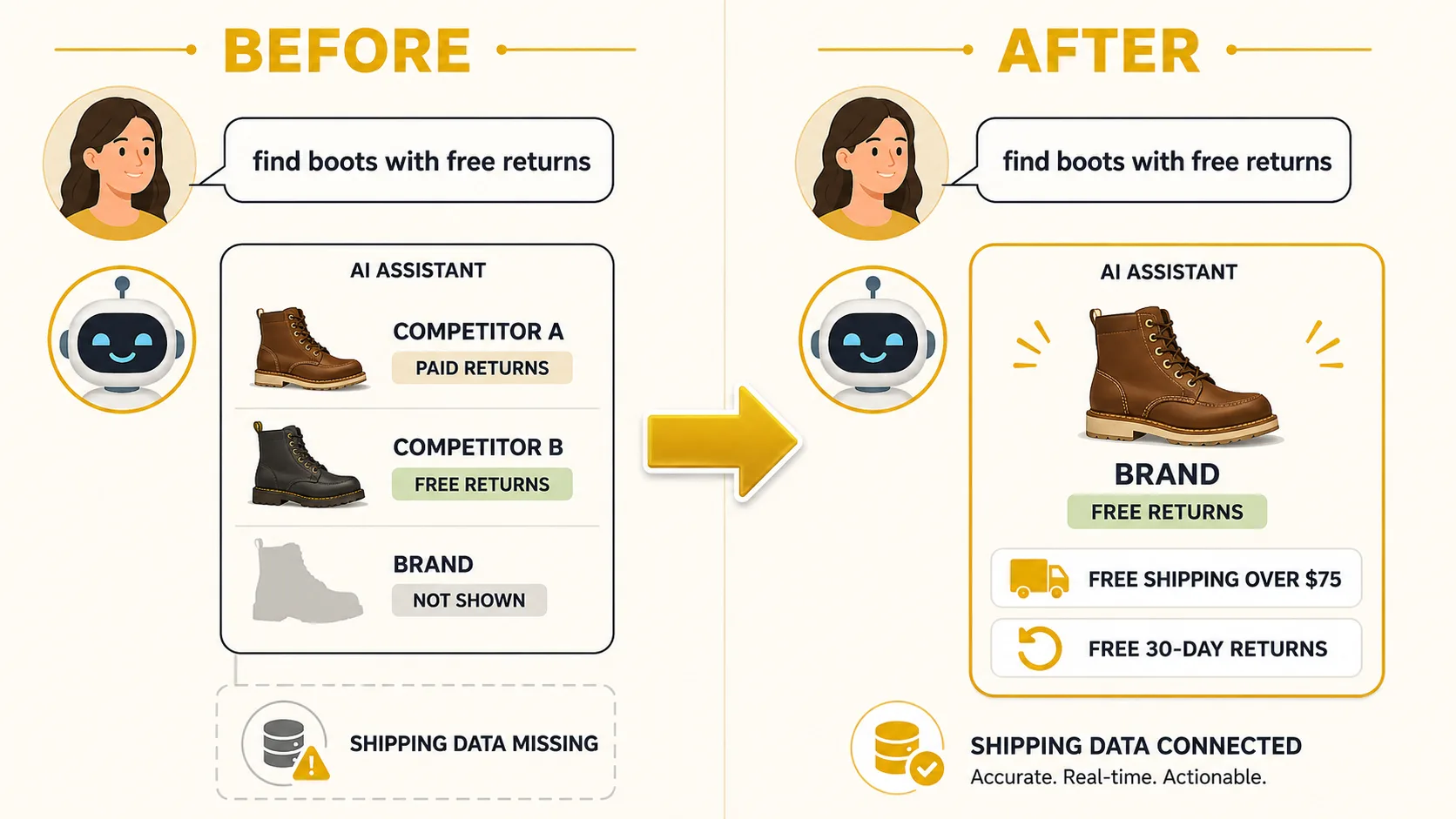
A DTC brand spends $18K a year on free-return shipping as a conversion strategy. The PDP banner says “Free Returns, No Questions Asked.” The checkout abandonment email cites it. A/B tests prove it lifts conversion 11%. Then a shopper asks Perplexity to find hiking boots with free returns. The brand does not appear. The competitor with paid returns does, because its structured data is clean. Free returns do not count when the machine cannot read them.
Why Shopify’s Schema Ships Empty
Shopify auto-generates Offer schema for every product: price, priceCurrency, availability. But shippingDetails is not auto-generated. Neither is hasMerchantReturnPolicy. Both fields exist in schema.org’s shipping specification and the return policy specification. Google’s Rich Results Test validates them. But no Shopify theme, app, or native feature populates them from the shipping settings already configured.
The structural gap:
Shipping zones, rates, and thresholds are configured in Shopify Settings → Shipping and Delivery. That configuration drives the cart and checkout calculation at transaction time. It never touches the product page’s structured data. AI shopping assistants scrape product pages. They never reach the cart. The data that decides the deal is the one piece of the page the machine cannot see.
What existing tools do instead:
SEO apps flag missing schema but do not populate shipping data. Shipping apps manage fulfillment, not discovery. Google Merchant Center captures shipping in the feed, but that serves Google Shopping ads, not AI assistants scraping product pages. Shopify Markets handles international pricing, not structured shipping metadata.
What Invisible Shipping Data Costs
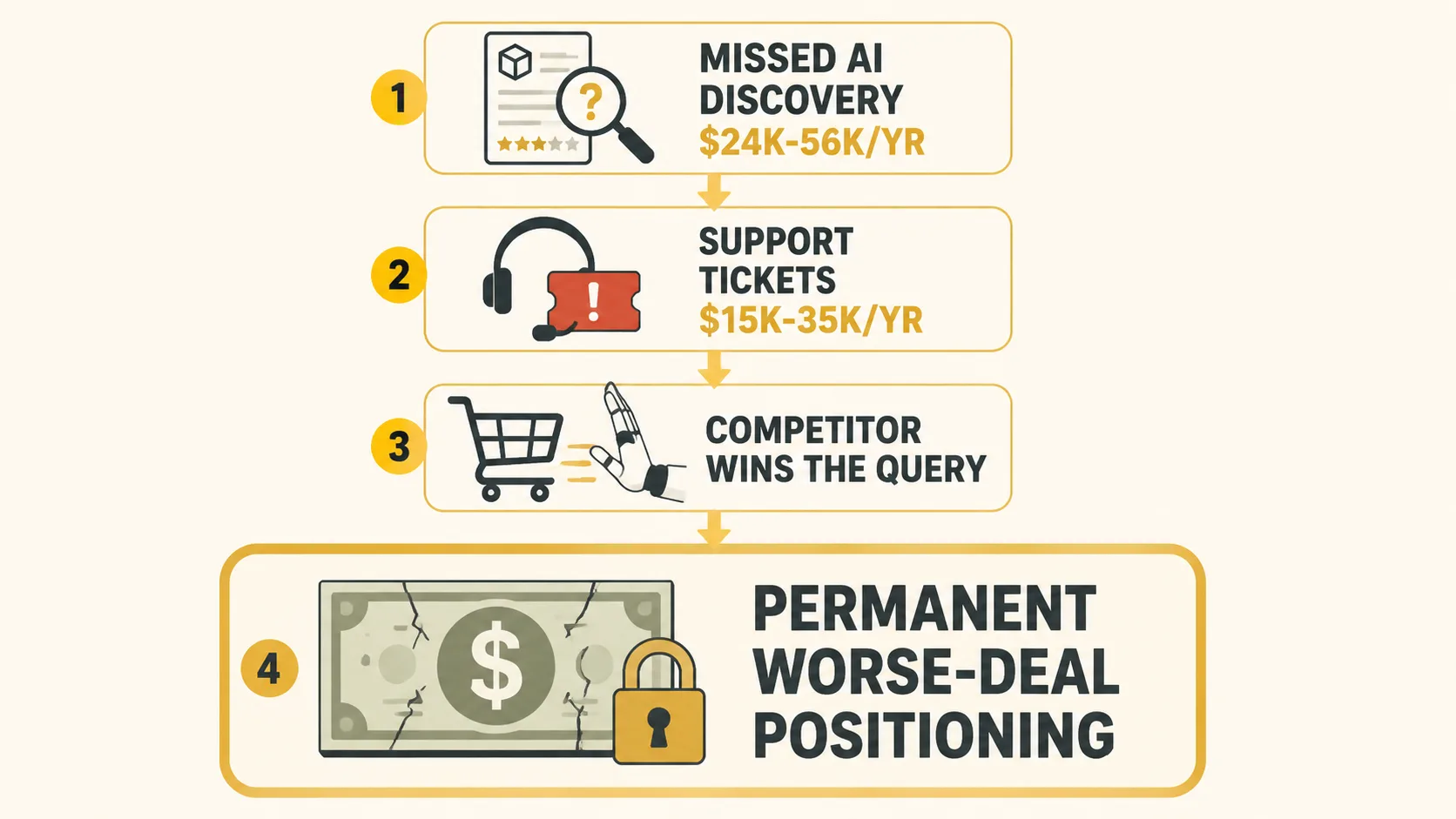
The obvious cost: $24K–$56K a year in missed AI-assisted discovery. A $3M DTC store with a free-shipping-over-$75 offer holds a structural conversion advantage over competitors who charge. AI shopping assistants do not factor it into recommendations. If 8–14% of organic discovery now routes through AI queries, and shipping ranks in the top three decision factors for 30–40% of comparison shoppers, that is a 2.5–5.6% revenue gap. $24K–$56K a year, driven entirely by data format, not merit. By comparison, 58% of shoppers now use generative AI instead of traditional search for recommendations, per Capital One Shopping Research.
The hidden cost: $15K–$35K a year in shipping-policy support tickets and content ROI waste. AI assistants that cannot parse shipping information generate wrong answers. “Shipping costs not listed” sends the shopper elsewhere. Support teams field 12–25 inquiries a month from AI-misdirected customers asking questions already answered on the site. The free-shipping threshold optimized with $4K in A/B testing? AI shoppers never learn it exists.
The compounding cost: permanent “worse deal” positioning as AI query volume grows. Every quarter more comparison shopping shifts to AI. A brand whose shipping advantage is invisible today becomes the “unknown shipping cost” option tomorrow. Within 18 months the gap widens from 2.5–5.6% to 8–14% of AI-assisted revenue. Competitors with machine-readable shipping data capture the default-answer position for the entire category. The AI shopping assistant market is projected to grow from $4.62B in 2025 to $41.88B by 2035, a 24.75% compound annual rate per SNS Insider. Switching the default answer later costs 3–5 times more than claiming it first.
Why the Industry Accepts This
Three reasons nobody has fixed it:
Schema validation tools check presence, not shipping depth. Google’s Rich Results Test marks product schema as valid without shippingDetails. The validation bar is transaction completeness: price, availability, image. Shipping is treated as nice to have, not structural. AI shopping assistants hold a different bar, and Shopify merchants on the official forum describe adding these fields as really difficult because the data is not available in Shopify.
The “cart will handle it” assumption. Shopify treats shipping as a cart and checkout concern, not a product-page concern. That made sense when humans browsed product pages and proceeded to cart to see shipping. AI assistants scrape product pages and never reach the cart. The architectural assumption held for 15 years. It breaks now.
The mid-market gap. Enterprise brands on headless and custom stacks have developers who hand-code shippingDetails into schema. The 50,000+ DTC brands on standard Shopify themes have no tool, no app, no native feature that populates it from their existing shipping configuration. The data already exists, trapped in a different part of the stack, the same gap pattern TheiaOps maps when validating markets before building. As one r/shopify technical breakdown put it, most Shopify and WooCommerce themes generate “simple” product schema and fail to inject the nested return policy object, leaving products essentially invisible to AI shopping agents.
What Changes When AI Can Read the Offer
Week 1–2: audit. Identify the top 40 revenue-driving SKUs. For each, map the existing shipping configuration (free shipping threshold, delivery timeframes, return policy URL, return window, return shipping cost) into shippingDetails and hasMerchantReturnPolicy fields. No new copy, no new photography, no new shipping logic. Existing data moved into machine-readable format.
Week 3: validate and deploy. Test with Google Rich Results and the schema.org validator. Deploy structured shipping data on the top 40 SKUs. AI assistants can now parse shipping cost, delivery estimate, free shipping threshold, return window, and return shipping cost. This is the same format gap that hides sale prices, covered in what DTC brands lose when AI shoppers cannot see sale prices; shipping is the second half of the same story.
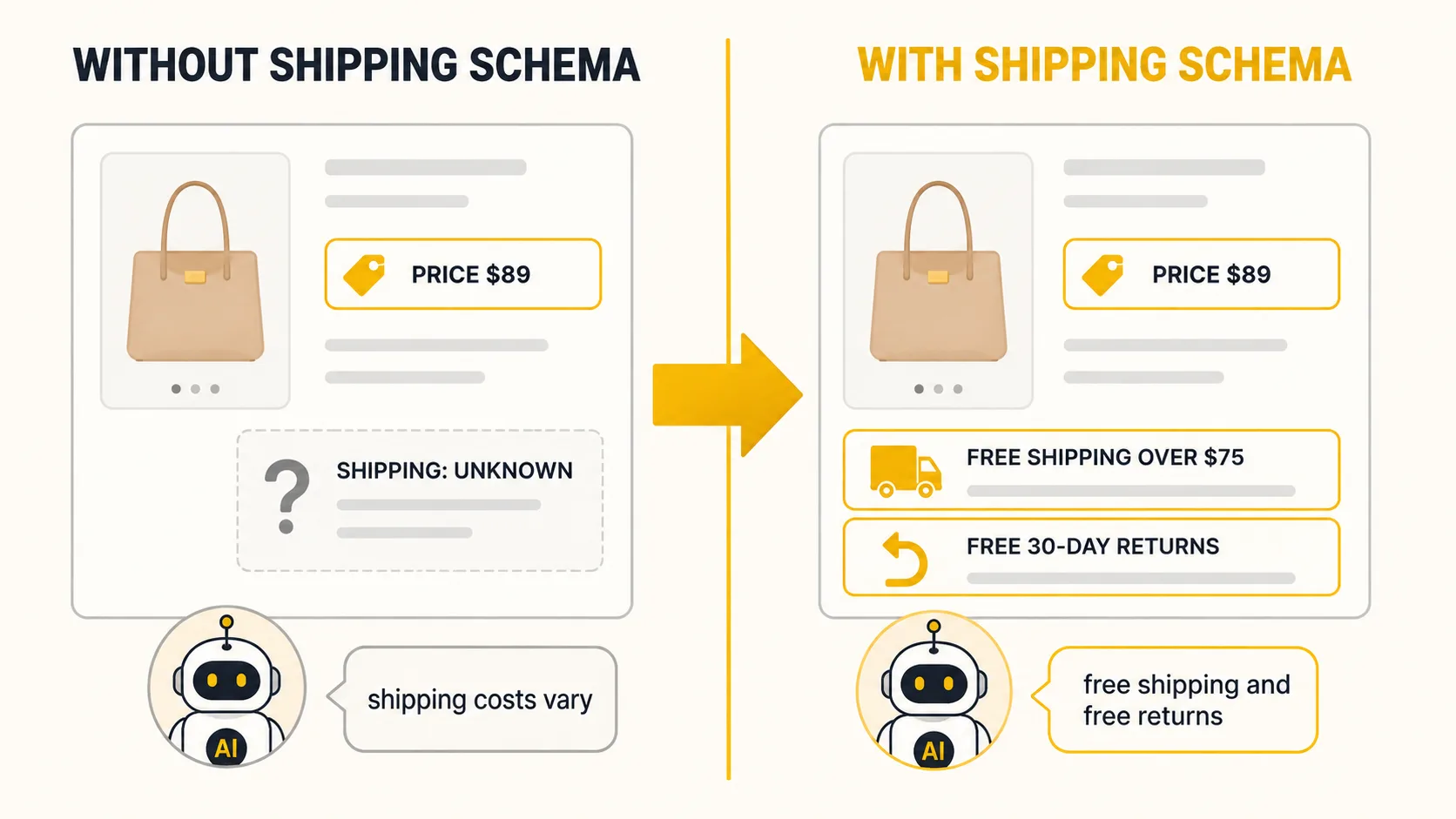
90-day outcome: 7–12% AI-assisted discovery lift on shipping-sensitive queries. AI assistants that previously returned “shipping costs vary” or omitted the brand now surface the offer. Support tickets from AI-misdirected customers drop 40–60%. The free-shipping threshold, already proven to convert at +11%, now works at the discovery stage, not just the conversion stage. When assistants can read structured answers, the brand becomes the default response, the same way AI shoppers get better answers about competitor products when the competitor’s data is complete. But the default response is held, not owned. Assistants default to Amazon and the big brands, so staying the default is a fight measured every week, never won once.
What to ask next
Common questions operators ask after reading this:
What structured data do AI shopping assistants read?
How do I add shipping details to Shopify product schema?
Does free shipping help with AI product recommendations?
What percentage of shoppers use AI to compare products?
Get a Shipping Schema Diagnostic
An audit of the top 40 revenue-driving SKUs surfaces exactly what AI shopping assistants see when they ask about shipping costs and return policy. The output is a side-by-side: the PDP vs what Perplexity, ChatGPT, and Claude actually parse. No new photography. No new copy. Just machine-readable shipping data from configuration already in place.