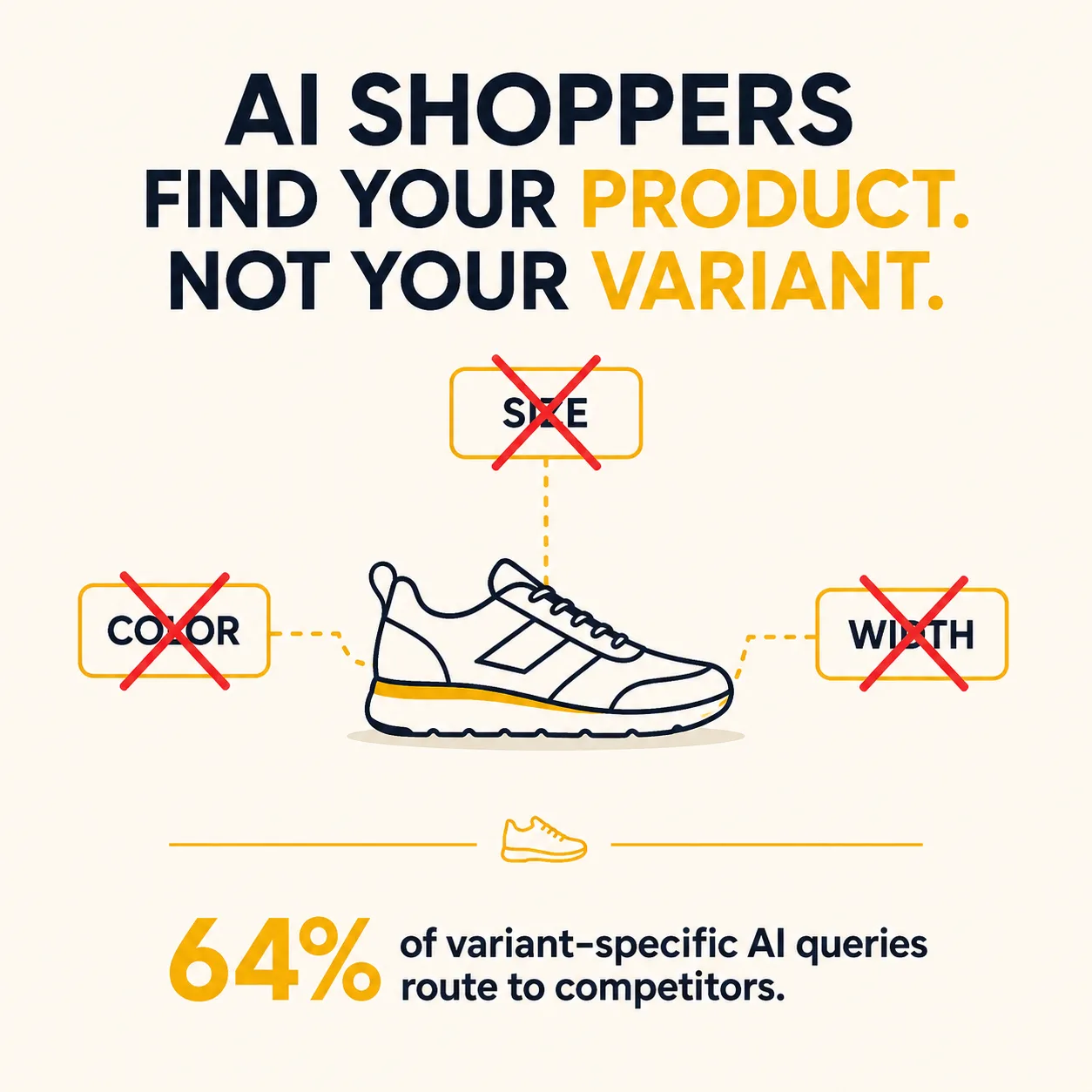
DTC brands lose the sale when AI shoppers pick the wrong variant because variant-level data, width availability, variant pricing, variant stock, does not exist in machine-readable form. The assistant found the product but not the wide boot, so the recommendation went to a competitor.
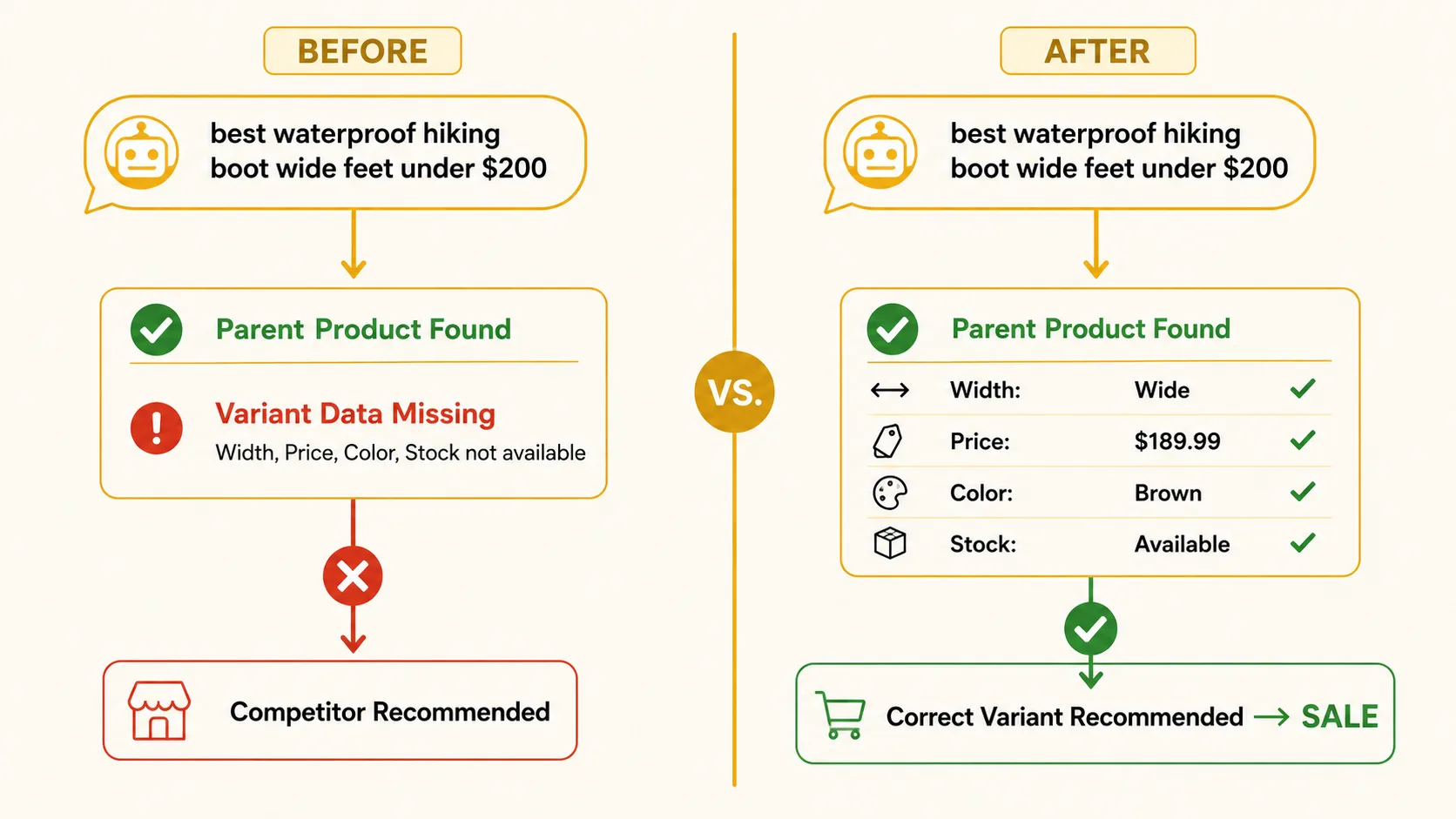
A shopper asks ChatGPT “best waterproof hiking boot for wide feet under $200.” The Merrell Moab 3 Waterproof is the right answer. It has a wide variant. It has 4.6 stars. It costs $189.99. The AI recommends a competitor’s boot instead. Not because the Merrell is worse. Not because the competitor is cheaper. Because the variant-level structured data — wide width availability, variant-specific pricing, variant-specific stock status — does not exist in machine-readable form. The AI found the product. It could not find the wide one. The sale that should have closed never started. The search terminated one level above the answer.
Shopify’s Variant Schema Exists. It Does Not Go Deep Enough.
Shopify’s auto-generated Product schema supports hasVariant with ProductVariant items. The field is there. The structure exists. But Shopify auto-generates variant entries only as far as the theme rendering needs them: variant name, SKU, and a link to the parent image. Variant-specific pricing when different from the parent. Variant-specific availability when size 10 is sold out but the product is not. Variant-specific images for color swatches. Variant-specific attributes for width, material, and fit. None of these survive into the structured data unless manually enriched. Shopify’s new structured_data Liquid filter opened the door. But the auto-generated output still stops at surface level.
Validators do not catch this. Google’s Product Variant structured data guidelines define ProductGroup with nested variesBy, hasVariant, and per-variant offers. The standard is comprehensive. But Shopify’s structured data validator checks presence, not depth. Google Merchant Center does not flag missing variant attributes. It only validates against the parent. Every validation pipeline a DTC brand runs returns green. The gap is invisible. And it stays invisible until someone audits variant-level schema completeness against what the schema.org Product specification actually supports.
The same structural pattern appears across AI commerce visibility. This is not a new problem. It is the same problem described in why AI shoppers cannot compare products accurately: the schema carries the parent attributes. It does not carry the variant-level operational reality. The gap is invisible to anyone who trusts the schema. It is invisible to the brand until someone measures it. And it is invisible to the AI assistant that has no mechanism to fill in what the schema never provided.
What Invisible Variants Actually Cost
The obvious cost: $22,000 to $48,000 per year in missed variant-specific AI-driven sales for a $3 million store. An AI shopping assistant that finds the parent product but cannot confirm the right variant exists routes the shopper to a competitor whose variant data is complete. Every long-tail query with a variant qualifier — size, color, width, material — is a sale that never materialized. The product was found. The variant was not. The competitor got the order. The brand never knew the query happened.
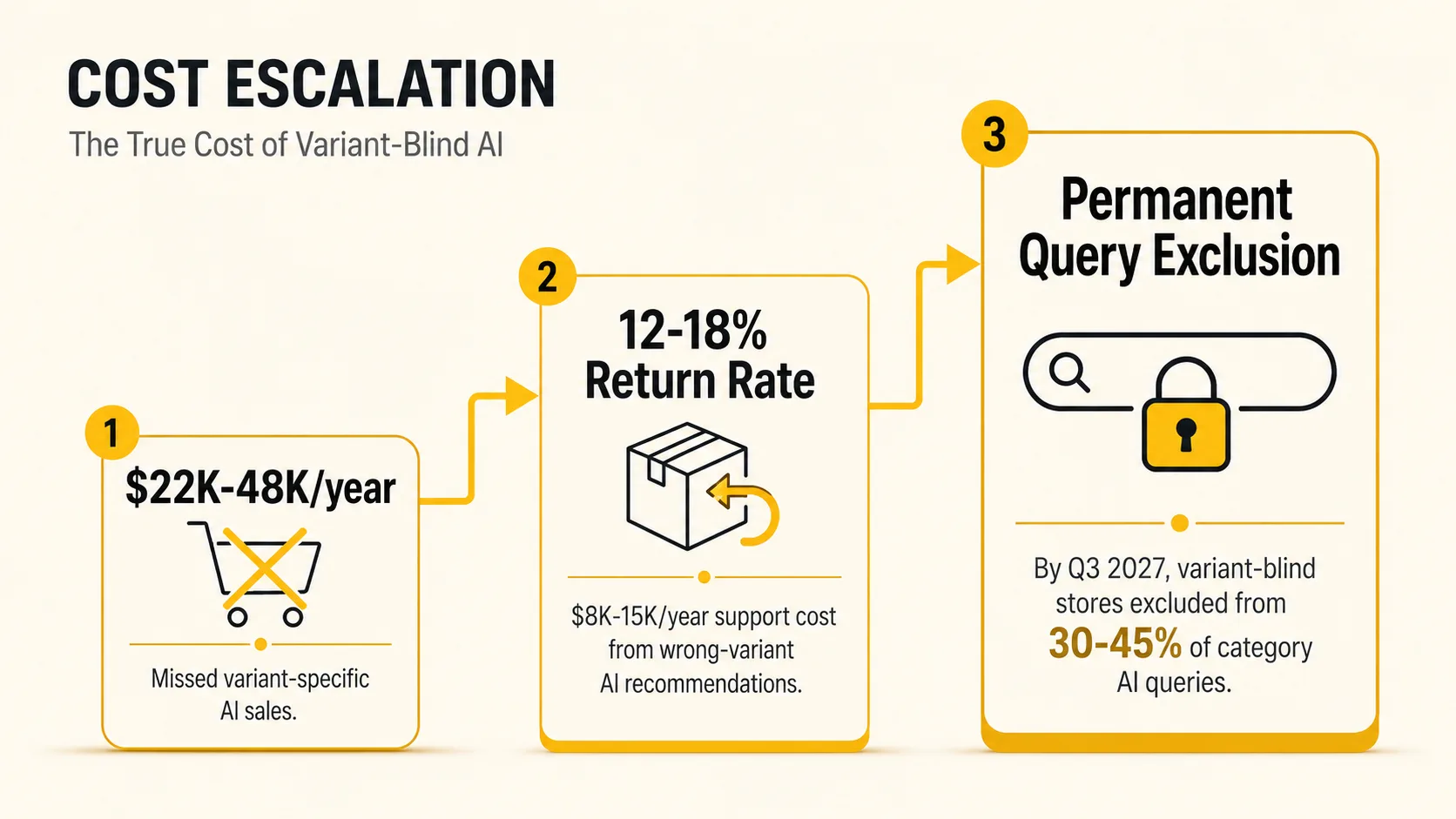
The hidden cost is return rate and support drain. When an AI assistant recommends the parent product but the shopper orders the default variant, the mismatch becomes a return. The shopper who asked for a medium and received a large blames the brand. Not the AI intermediary. Support teams field tickets with no understanding that an AI assistant routed the shopper incorrectly. The return costs $8,000 to $15,000 per year in processing, restocking, and customer service time. The brand absorbs the cost of a broken AI recommendation it never saw.
The compounding cost is permanent long-tail query exclusion within 18 months. AI query sophistication grows substantially quarter over quarter. The AI shopping assistant market is projected to reach nearly $42 billion within the decade. 58 percent of shoppers already use generative AI instead of traditional search for product recommendations. Today a shopper asks “best running shoe.” In 12 months the same shopper asks “best stability running shoe for overpronators with wide toe box under $150.” Every dimension of variant specificity is a filter. Stores without variant depth fail every filter. By Q3 2027, variant-blind stores are excluded from a significant share of category queries. The brand that does not close the variant-data gap today is invisible to AI shoppers for entire product lines in 18 months. Not because the products are bad. Because the variant data was never written.
Why the Industry Accepts Variant-Blind AI Visibility
No tool exists for the mid-market. Enterprise product information management systems handle variant attribute syndication at scale. Akeneo. Salsify. inRiver. They cost $40,000 to $80,000 per year and break even at 500 or more SKUs. Mid-market DTC brands with 50 to 400 SKUs fall through the gap: too large for manual variant enrichment, too small for enterprise PIM economics.
The Shopify app ecosystem for variants is built entirely on the visual side. Swatch apps. Variant picker apps. Size guide apps. Every app outputs to the theme rendering humans see. None of them touch the structured data side. A brand installs a color swatch app that shows red, blue, and black variants with variant-specific images. Humans see the swatches. Machines see the same flat hasVariant entry with no image references per variant, no color attribute values, and no variant-specific availability. The swatch renders in the DOM. The JSON-LD is unchanged.
The frustration is specific and documented. A Shopify operator asked on the Shopify community: “Although I have a common description for all variants for the same product, it looks like my Shopify theme is not picking up variant descriptions in the structured data.” The operator identified the gap. The thread had no solution. The community understands the problem exists. The tools do not yet solve it. The pain is visible in support forums but invisible on validation dashboards. Every structured data check returns green. Every sale that depended on a variant-specific query was lost silently. The brand accepts variant-blind AI visibility because nobody has shown them a diagnostic that measures it.
As @martincox100 noted on X during Shopify’s developer conference that the AI Product Discovery session at #dotdev was the catalyst for Product Pelican: finding gaps in data catalogs, structured metafields, and ensuring the data in description and title fields carry weight. The Shopify ecosystem knows variant data matters for AI discovery. The Shopify ecosystem knows variant data matters for AI discovery. The tools are being built. But the gap between “Shopify released the structured_data filter” and “every variant is machine-readable” is measured in years. And every year the gap stays open, variant-blind stores lose sales they never knew existed.
What Changes When Variants Become Machine-Readable
Auditing variant-level structured data completeness on the top 40 revenue-driving SKUs takes 10 to 14 days. The fix is structural, not content-heavy. Enrich existing ProductVariant entries with variant-specific offers including price and availability per variant. Add variant-specific image references for each color or style. Add variant-specific additionalProperty entries for width, material, and fit. No new photography. No new copy. No product changes. The same products. The same store. The same theme. One additional dimension of machine-readable truth per variant.
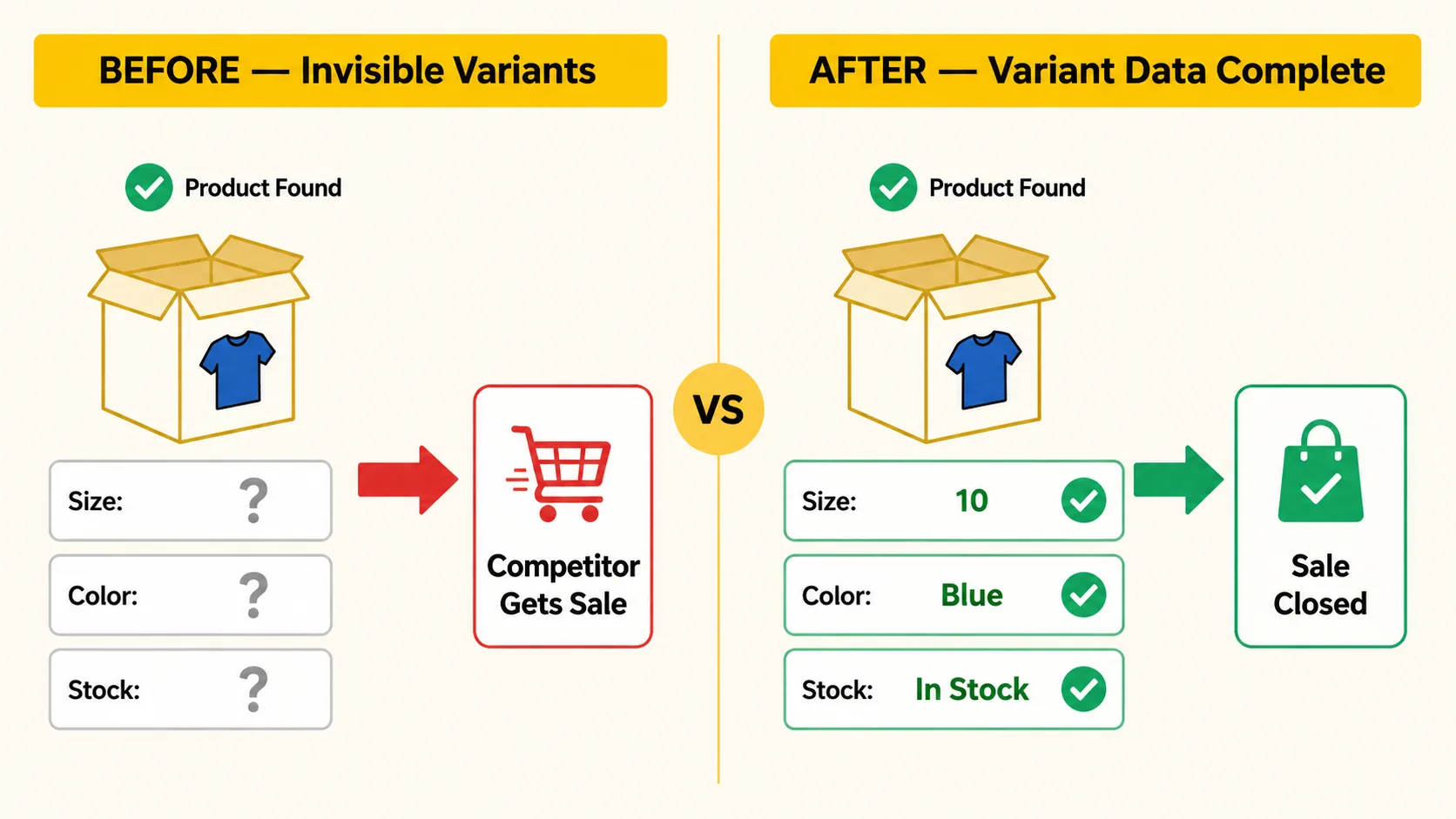
Within 90 days: variant-specific AI-assisted discovery lifts 8 to 14 percent. Variant-mismatch returns drop 55 to 70 percent. The brand becomes the default answer for qualified variant queries in its category. Not because the products improved. Not because the prices changed. Because the data that AI assistants needed to recommend the right variant was finally there. The same competitive moat logic that makes sale prices machine-readable applies to variants too. Every variant attribute that becomes discoverable widens the gap between brands whose structured data broadcasts variant depth and brands whose schema still stops at the parent product.
The outcome is not improved structured data. It is inventory that AI assistants can actually see. The same diagnostic approach described in how TheiaOps validates markets applies here: find the gap, measure the cost, fix the schema, own the category. And keep owning it. The product never changed. The AI assistant finally had the data it needed to make the right recommendation. But readable variants earn a seat, not a guarantee. AI assistants default to the big brands, so staying recommended is the ongoing fight.
What to ask next
Common questions operators ask after reading this:
Can AI shopping assistants see my product variants?
Why does my Shopify store pass schema validation but still miss AI discovery on variant queries?
How do I add variant-specific pricing to Shopify structured data?
What variant data do AI shopping assistants actually read when recommending products?
Related read: Images are not the only thing AI assistants miss during promotions. DTC brands lose $18K–$48K per year when AI shoppers cannot see sale prices in structured data. The discount is live. The schema still shows full price.
Related read: The same format gap decides which answers AI assistants read. FAQ content locked in accordions is invisible to AI shoppers; structured answers win the recommendation.
Get a Variant Data Diagnostic
An audit of the top 40 revenue SKUs surfaces every variant where width, size, color, material, price, or availability is invisible to AI shopping assistants. The output is a list of exact schema enrichments per variant. No app to install. No theme to modify. Just the diagnostic that shows which variants AI assistants can see and which ones they are routing to competitors.