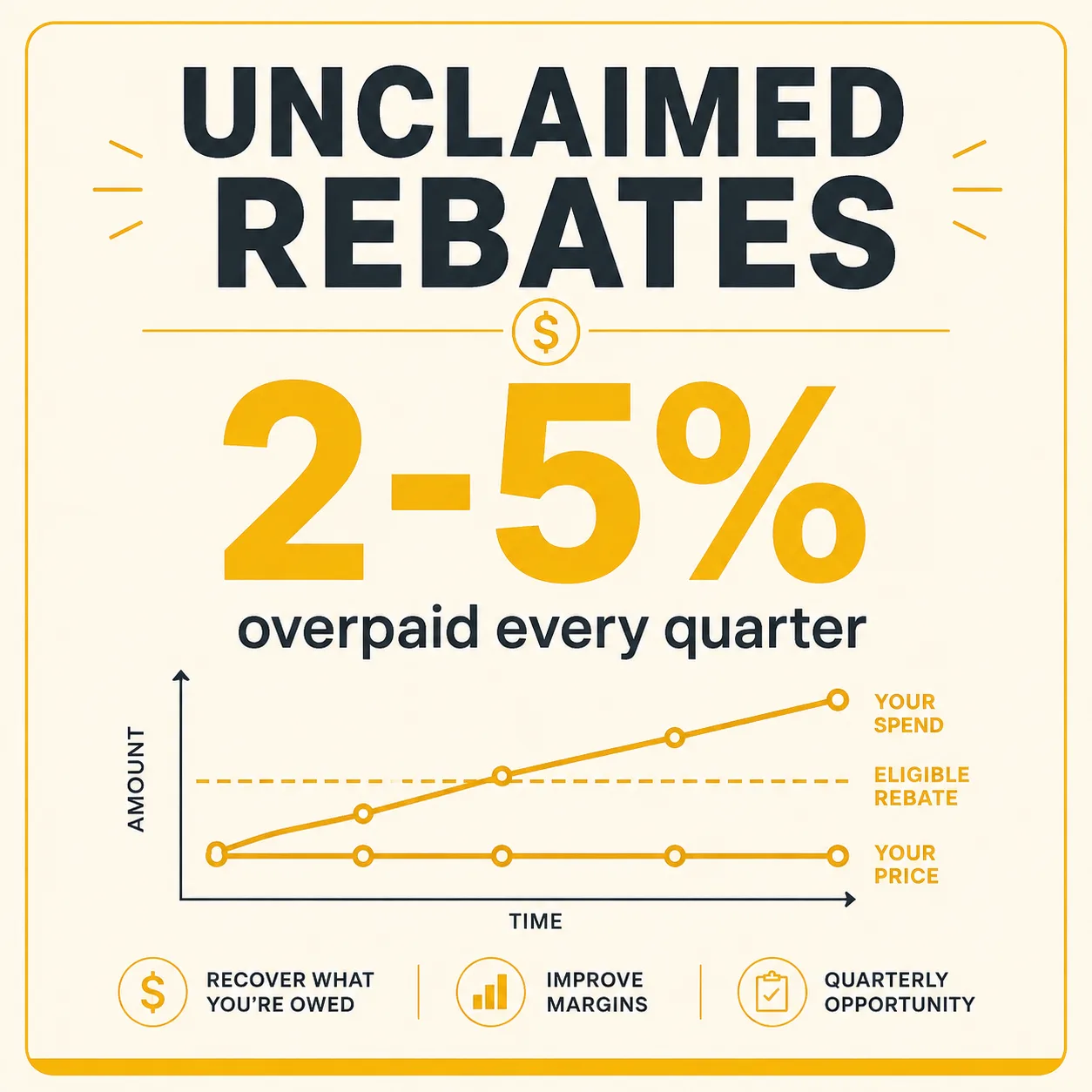
Distributors leave volume rebates unclaimed every quarter because the ERP records each purchase order as its own transaction and never tracks cumulative spend against the negotiated tier. Spend crosses a threshold and nothing in the system notices, so the distributor keeps paying the old price long after it qualified for a better one. The rebate is earned. It just never gets claimed.
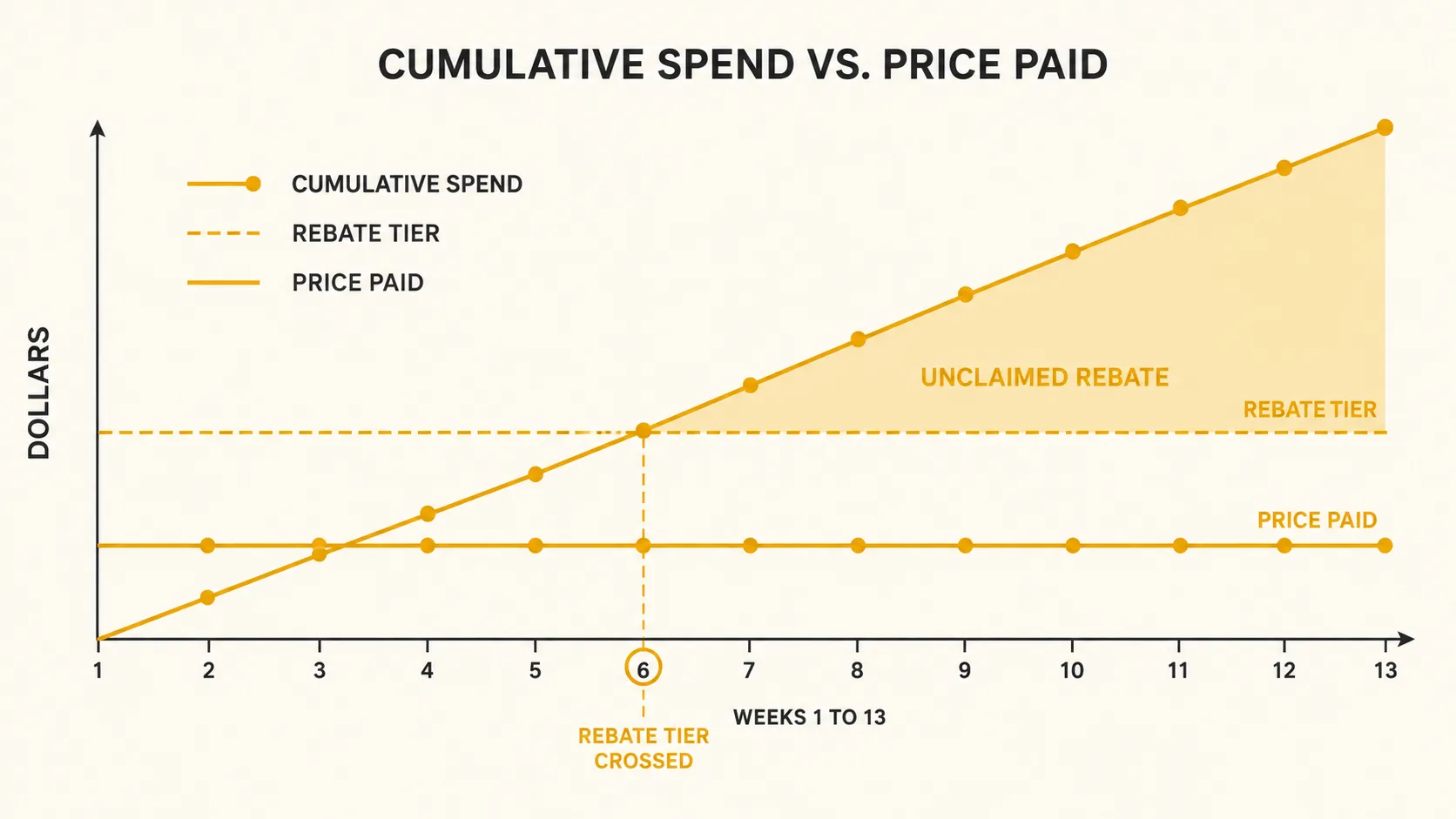
The quarterly reconciliation ritual: finance spends the first two weeks of every quarter pulling supplier statements, reconstructing cumulative spend from last quarter's PO history, and discovering, again, that the distributor crossed a volume threshold in week 6 but kept paying the lower-tier price for the remaining seven weeks. And a rebate they had earned sat unclaimed because no one saw the running total until it was too late to act.
What Are Volume Rebates and How Do Tier Thresholds Work?
A volume rebate is a retroactive payment a supplier owes once cumulative purchases cross an agreed threshold. A distributor might earn 1 percent on the first $100,000 of purchases, 2 percent on the next $100,000, and so on. Supplier rebates arrive weeks or months after the invoice is paid, not at the point of sale. They reward cumulative volume, which is precisely what a transaction ledger does not hold.
Tiered pricing works the other way: the discount percentage steps up at cumulative spend thresholds, so the price on the next order should fall once a tier is crossed. Both structures share one failure point. The trigger is cumulative spend over time, and cumulative spend is what a purchase-order ledger never sums.
Why Your ERP Can't Track Spend Against Supplier Tiers
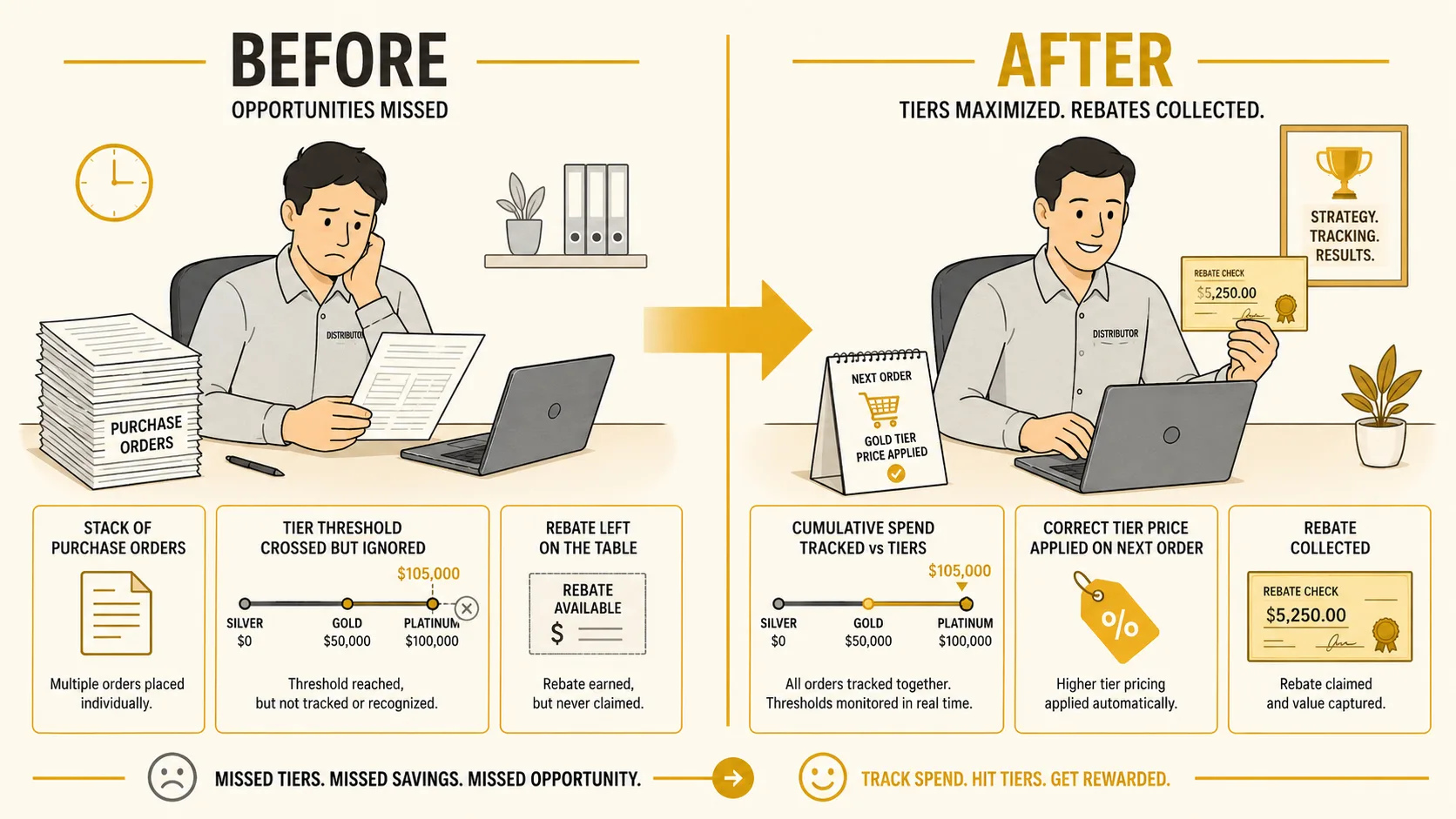
The ERP treats every purchase order as an independent transaction. It records the price on the PO, full stop. It has no concept of cumulative spend this quarter versus the negotiated tier. Contract terms live in a PDF. Price lists are static snapshots entered at vendor setup. When spend crosses a threshold, nothing in the system notices. The next PO still pulls the old price.
Rebate tracking is a finance-side spreadsheet reconciled at quarter close, two to four weeks after buying decisions are locked. Bizowie documents a distributor that bought $3.2 million from a supplier offering a 4 percent rebate above $3 million, qualified for a $128,000 rebate, and never filed the claim because no one tracked purchases against the threshold. This is a structural limitation of transaction-ledger architecture, not buyer negligence.
Enterprise procurement suites such as Coupa, Jaggaer, and Ariba carry contract and tier management, but they break even at 50-plus suppliers and $100 million-plus in spend. That is structural overkill for the mid-market. The fallback is more finance headcount or a better spreadsheet. And suppliers have zero incentive to surface a missed tier. An unclaimed rebate is margin the supplier keeps.
What Unclaimed Rebates Actually Cost a Distributor
The obvious cost: 2 to 5 percent overpayment on contract-covered SKUs. A $15 million distributor with $8 million in contracted spend pays $160,000 to $400,000 a year above the negotiated rate. Add 1 to 3 percent in earned-but-unclaimed volume rebates, another $80,000 to $240,000 a year.
The hidden cost: 10 to 20 hours a quarter of finance time. Reconstructing spend, reconciling rebates, buyers re-checking prices by hand, and quotes priced from an inflated cost basis that lose competitive bids. Sikich found 57 percent of distributors in buying groups admit they do not know how much they are getting from individual manufacturers, and most still manage rebates manually with real financial risk from miscalculation.
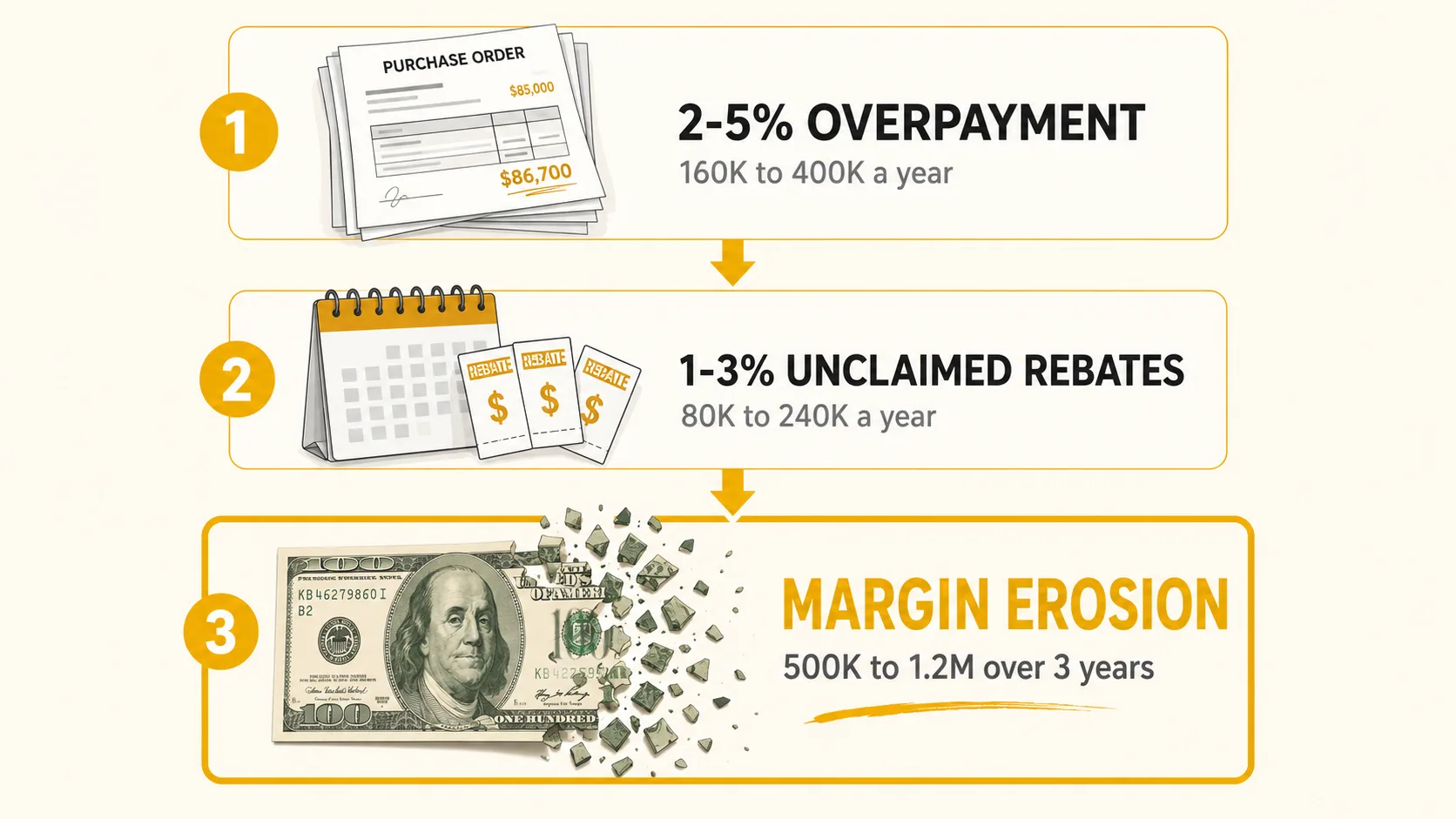
The compounding cost: $500,000 to $1.2 million in margin erosion over three years. Every quarter of overpayment bleeds into the cost base that sets all downstream pricing. GPO and managed-account quotes become less competitive. Contract renewals are negotiated from stale data, locking in the wrong tier for another full year.
How to Recapture Overpayment Before the Quarter Closes
Cumulative spend-to-tier visibility sits on the existing ERP. It does not replace the procurement suite. It tracks actual PO spend against negotiated tiers in real time, flags when a distributor is $14,000 from the next tier while there is still time to steer a PO, and shows the exact price that should apply on the next order.
Within 30 days, the top 10 suppliers driving 80 percent of overpayment are identified and corrected. Within 90 days, $60,000 to $140,000 in overpayment and unclaimed rebates is recaptured. The supplier conversation changes too. One buyer puts it plainly: ask for a rebate, not a discount. The distributor that opens the conversation with a running total sets the number.
This is the same transaction-ledger blindness that makes an ERP assume suppliers deliver on time, and the same post-hoc reconciliation that keeps returns in quarantine while the ERP buys replacements. The purchase data exists in every system. It has never been summed against the contract.
The multi-property intelligence approach that surfaces tier gaps inside a distributor is the same way TheiaOps validates markets: read everything, normalize it, surface what the architecture hides. The rebate leak is not a missing feature. It is a missing view.
What to ask next
Common questions operators ask after reading this:
How do volume rebates work in supplier contracts?
How to track supplier volume rebates in an ERP
What is tiered pricing in distribution?
How much do distributors overpay on supplier contracts?
Get a Rebate Diagnostic
A diagnostic reconstructs the last 90 days of purchase orders against the negotiated tiers and maps exactly where overpayment and unclaimed rebates live: which suppliers, which thresholds, and how much is recoverable before the quarter closes. The ERP stays. The overpayment stops.