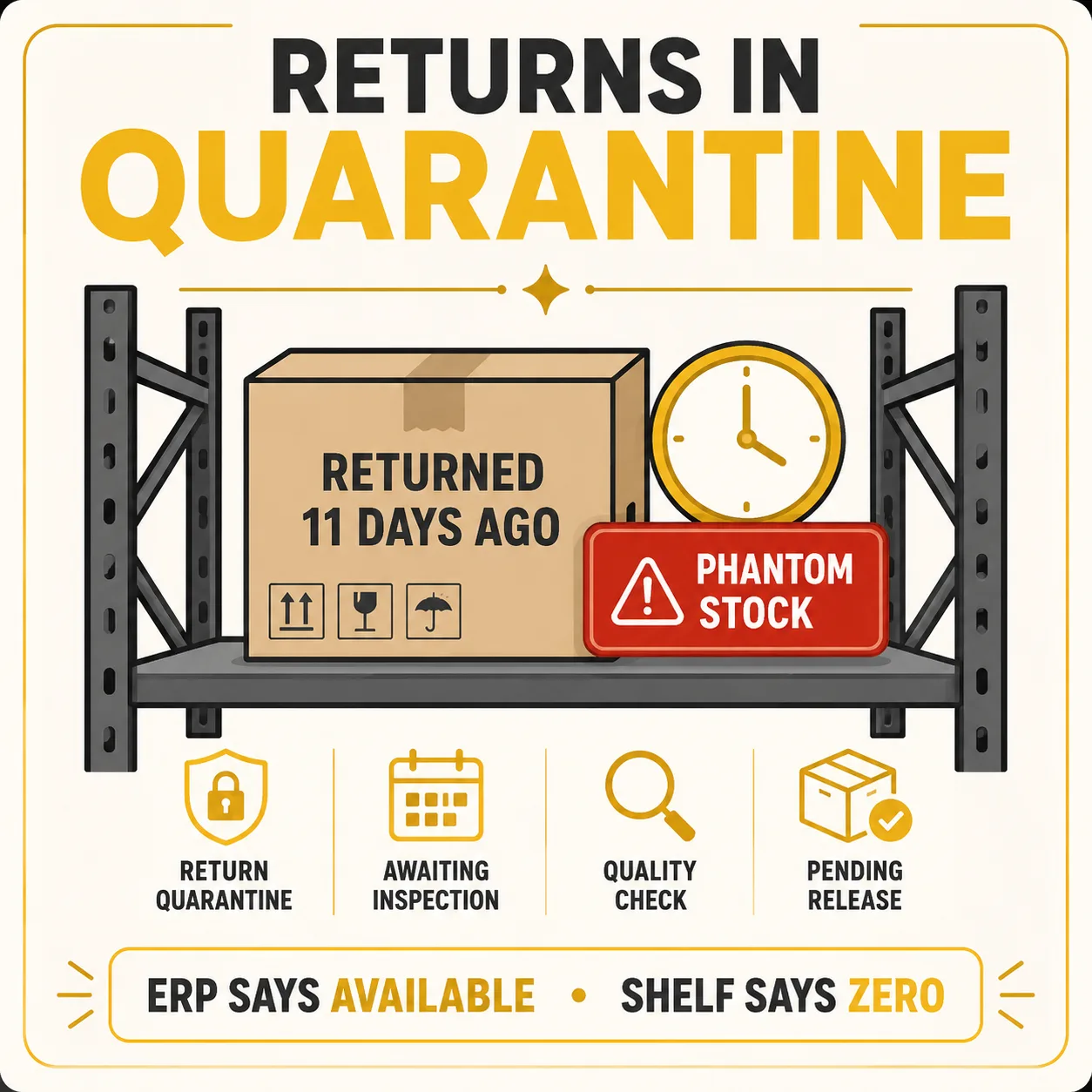
Returns sit in quarantine while the ERP buys replacements because ERP returns modules close the financial reversal the moment the credit memo posts, marking the goods available before inspection ever happens. Inspection takes 3 to 14 days. For the entire window, reorder reports count returned stock as sellable, so the buyer reorders product that already sits in the warehouse.
Monday morning reorder review at a $12 million medical supply distributor. The buyer sees 42 units of a high-movement surgical supply SKU in the ERP, enough to cover the next two weeks, and skips the reorder. Tuesday afternoon the sales desk sells 30 of those 42. Wednesday morning the warehouse confirms the truth: those 42 units have been sitting in quarantine for 11 days. Returned by a hospital, not yet inspected, not restocked. The ERP says available. The shelf says zero. Wednesday afternoon an expedited freight order goes out at 3 times landed cost. This happens 3 to 6 times a month, and nobody connects the dots because the financial transaction closed weeks ago.
Why ERP Returns Modules Create Phantom Availability
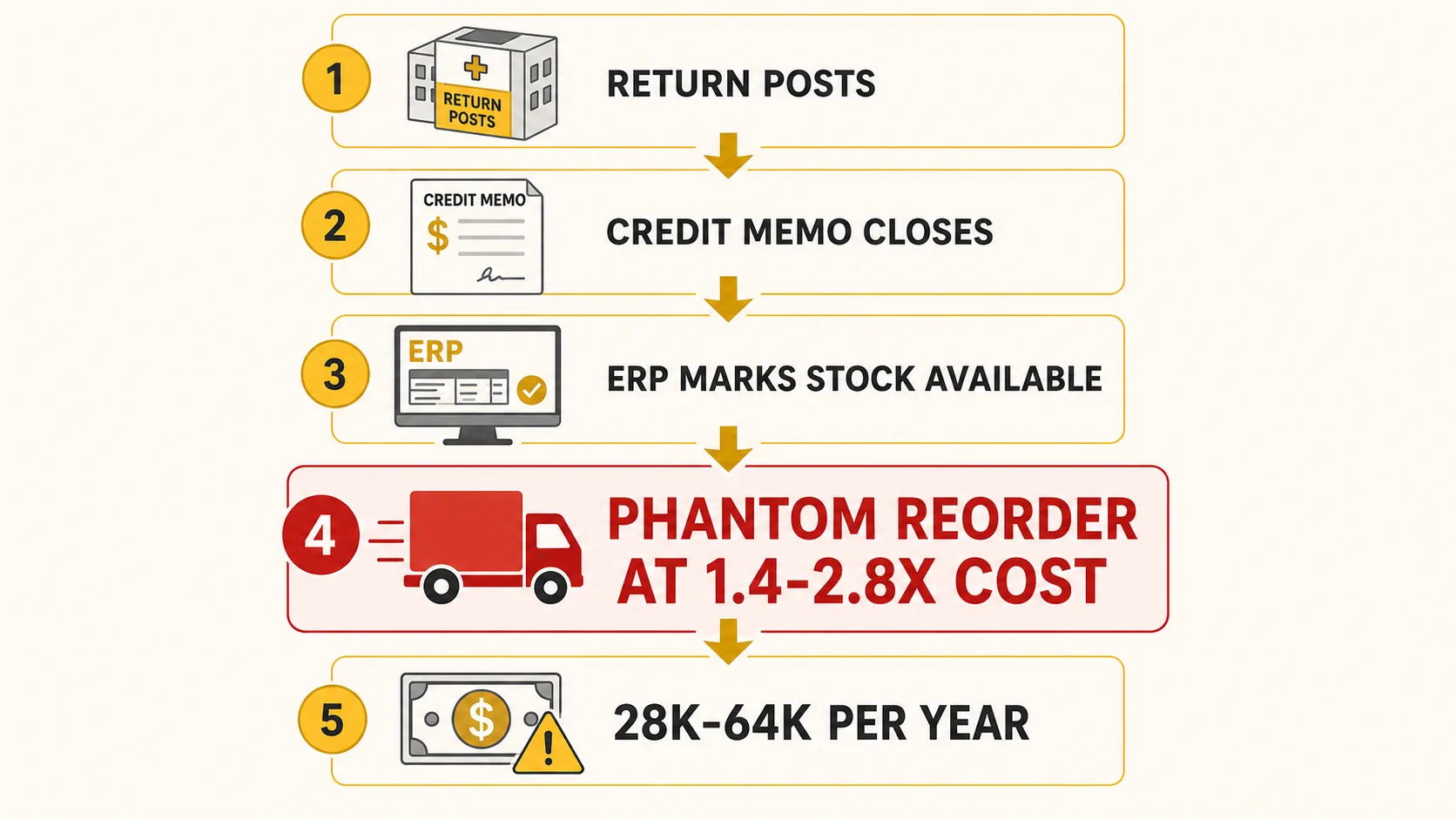
ERP returns modules are financial ledgers, not physical workflows. Credit the customer, debit inventory, one journal entry, instant reconciliation. The physical world does not reconcile instantly. A return needs inspection for sterilization integrity, expiry validation, and packaging condition. It needs a restock classification: resellable, discount, or dispose. It needs putaway. The ERP has no quarantine state. Inventory is either available or it is not. The moment the credit memo posts, the ERP marks the goods available.
The structural gap is architecture, not configuration. ERP WMS modules add quarantine workflows, but implementations run $50,000 to $150,000, unjustifiable for a returns process that mid-market distributors handle manually 15 to 30 times a week. The financial transaction reconciles in seconds. The physical process takes days. The ERP cannot represent that difference, so it pretends the difference does not exist.
The returns software industry documents the same failure mode. Returns are one of the fastest ways to create phantom inventory, because a returned unit lives in limbo until someone inspects, grades, and restocks it. In medical supply the stakes are higher. A returned surgical device cannot re-enter stock until sterility and expiry checks pass, so the limbo is longer and the phantom window wider. As @Xorosoft observed, returns do not just cut revenue. They distort demand signals, reorder points, and inventory forecasts. That distortion lands directly in the reorder report: stock that cannot be sold still drives the reorder calculation.
What Quarantine Blind Spots Actually Cost
The obvious cost: $28,000 to $64,000 per year in unnecessary re-purchases. Fifteen to thirty returns per week. Four to eight percent of them trigger phantom reorders because the ERP shows availability from unprocessed returns. Each reorder ships at 1.4 to 2.8 times standard landed cost. For a $5 million to $20 million medical distributor, that is the expedited freight bill paid to replace stock that never left the building.
The hidden cost: $14,000 to $28,000 per year in reconciliation time, plus 2 to 4 avoidable stockouts per quarter. Buyers and the sales desk chase phantom-availability discrepancies while the warehouse chases inspection backlog. Each avoidable stockout carries $4,200 to $12,000 in emergency fulfillment cost and account damage. The hospital that backordered twice starts calling the competitor.
The compounding cost: GPO audit exposure and customer churn. A 3 to 5 percent phantom availability rate per quarter triggers inventory accuracy audits. One failed audit puts $400,000 to $1.2 million in GPO contract revenue at risk over three years. On top sits 2 to 5 percent annual customer churn from fulfillment reliability degradation. Medical supply distributors live on availability promises. Hospitals do not care why a distributor is out of stock. They care that it is.
The industry scale is not small. Pharmaceutical Commerce reports $2.5 to $4.0 billion worth of prescription products are returned in the US for manufacturer credit each year. Every one of those returns passes through a quarantine state that most ERPs cannot represent.
Why the Industry Accepts the Gap
ERP vendors solved the financial side perfectly. Credit memo posts, inventory adjusts, reconciliation closes. WMS vendors solved the physical side at enterprise scale: barcode-driven quarantine zones, inspection workflows, automated restock triggers. The mid-market gap exists because returns volume of 15 to 30 per week does not clear the ROI threshold for a WMS implementation, while the cumulative error rate of 40 to 80 phantom availability incidents per year causes real financial damage spread across purchasing, sales, and compliance.
The manual workaround, a shared spreadsheet tracking quarantine, is brittle. It falls out of sync within two weeks. Nobody maintains it during month-end close when the buyer is buried in PO reconciliation. The industry accepts the gap because the pain is distributed across departments. Purchasing pays the expedited freight. Sales absorbs the stockout complaint. Compliance carries the audit risk. No single department owns the full P&L hit, so no single department builds the case for a fix.
What Changes With Returns-to-Availability Visibility
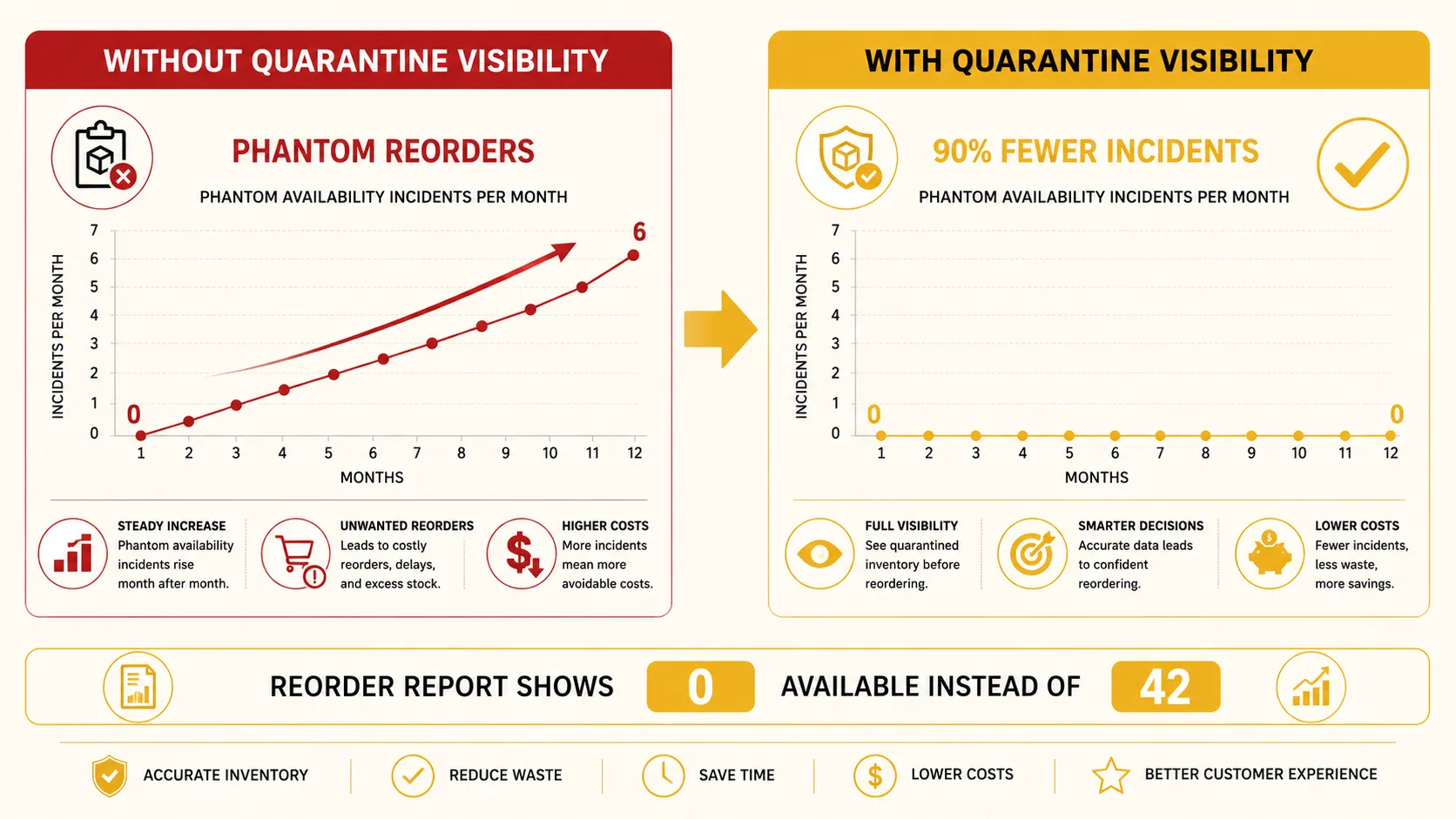
A returns-to-availability pipeline bridges the ERP financial transaction and the physical inspection workflow. Not a WMS. A lightweight quarantine-visibility bridge on the existing ERP. When a return posts, inventory moves to a pending inspection state visible in reorder reports. Inspection status, pending, resellable, restocked, updates in real time and flows back into availability calculations.
Within 14 days, 90 percent or more of phantom availability incidents are eliminated. The Monday morning reorder report shows zero available instead of 42, and the buyer makes the right call. Within 90 days, $22,000 to $48,000 is recovered in avoided expedited re-purchases, reconciliation time drops 70 percent, and the distributor is audit-ready on return-to-stock traceability. No WMS implementation. No ERP replacement. No new hardware.
This is the same pattern covered in the ERP accuracy drift analysis: the ERP records transactions, not physical reality. The quarantine gap is one specific failure of that architecture, and it is the easiest to fix because the return already exists as a transaction. The visibility bridge simply refuses to call returned stock sellable until inspection says so. It is the same inventory distortion detection the TheiaOps market-validation approach applies to every mid-market operation: find the blind spot the software architecture created, then close it with the data that already exists.
What to ask next
Common questions operators ask after reading this:
How long do medical supply returns sit in quarantine before restocking?
Why does the ERP show returned inventory as available when it is still in quarantine?
What does reverse logistics cost mid-market medical distributors?
How do distributors track return-to-stock time in an existing ERP?
Get a diagnostic of quarantine-driven reorders →
The diagnostic traces the last 90 days of purchase orders against the returns ledger. It maps which POs were triggered by phantom availability from unprocessed returns, how much expedited freight those POs carried, and the specific SKUs where the quarantine window runs longest. From the existing ERP transaction log. In 48 hours. No WMS. No new hardware.