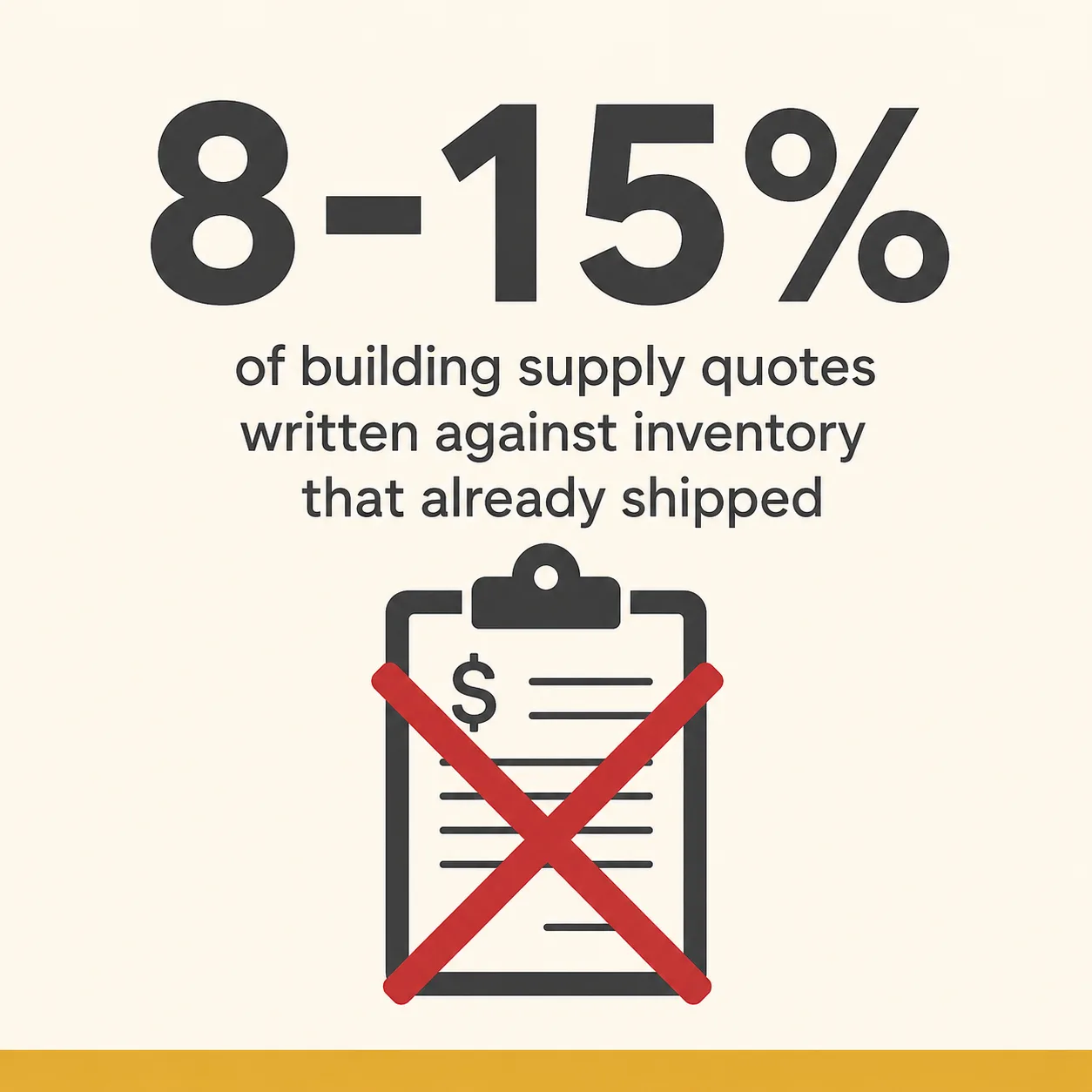
Building suppliers quote inventory they no longer have because quotes run on batch-cycle data that is hours stale. The report was accurate at 2 AM when the batch finished; by the time the sales desk opens, the racks have already moved.
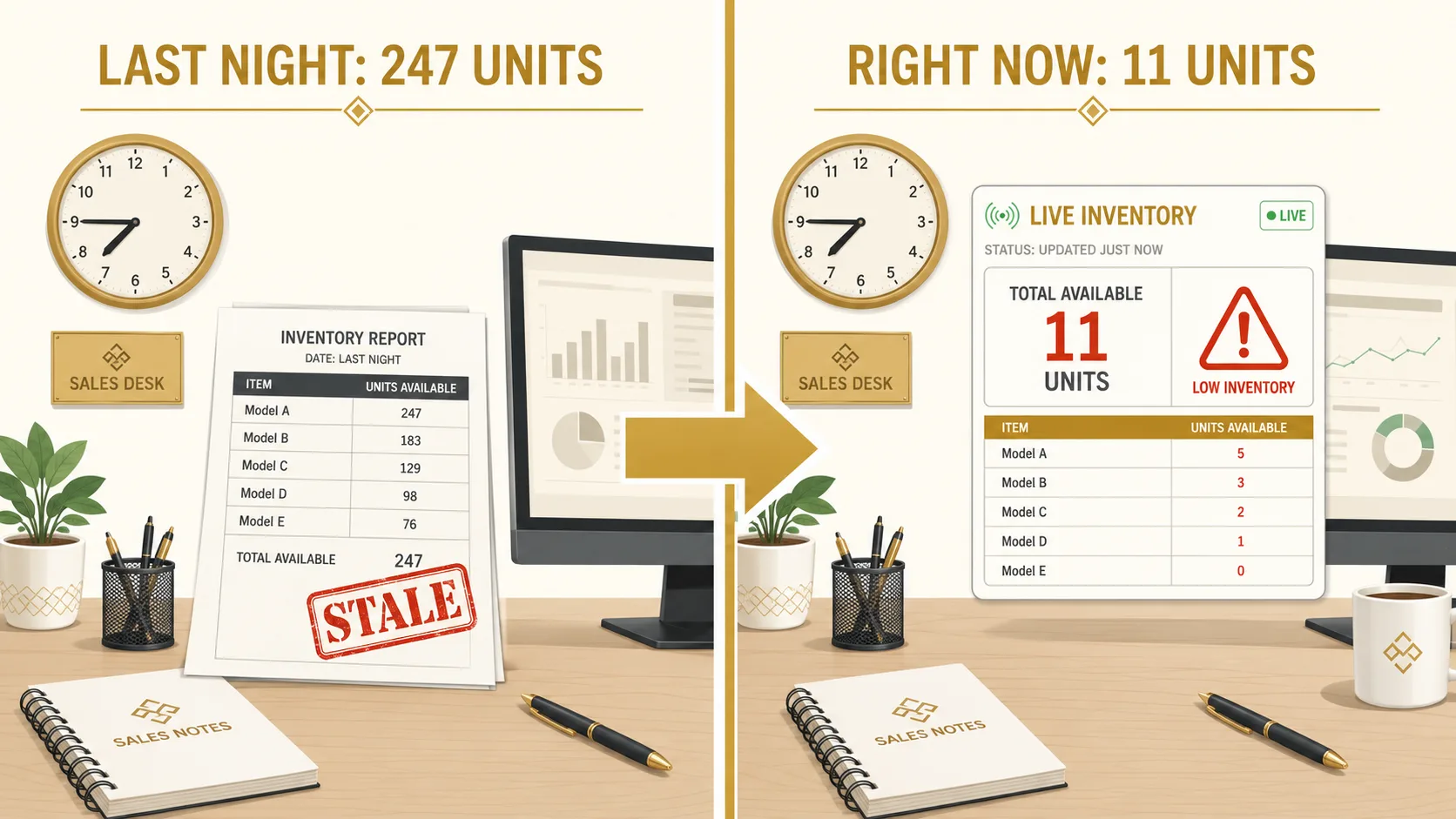
The sales desk opens at 7:45 AM. A contractor calls. Two hundred sheets of 3/4-inch CDX plywood. Four thousand linear feet of 2×6 #2 SYP. Thirty squares of architectural shingles. Job bid due by noon. The desk pulls the inventory report from last night's batch cycle. It shows 247 sheets. Quote goes out. Contractor wins the job. Calls back at 2 PM to confirm the order. The yard manager walks the racks. Eleven sheets left. The other 236 went out on three jobs between 6 AM and 10 AM. The quote was dead before the contractor ever submitted a bid. Nobody lied. The system was accurate once, at 2 AM, when the batch cycle finished. By the time the sales desk opened, it was five hours stale. By noon, the number was fiction.
How Much Inventory Moves Between Batch Cycles at a Building Supply Yard?
Mid-market building supply ERPs run inventory reconciliation through overnight batch processing cycles. Epicor BisTrack. ECI Spruce. DMSi Agility. ECI RockSolid. Inventory is accurate once per 24 hours, at the moment the cycle completes. For a yard receiving trucks at 6 AM and dispatching through the morning, the gap between batch accuracy and quoting reality widens by the hour. By 8 AM, 30 to 40 percent of high-movement commodity SKUs — framing lumber, sheathing, drywall, treated posts — have shifted from their batch-cycle positions. By noon, when contractor bid deadlines land, the number crosses 50 percent. The sales desk quotes from data that was stale before the first truck rolled.
This is not user error. It is not a training gap. The ERP is structurally incapable of answering "how much inventory is actually in the yard right now" during business hours. These systems were built for order to cash, not quote to fulfillment. In an industry where the quote is the sale — where a contractor calls three yards and awards the job before lunch — that gap is the one that matters. The batch cycle tells the yard what sold yesterday. It does not tell the sales desk what is available to quote this morning. The two numbers diverge on every high-velocity SKU by the time the phone rings.
Some yards run mid-day manual counts to catch the drift. A yard hand walks the lumber racks with a clipboard, writes down what they see, radios the numbers back to the desk. By the time the count reaches the quoting screen, another truck has loaded and left. The manual override is stale before it is applied. The problem is not that nobody checks. It is that the checking mechanism is slower than the movement it is supposed to track. A clipboard cannot outrun a forklift. Nobody is failing. The process was built for a world where batch accuracy was good enough because the alternative did not exist. It exists now. The structural gap in inventory distortion detection is the same pattern: a metric that reconciles at midnight tells a clean story that falls apart by 10 AM.
What Is the Real Cost of Quoting From Stale Inventory Data?
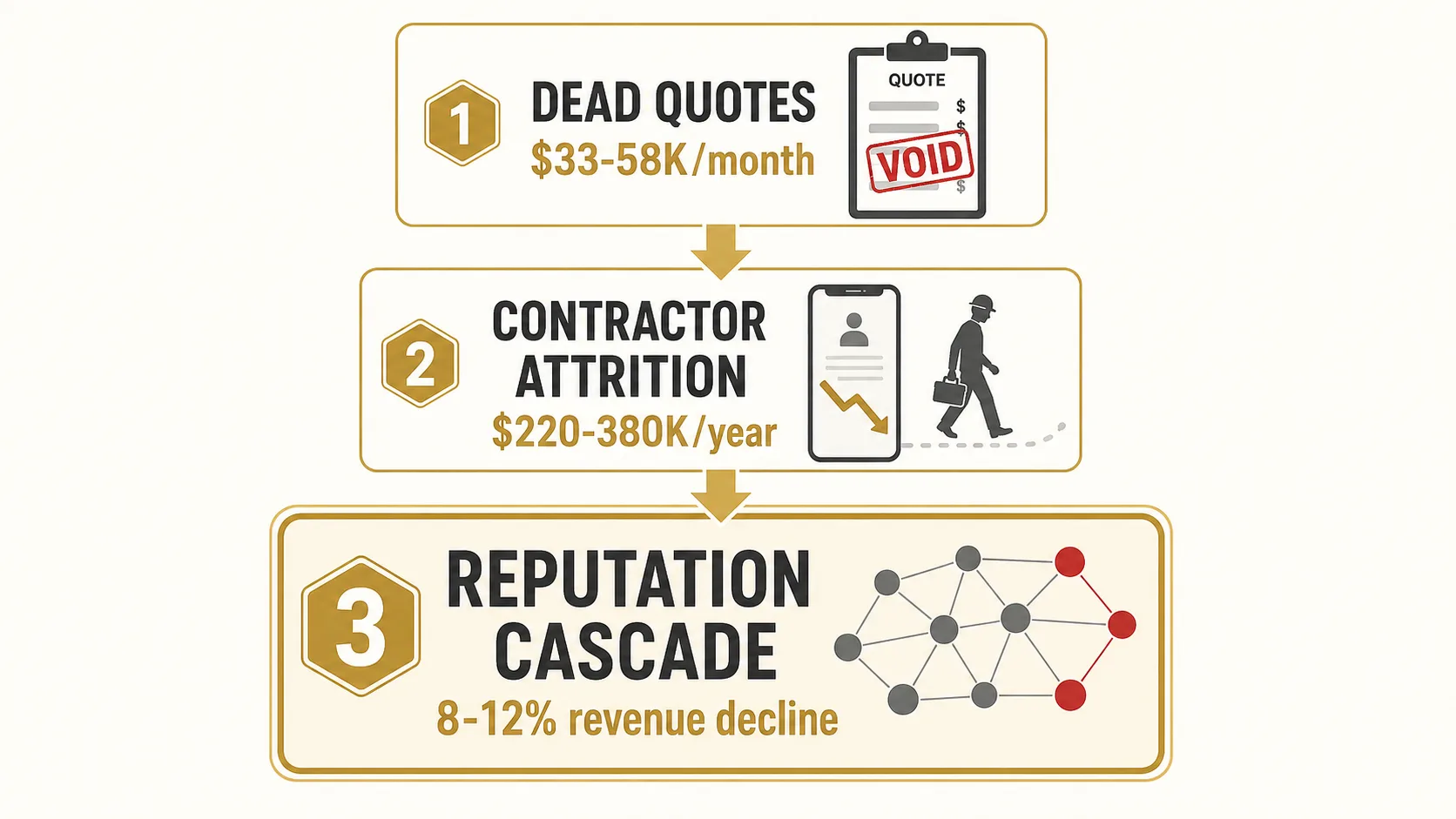
The obvious cost: 8 to 15 percent of quotes written against inventory that cannot be fulfilled. For a $12M supplier writing 40 contractor quotes per day, that is 4 to 6 dead quotes daily. Roughly 3 to 5 lost jobs per week at a $2,800 average ticket. That is $33,000 to $58,000 per month in revenue walked away from. Not because the yard could not supply the material. Because the yard did not know it had already supplied the material. The inventory was sold, loaded, and delivered. The system still showed it available. The quote went out on a promise the yard had already kept to someone else. Rush PO premiums on the fill-in orders eat another 8 to 12 percent margin on the jobs the yard does manage to salvage. The yard pays twice: once in the lost job, once in the premium to keep the job it barely saved.
The hidden cost: contractor attrition. Contractors do not complain. They stop calling first. After the third "sorry, that material moved," the number drops to second or third on the call list. The yard becomes the backup quote. The one called when the primary cannot deliver. Default-supplier status at a mid-sized builder running 4 to 6 active jobs is worth $220,000 to $380,000 per year. Losing it to a competitor with live inventory access costs 18 to 24 months of relationship equity. Money that cannot be bought back with better pricing or faster delivery. The contractor already made the switch. They are not coming back because the yard got its inventory visibility fixed. They are coming back when the new supplier fails them. And the new supplier has the same live data that stole the relationship in the first place.
The compounding cost: reputation travels faster than correction. Contractor networks are tight. Three bad quotes and the story moves. A framing crew lead mentions it to the general contractor over coffee. The GC mentions it to another sub at the next site meeting. Market share erosion compounds because the top 20 percent of contractors, the highest-volume, best-margin ones, talk to each other. Losing two key contractors cascades into 8 to 12 percent revenue decline over 18 months. Not from price competition. From reliability reputation. The yard never hears about the jobs it lost. The contractor just stopped calling. The sales numbers dip. Nobody connects it to the inventory system because the inventory system reports 98 percent accuracy. It reconciles at midnight. The metric is real. It just measures the wrong moment.
Why Do Building Supply ERPs Not Track Inventory in Real Time?
Enterprise real-time inventory solutions exist. Infor CloudSuite. SAP S/4HANA. Epicor Prophet 21 at the multi-branch tier. They break even at 20-plus locations. Implementation costs of $150,000 to $400,000 with deployment timelines of 9 to 18 months. A mid-market supplier running 1 to 5 yards cannot close the math. The ERP vendors pitch "real-time" as an upgrade tier requiring cloud migration, new scanning hardware, and six-figure consulting engagements. The yard stays on batch because the price of real-time was set for companies three times its size.
The gap is not technology. It is segmentation. The tool that would solve this is not a replacement ERP. It is a lightweight accuracy tool that reads batch data at rest and tracks movements during business hours, sitting on top of the existing system without migration. Nobody has built it for this market. The vendors who could — the ERP companies themselves — have no incentive. The batch-cycle architecture locks yards into upgrade paths that fund their enterprise sales motion. A $12M yard that solves inventory visibility without buying the cloud migration is a $12M yard that exits the upgrade funnel. The industry accepts batch cycles the same way it accepted paper tickets before digital. Not because batch is good. Because the alternative was priced for someone else.
The acceptance is reinforced by the gap between what the ERP reports and what the yard manager knows. The inventory system says 247. The yard manager says "we were light on that last night." The system reconciles at midnight. The manager's intuition reconciles on walkthroughs. The two numbers disagree. The ERP is trusted because it is systematic. The manager's doubt is suppressed because it is anecdotal. Meanwhile, the ERP stays silent when safety stock calculations drift into fiction. Same root cause. Different symptom. The system was never architected to distinguish between what the database says and what the yard actually holds.
What Changes When the Sales Desk Quotes From Live Inventory?
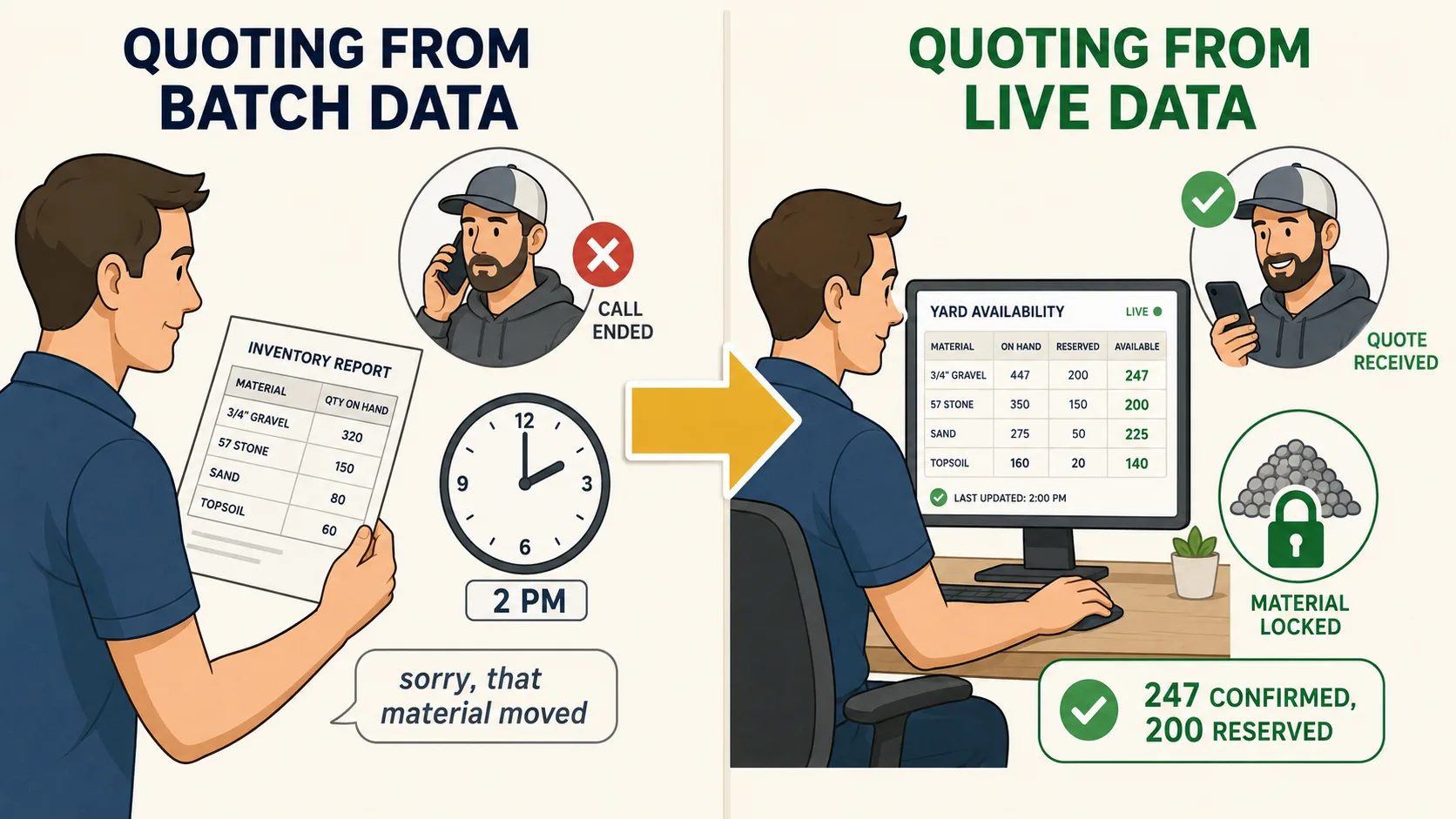
Live inventory visibility during quoting hours. Not a new ERP. Not a cloud migration. A lightweight system that reads the batch-cycle data at rest and tracks movements the batch system cannot see between cycles. When a sales rep pulls up a quote, they see actual yard-level availability, not last night's snapshot. The system reserves stock at quote time for a configurable hold window: 90 minutes, 4 hours, end of day. The reservation is firm. The next quote sees the adjusted number. Two sales reps cannot quote the same material to two different contractors.
Results shift fast. Dead quotes drop from 8 to 15 percent to under 3 percent. "I'll check the yard and call you back" becomes "we have 247 in stock. I'm reserving 200 for your quote now." The contractor gets a confirmed number. The bid goes in with certainty. The sale closes because the material was guaranteed, not hoped for. Quoting speed improves because the sales rep is not walking the yard or calling the yard hand to verify a number the system should already know. The rep quotes from the desk. The yard hand moves material. Two people stop doing each other's jobs.
Contractor retention improves. The third time the yard confirms a quote with live data instead of apologizing for batch data, the contractor moves the yard back to first on the call list. The reliability metric that lost the relationship is the same one that wins it back. Faster than pricing ever could. The net revenue lift: 6 to 11 percent inside 90 days. Not from new customers. From the quotes that had been walking away. The diagnostic sits on top of existing ERP infrastructure. No rip and replace. What changed: the sales desk stopped guessing what was in the yard and started seeing it. The data was always there. It was just 5 hours late. That is the gap real-time inventory intelligence closes.
What to ask next
Common questions building supply operators ask after reading this:
How do I track real-time inventory without replacing my ERP?
What percent of building supply quotes are written against unavailable stock?
How much revenue do lumber yards lose from batch-cycle inventory gaps?
What is the difference between ERP inventory and yard-level availability?
Related read: Batch-cycle blind spots are not unique to building supply. ERPs stay silent when safety stock calculations drift from reality. The same inventory that shows 247 on screen shows zero on the racks. Different industry. Same structural gap.
See What Your Quotes Actually Promise
Upload last quarter's quotes and see how many were written against inventory that moved before the contractor could call back. Exact numbers. How many quotes went out against unavailable stock. How many would have been unfillable. The revenue that walked. The contractors who stopped calling. No product pitch. Just data analyzed for the gap the ERP cannot see. How market-validated intelligence finds these gaps starts with one question: what did the inventory system say, and what did the yard actually hold?