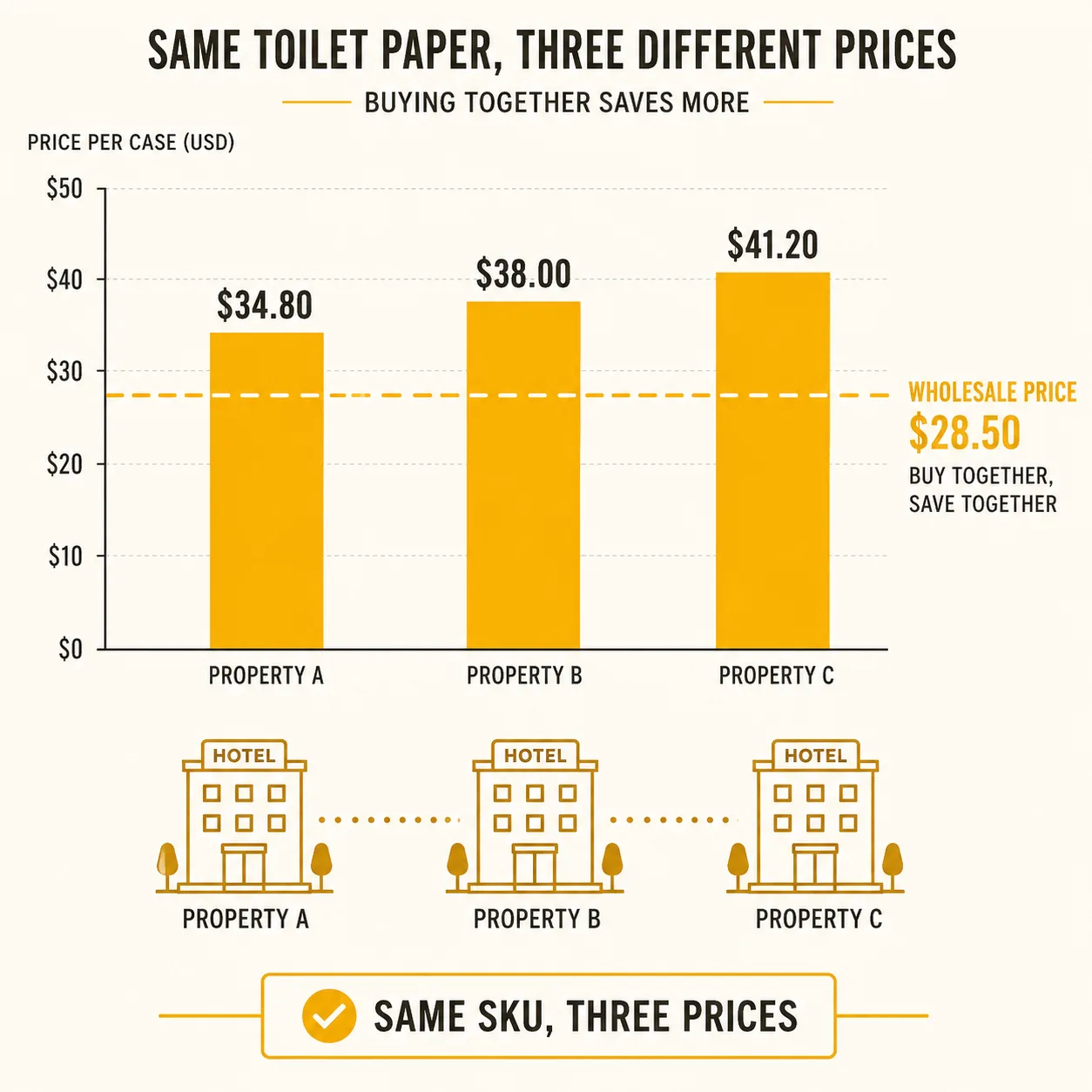
Hotel groups pay retail prices for wholesale volume because every property buys alone and nothing connects the purchases. Each property negotiates its own suppliers, its own prices, its own process. A 10-property group buying $320,000 to $400,000 a year in recurring supplies pays the small-buyer price ten times over. The volume is wholesale. The buying is retail.
Every property manager forwards supplier invoices to the regional office around the 5th. Someone opens Excel, sorts by supplier, and discovers the same case of toilet paper cost $34.80 at Property A and $41.20 at Property C, ordered three days apart from different suppliers. It is not negligence. It is that every hotel has its own P&L, its own supplier relationships, and its own process. PMS tracks guest spend down to the cent. Nobody tracks operational spend across properties.
Why PMS Can't Track Procurement Spend
PMS systems are structurally transaction engines for rooms. Opera, Cloudbeds, and Mews handle reservations, check-ins, and folios. They do not touch operational procurement. Housekeeping orders supplies by text message. F&B managers call their local distributors. Maintenance buys from whoever delivers fastest. Accounting systems like QuickBooks and NetSuite see invoices 30 days after the order, in time to pay, not in time to prevent the next fragmented purchase.
Enterprise procurement software from Coupa and SAP Ariba requires dedicated procurement staff and $50,000-plus per year. That works at 50 properties. It collapses at 10. The mid-market gap has no bridging tool. This is not a missing module. It is a category that does not exist for the mid-market.
What Fragmented Hotel Purchasing Actually Costs
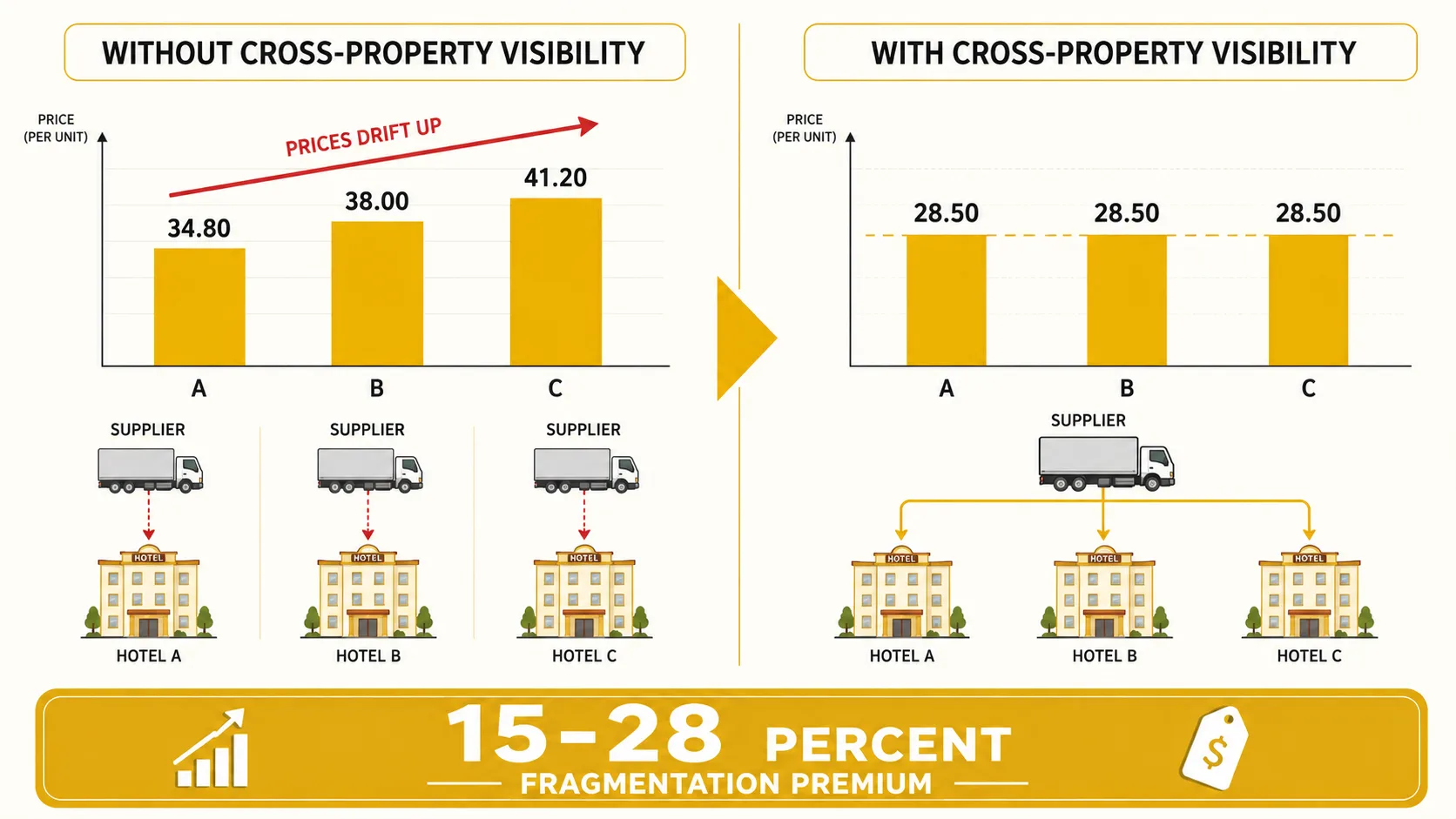
The obvious cost: a 15 to 28 percent procurement fragmentation premium. A 10-property group spending $320,000 to $400,000 per year on recurring supplies, linens, amenities, cleaning chemicals, F&B basics, paper goods, overpays $48,000 to $112,000 per year. Each property negotiates alone and pays the small-buyer price. The group buys at retail when it should buy at wholesale.
The hidden cost: $18,000 to $35,000 per year in invoice reconciliation labor. A regional ops manager spends 6 to 10 hours every month matching supplier invoices across properties by hand. Manual invoice processing runs $15 to $16 per invoice industry-wide, and hotel groups add the cross-property matching step that automation never touched. Add 3 to 5 emergency orders per year at a 40 to 80 percent premium when a property runs out of a critical supply that a sister property across town has in surplus. Nobody can see the surplus.
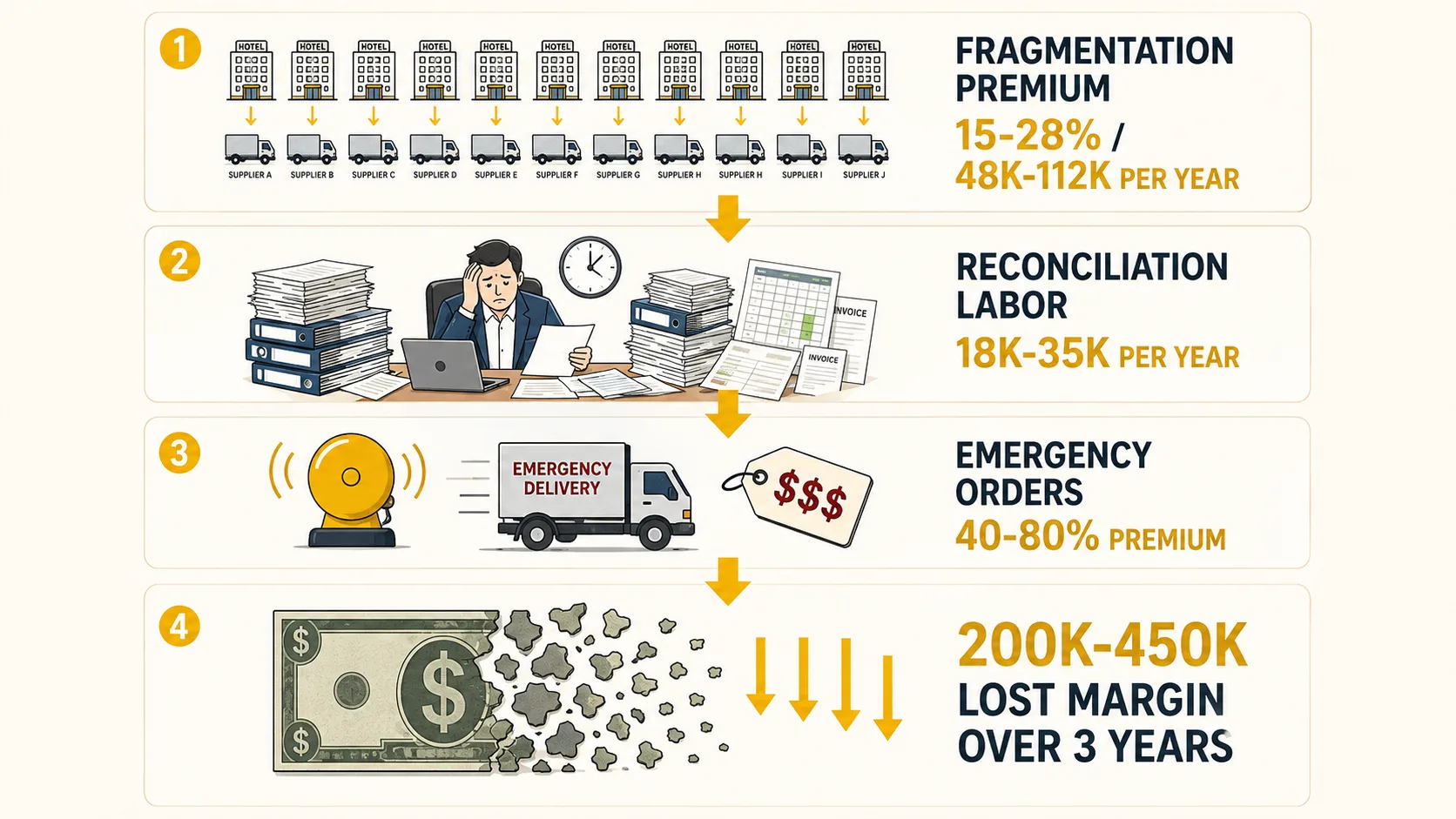
The compounding cost: 5 to 8 percent annual margin erosion. Supplier relationships never consolidate because nobody sees the aggregate spend. Volume discounts never materialize. The group permanently operates as 10 small buyers instead of one mid-sized buyer. Over 3 years, that is $200,000 to $450,000 in permanently lost margin. Not from bad management. From structural invisibility. CBRE’s analysis of 2,600 U.S. hotels found operating supplies costs rose 9.4 percent in 2024, faster than revenue, so the fragmentation premium gets more expensive every year.
The Mid-Market Procurement Gap
Enterprise hotel groups at 50-plus properties run centralized procurement with dedicated staff and enterprise systems. The mid-market, 5 to 20 properties, lives in a structural gap: too big to manage procurement ad hoc, too small to justify an enterprise tool. Each hotel’s P&L autonomy is culturally sacred. “My property, my suppliers.” Consolidation feels like losing control, so nobody pushes for it. Without visibility, nobody can prove what fragmentation actually costs.
The industry accepts it because the alternative, enterprise procurement software, costs more than the problem. Or so the assumption goes, because nobody has done the math. Hospitality procurement spans guestroom amenities, linens, cleaning chemicals, F&B, and maintenance services, and the categories are bought from different distributors in different places. The spread is structural, not a people problem.
What Changes With Cross-Property Spend Visibility
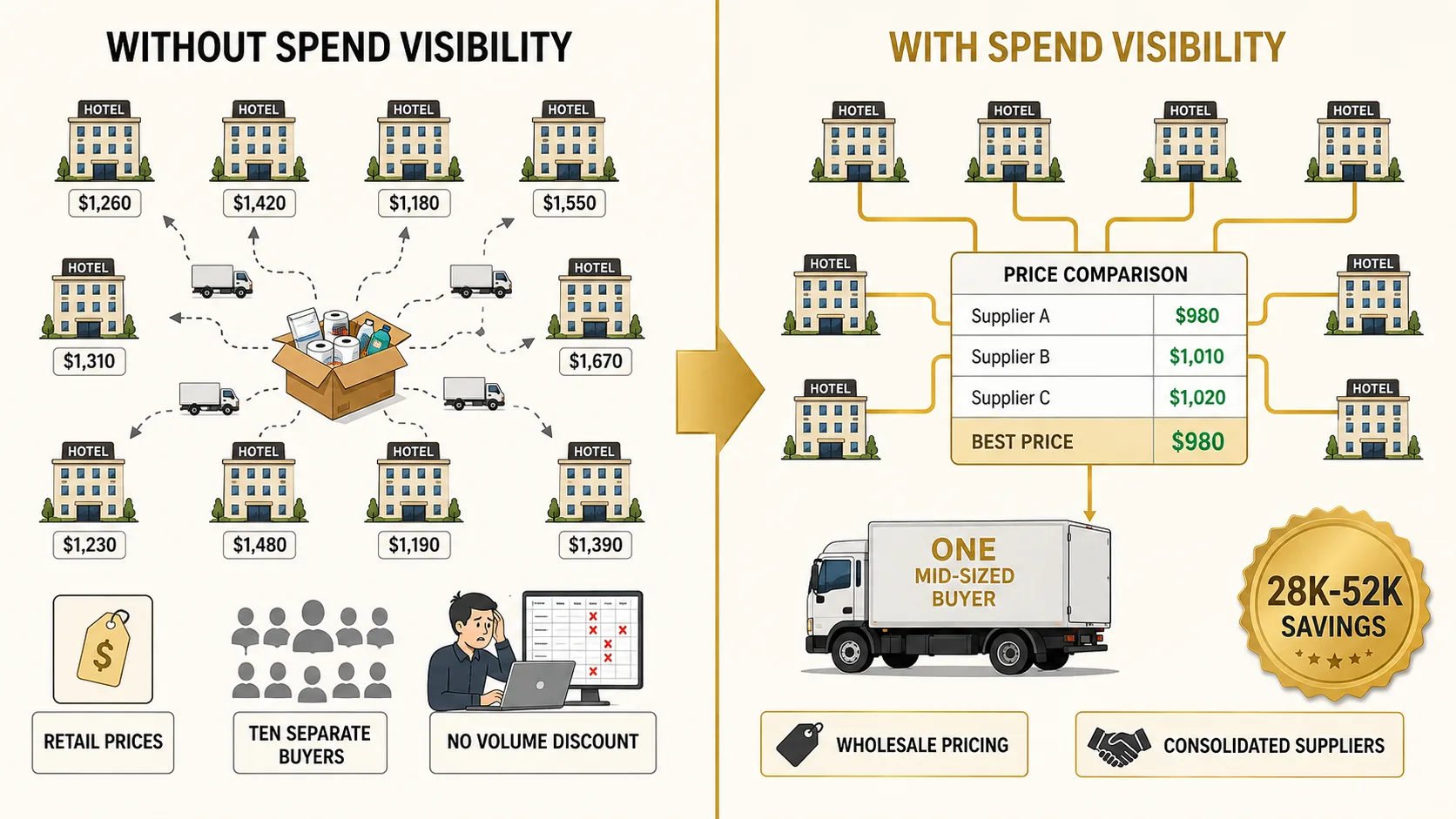
Cross-property spend visibility ingests supplier invoices across properties, normalizes line items to comparable SKUs, and surfaces price variance. It does not require centralized procurement or new supplier contracts. Each property manager keeps their suppliers. They just see, for the first time, what everyone else is paying.
Within 30 days, a 10-property group identifies 8 to 15 items with 15 to 40 percent price variance across properties. Within 90 days, consolidating 3 to 5 suppliers across the group, linens, cleaning chemicals, paper goods, delivers $28,000 to $52,000 in realized savings. No PMS replacement. No ERP migration. Just visibility into what is already being spent.
This is the same structural blindness that makes one hotel scramble while another has idle staff, and the same manual coordination that eats 15 percent of hotel group labor in task handoffs. The spend data exists in every accounting system. It has never been connected.
The multi-property intelligence approach that surfaces price variance across sister properties is the same way TheiaOps validates markets: read everything, normalize it, surface what the architecture hides. The procurement gap is not a missing feature. It is a missing view.
What to ask next
Common questions operators ask after reading this:
How much do hotel groups lose to fragmented procurement?
Can hotel groups consolidate suppliers without centralized purchasing?
What does cross-property spend visibility cost for mid-market hotels?
How do hotel groups negotiate volume discounts across properties?
Get a Procurement Diagnostic
A diagnostic analyzes the last 90 days of supplier invoices across properties and maps exactly where the fragmentation premium lives: which SKUs, which suppliers, what the consolidation savings would be, and which three suppliers to consolidate first. The PMS, the accounting system, and the supplier relationships stay. The retail prices stop.