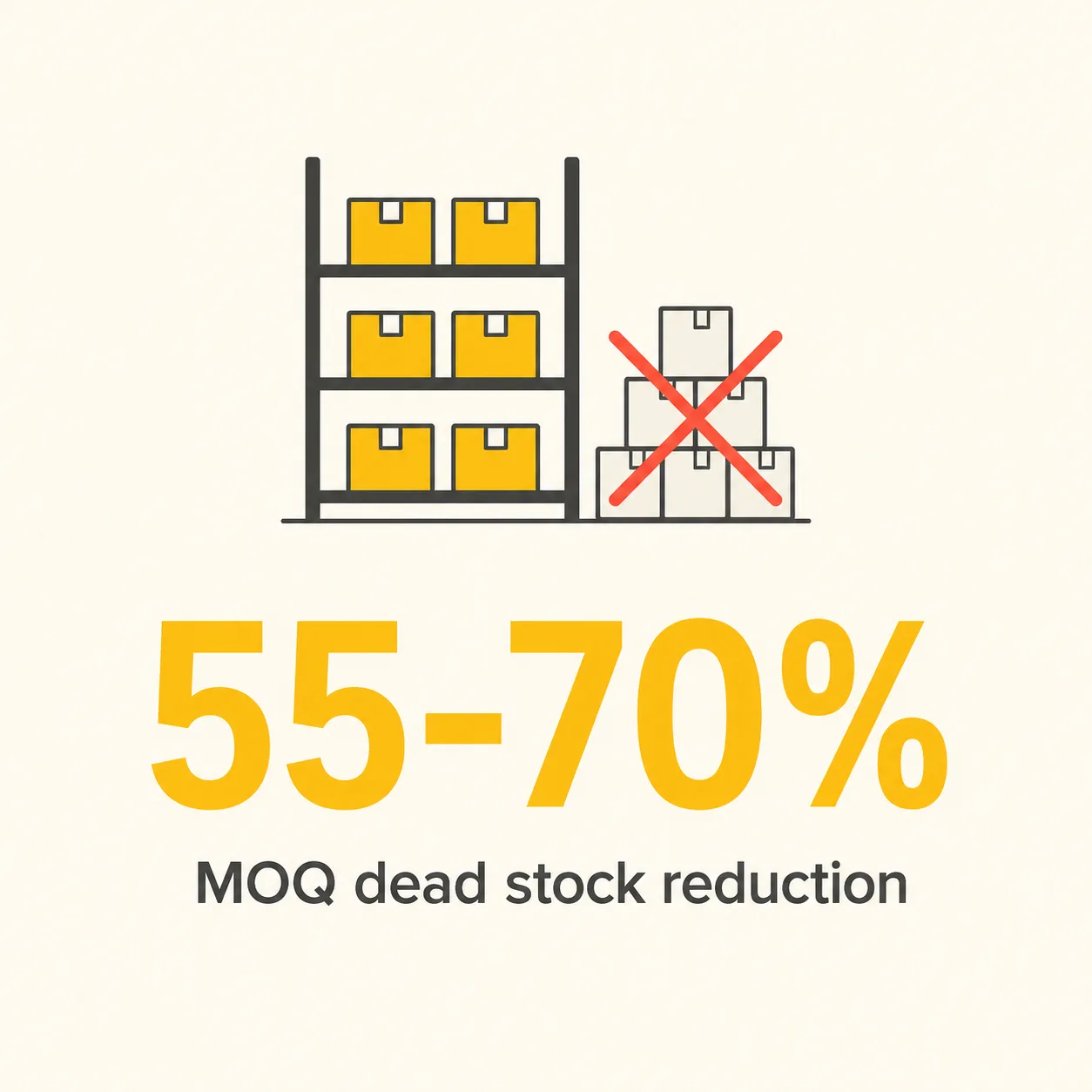
Supplier minimum order quantities override actual demand, so every padded purchase ships 30 to 40 percent of its units straight to dead stock. A 50-unit minimum against 14 units of real demand puts 36 units on the shelf, six months of stock the business will move in two.
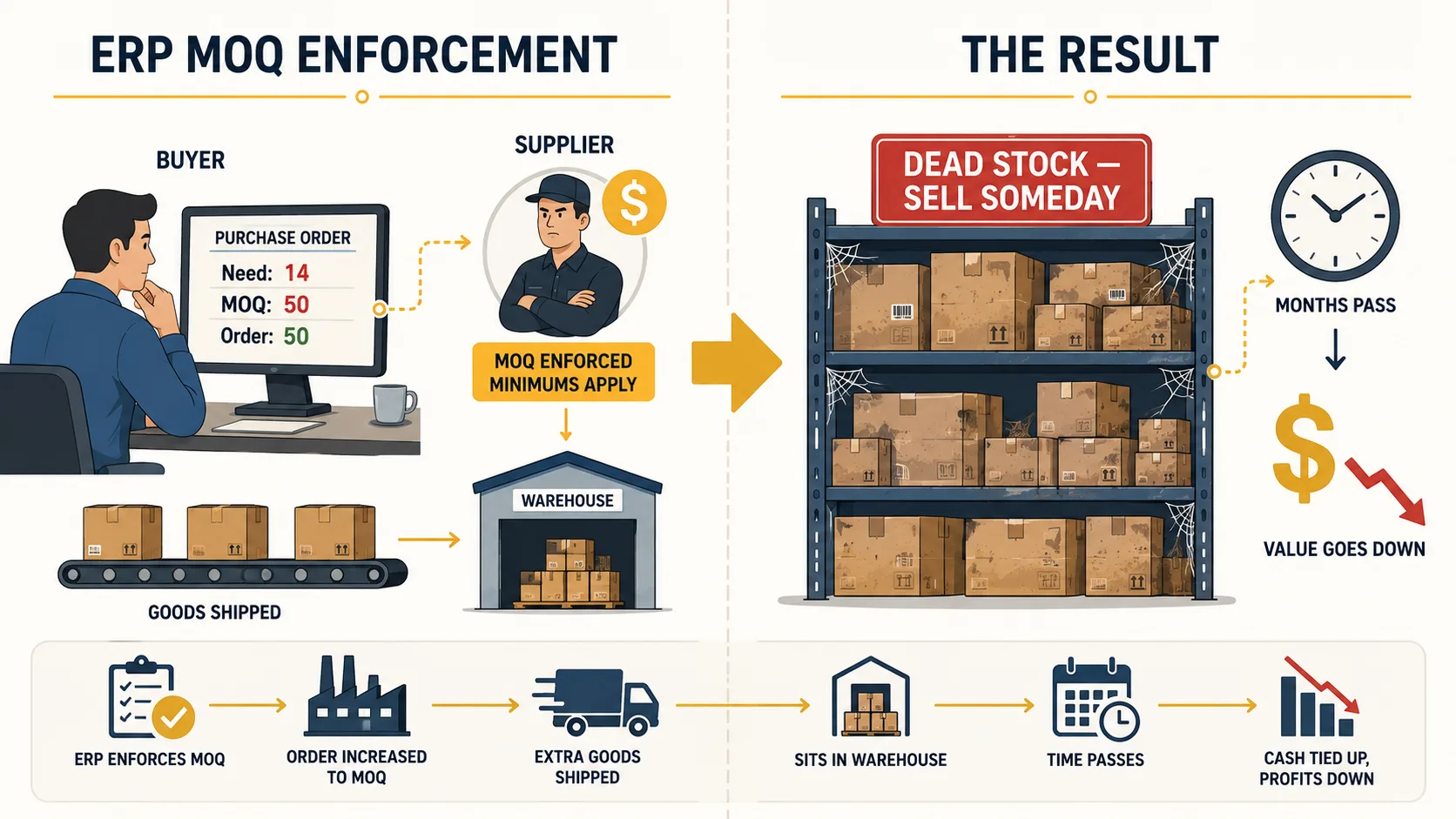
It is the 25th of the month. The senior buyer opens the ERP purchase recommendation report. SKU 8472 . a mid-volume surgical drape . sits at 14 units. The flagged reorder threshold is 12. The supplier minimum order quantity is 50. The buyer stares at the screen for 20 seconds. Then clicks approve. Thirty-six units go straight to the shelf that might as well be labeled "sell someday." This same ritual repeats 15 to 20 times per month across the SKU base. Nobody broke policy. The ERP enforced it.
Why ERP Procurement Modules Cannot Consolidate Across SKUs
ERPs treat the minimum order quantity as a binary gate. Purchase order meets minimum . approved. Purchase order falls below minimum . padded to the threshold. There is no cross-SKU consolidation logic anywhere in the procurement module. The system sees one line item at a time. It cannot ask whether three other SKUs from the same supplier also need replenishment this week, and whether those four orders collectively exceed the minimum without a single line being padded. This is not a bug. It is the architecture. MOQ enforcement is a purchase order rule, not an inventory optimization rule. The ERP was designed to prevent under-ordering. Nobody asked it to prevent over-ordering.
The procurement modules in NetSuite, Microsoft Dynamics, and Sage were architected for manufacturing environments where minimum order quantities protect production run economics. A factory needs 50 units of a component to justify the line setup cost. The MOQ protects margin. In distribution, the same MOQ logic gets applied to finished goods where there is no production run to protect. The minimum exists because the supplier set it . not because the math demands it. The ERP cannot distinguish between these two cases because the procurement module treats MOQ as a data field, not a decision point.
This is the same structural gap that makes multi-location suppliers buy inventory they already own across town. Same ERP. Same line-item blindness. Different symptom. The ERP sees a purchase order. It never sees the relationship between purchase orders. It enforces rules at the line level. It does not optimize at the order level. The architecture was never asked to. The mid-market buyer lives inside this gap every day.
What MOQ Padding Actually Costs Mid-Market Distributors
The obvious cost: 30 to 45 percent of MOQ-padded units become dead stock within 18 months. This is inventory that was never forecast to move at the original demand velocity. For a $3 million medical supply distributor ordering from 40 suppliers with active minimums, that is $42,000 to $68,000 per year in carrying cost on stock that was purchased to satisfy a supplier rule, not a demand signal. The carrying cost . warehousing, insurance, obsolescence, and the capital itself . compounds every month the inventory sits. The distributor pays to store the consequence of a data field.
The hidden cost: 25 to 30 percent of a senior buyer's working week. That time does not go toward strategic sourcing. It goes toward reviewing MOQ exceptions . cross-referencing other open purchase orders, calling suppliers to negotiate minimum waivers, splitting orders across warehouses to justify quantities the system cannot consolidate. At a $75,000 to $95,000 loaded cost for a senior buyer, that represents $19,000 to $28,000 per year in pure administrative waste. The spreadsheet the buyer builds to track MOQ exceptions across suppliers is the workaround for a capability the ERP should provide but never will. The buyer knows the purchase order is padded. The buyer does it 200 or more times per year anyway. The mental tax is real. Every padded PO is a small decision that trades professional judgment for system compliance.
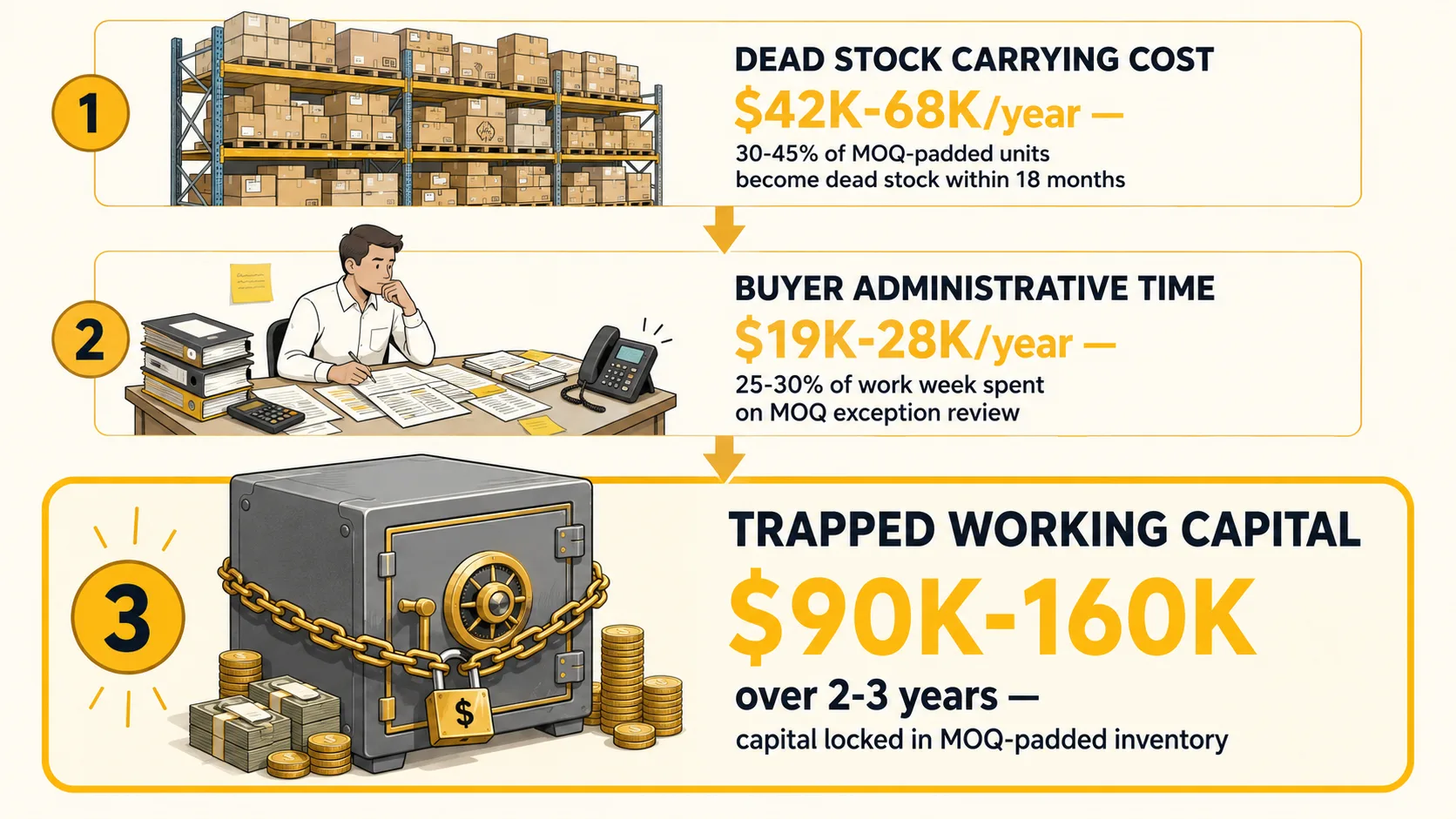
The compounding cost: working capital trapped in MOQ dead stock. Over two to three years of routine MOQ padding, a mid-market distributor accumulates $90,000 to $160,000 in working capital locked in inventory that was purchased to meet a supplier rule, not a demand signal. That capital could fund two or three new supplier relationships. It could finance a bulk discount negotiation with an existing partner. Instead it sits on warehouse shelves. Worse: after enough quarters of watching the MOQ line item on the balance sheet, distributors begin quietly dropping suppliers with aggressive minimums . even when those suppliers carry high-margin SKUs. The distributor shrinks the supplier base to avoid a problem rather than solving it. The tooling gap becomes a strategy constraint.
Why Mid-Market Distributors Accept MOQ Waste as Inevitable
Three reasons. First, the ERP procurement architecture. As covered above, the modules were built for manufacturing environments where MOQs protect production economics. Distribution companies inherited the same logic and applied it to finished goods where those economics do not exist. The ERP vendor has little incentive to change this. Procurement is a mature module. The revenue is in the software subscription, not in procurement optimization features.
Second, the alternatives are priced out of reach. Enterprise supply chain optimization tools from Kinaxis, Blue Yonder, and o9 Solutions offer multi-echelon inventory optimization that includes supplier constraint modeling and cross-order consolidation. These tools can model MOQ constraints across the full procurement base. The price: $150,000 to $500,000 per year with 12 to 18 month implementations. They target $500 million-plus enterprises with dedicated supply chain planning teams. A mid-market distributor running $5 million to $50 million in revenue cannot close the math. The tooling exists. The price point does not.
Third, the heroic buyer trap. Senior buyers compensate with manual workarounds that work well enough to mask the problem but not well enough to solve it. They maintain spreadsheets that track pending orders by supplier. They call reps to negotiate minimum waivers on slow-moving SKUs. They split purchase orders across warehouses to justify quantities the ERP cannot consolidate. Individual skill papers over a structural gap. Management sees the orders getting placed. The POs are approved. The suppliers are paid. The system reports everything as normal. The buyer's spreadsheet is the only thing preventing a worse outcome. Nobody upstairs knows it exists. The distributor accepts the waste because the alternative . admitting the ERP cannot do its job . feels more expensive than the waste itself.
What Changes When Purchase Orders Consolidate Across SKUs
Cross-SKU purchase consolidation across a single supplier transforms the buyer's week. The 15 to 20 individual MOQ exceptions that required manual review become 3 to 5 grouped orders where the collective quantity clears the minimum without padding a single line. The ERP purchase recommendation becomes an input, not a verdict. A consolidation engine sits between the ERP and the purchase order . it groups replenishment needs by supplier, flags SKUs where cross-order pooling eliminates the MOQ pad, and surfaces only the cases that genuinely require negotiation.
A mid-market distributor with 150 to 200 active SKUs and 30 to 40 suppliers can identify the full MOQ exposure within 72 hours. The analysis answers three questions no ERP report can produce: which suppliers cost the most in dead stock, which SKUs never justify their order minimum under any demand scenario, and where consolidation across the supplier eliminates the over-order entirely. This is not a system migration. It is a visibility tool that reads from the existing ERP and applies logic the procurement module was never architected to contain.
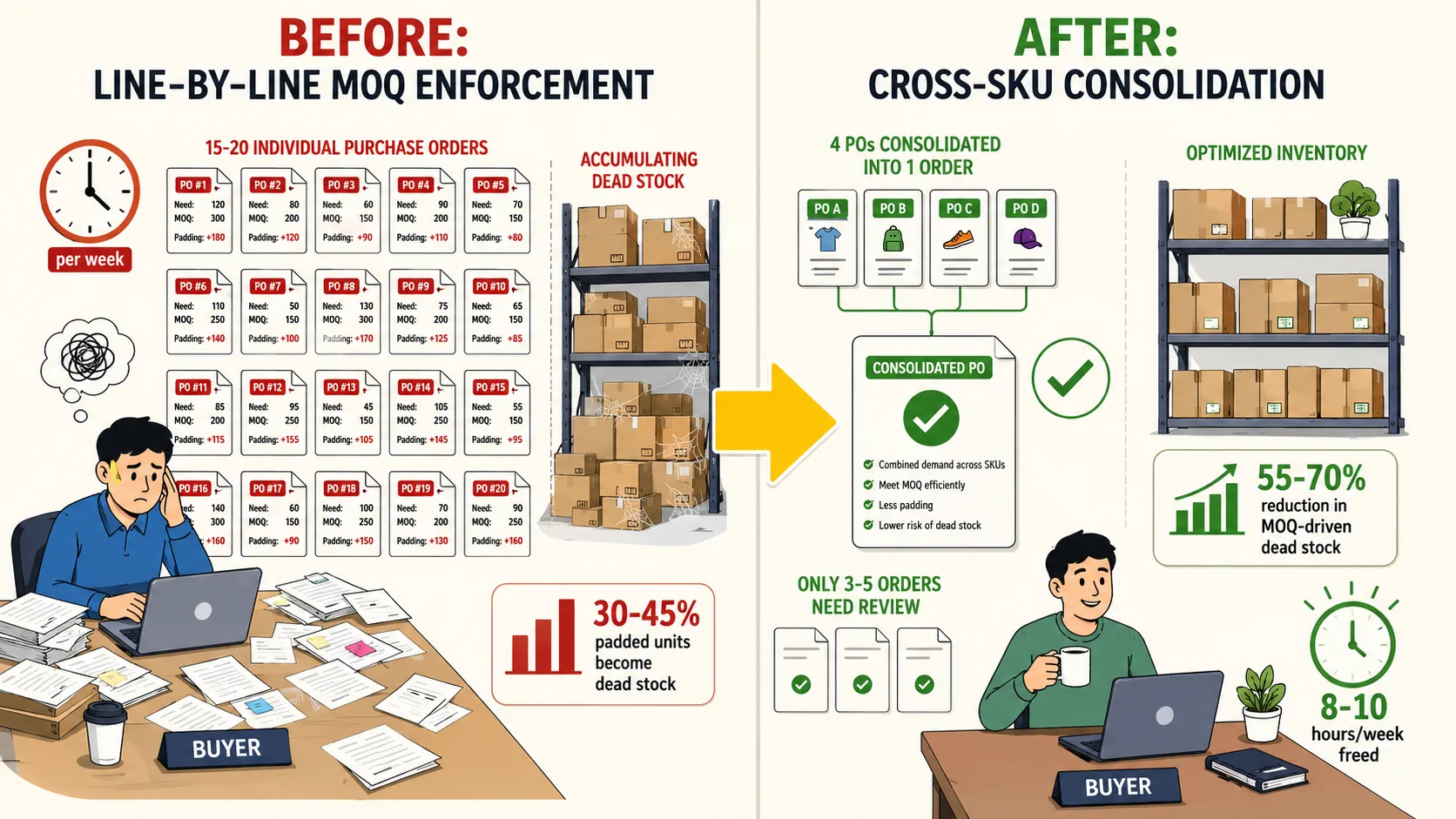
Within 90 days, MOQ-driven dead stock drops 55 to 70 percent. Buyers reclaim 8 to 10 hours per week . time that shifts from exception management to strategic sourcing. And $60,000 to $110,000 in working capital moves from the warehouse shelf back to the balance sheet. The supplier relationships improve because orders are larger and more predictable. The buyer's spreadsheet gets retired. The padding stops. Not because the supplier changed the minimum. Because the tool started asking a smarter question than "does this line meet the minimum."
What to ask next
Common questions operators ask after reading this:
How much dead stock do minimum order quantities create in distribution?
Can ERP systems consolidate purchase orders across suppliers?
What does MOQ padding actually cost mid-market distributors?
How do distributors reduce minimum order quantity waste without changing suppliers?
Get an MOQ Exposure Diagnostic
A diagnostic that maps MOQ exposure across every supplier and SKU . delivered in under five business days. No ERP replacement. No implementation project. The output identifies which suppliers account for the most MOQ-driven dead stock, which SKUs never justify their minimum, and where cross-order consolidation eliminates the padding entirely. The diagnostic produces a dollar figure for what the current MOQ rules are actually costing in dead stock, buyer time, and trapped working capital. That number is the baseline. Everything after it is recovery.
How TheiaOps builds multi-property intelligence for mid-market distributors →