A single lot recall costs medical suppliers tens of thousands of dollars because the ERP knows the lot was received but not which customer orders pulled from it. Under FDA traceability rules the clock starts immediately, and mid-market distributors trace recalled units through paper pick tickets.
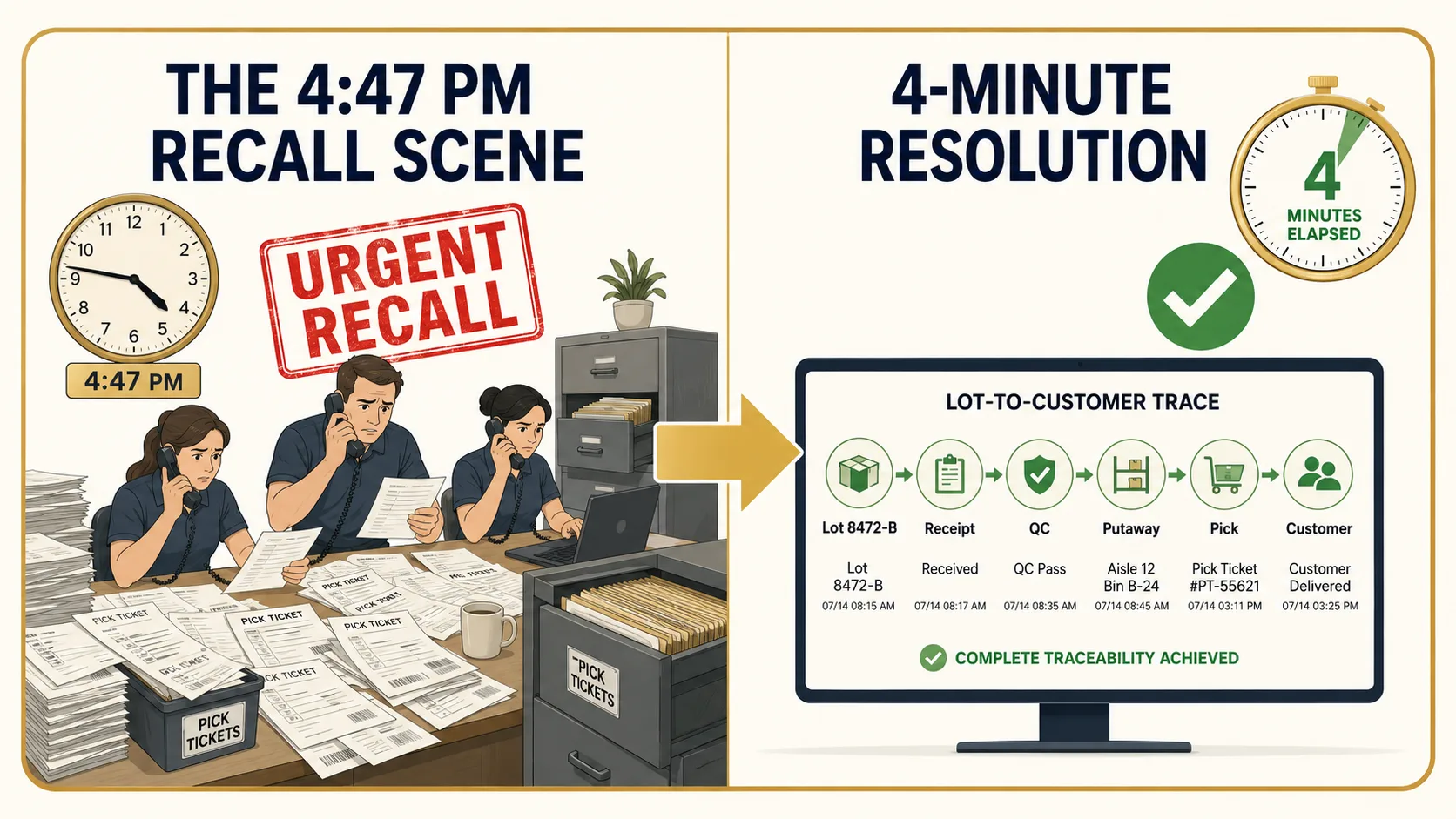
It is Thursday, 4:47 PM. A manufacturer recall notice lands. Lot 8472-B. Shipped across 6 purchase orders over 8 weeks. The ERP confirms the lot was received, QC checked, and put away. It does not show which of the 14 customer orders pulled from that lot. It does not show which hospitals received those units. It does not show whether any remain on the shelf. The clock starts. Under FDA 21 CFR Part 820, full traceability is expected within 10 working days. The operations director pulls the QA coordinator and two warehouse staff off their shifts. Somebody wheels out the filing cabinet with paper pick tickets from 6 weeks ago. The phone starts ringing. "Units from a recalled lot may have been shipped to this facility. Confirming which ones now."
ERP Lot Tracking Stops at Receiving. Then Silence.
ERP lot tracking is a procurement feature. It was never a fulfillment feature. Lot numbers enter the system at receiving. They are assigned at putaway. They are recorded in inventory valuation. Then the pick, pack, and ship workflow takes over, and the lot number does not follow the unit to the customer. The warehouse runs FIFO or FEFO logic. The picker scans the SKU barcode. The packer confirms the quantity. The shipping manifest references the order number. Nowhere in this sequence does the lot number transfer from the receiving record to the customer record. The ERP has two separate tables: one for what was received, one for what was shipped. They were never joined at the lot level.
The order says "shipped 12 units of SKU-4421 to Heartland Medical Center." It does not say "shipped 12 units from Lot 8472-B." The lot lineage breaks at the dock door. Every recall response starts with the same question: which customers got which lot? The answer lives in paper pick tickets, shipping manifests, and the memory of the warehouse lead who remembers that "the March 14th shipment pulled from the pallet on the left." This is not a system. It is archaeology.
Warehouse management systems close this gap. They carry price tags of $50K to $150K and require conveyor systems, scan tunnels, and zone picking infrastructure built for 100,000-plus square foot distribution centers. A mid-market medical supplier operating from a 15,000 to 40,000 square foot facility does not have conveyor systems or scan tunnels. A full WMS implementation means six figures and a warehouse redesign. The gap between "ERP lot tracking" and "full WMS traceability" is where $3M to $50M medical distributors live. It is where the recall risk concentrates. And it is a gap no existing tool was designed to fill at this price point.
The Three Tiers of Recall Cost
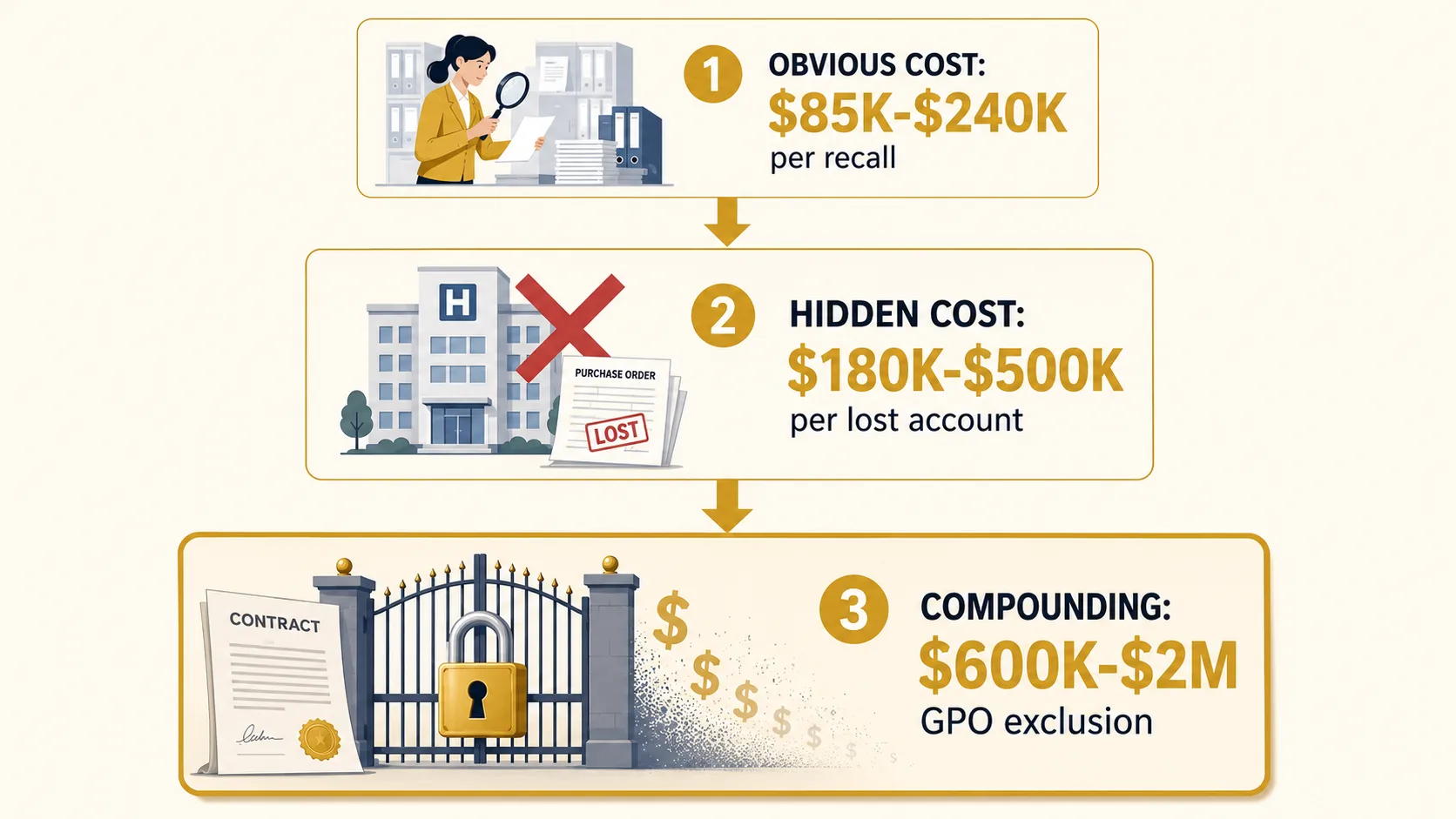
Tier one: the obvious cost. $85K to $240K per recall. Eighty to 120 staff hours spent tracing lots manually. QA staff pulling paper pick tickets. Warehouse leads cross-referencing shipping manifests. Operations directors calling hospital receiving departments to ask if they still have units from a specific shipment. At $45 to $65 per hour fully loaded for procurement and QA staff, that is $3,600 to $7,800 in direct labor alone. Then the product replacement cost. The supplier cannot prove which customers are safe, so the recall expands to all customers who received that SKU in the relevant date range. That is $30K to $180K in replacement units and overnight shipping to hospital facilities. Then regulatory exposure. One failed trace is a warning letter. Three is a shutdown risk.
According to the Health Industry Distributors Association, medical supply distributors face recall obligations that require complete lot-to-customer mapping. Most mid-market distributors lack the software infrastructure to comply at scale. They comply through overtime and hope.
Tier two: the hidden cost. $180K to $500K per lost hospital account. Hospitals run vendor qualification committees. One untraceable recall means probation. Two means delisting. Hospitals do not complain. They do not send a termination letter. They just stop sending purchase orders. The supplier discovers the churn six months later when quarterly volume drops 22 percent and nobody can explain why. Re-qualification takes 12 to 18 months. It requires proof of traceability systems the supplier still does not have. The supplier who cannot prove lot-to-customer traceability cannot get back on the approved vendor list. The account is gone.
This is not a theoretical risk. The cost of losing a hospital relationship runs 4 to 7 times the annual margin that account generates, per Harvard Business Review research on customer retention economics. A $50K annual margin hospital account costs $200K to $350K to replace, assuming replacement is possible at all. If the lost account was the result of a traceability failure, the supplier is trying to win back trust while still lacking the system that lost it.
Tier three: the compounding cost. $600K to $2M in blocked GPO revenue. Group purchasing organization contracts require traceability audit compliance. One failed audit triggers 3 to 5 year exclusion from the GPO roster. The supplier is not just losing one hospital. They are locked out of every hospital in that GPO network. Competitors who passed the audit inherit the contracts. The excluded supplier never sees the RFPs. A mid-market medical supplier with $5M in annual GPO-attached revenue loses $600K to $900K in net margin over the exclusion period. A $15M supplier with heavier GPO dependence loses $1.2M to $2M. And exclusion compounds: once a supplier is off one GPO roster, the next audit cycle at a different GPO flags the prior exclusion. The traceability gap becomes a permanent structural disadvantage.
Why Mid-Market Medical Suppliers Accept This Risk
Mid-market medical distributors operate between two worlds. Small distributors under $3M revenue with under 50 customers can trace lots manually. A phone call covers a quarter of the customer base. The owner knows which shipments went where because they signed the manifests. Large manufacturers above $100M run full DSCSA-compliant warehouse management systems with serialization at the unit level. They have traceability because regulators demanded it at scale. The mid-market, $3M to $50M revenue with 200 to 800 active hospital accounts, is too big for manual and too small for six-figure WMS. The market offers nothing in between.
Existing traceability tools are built for pharmaceutical manufacturers operating under FDA DSCSA serialization mandates. Unit-level serialization. Blockchain-adjacent verification. $200K-plus implementations requiring dedicated IT staff. A medical supply distributor who needs "which customer got which lot" does not need serialization. They need lot-to-customer mapping at the order fulfillment point, layered on top of their existing ERP. That tool does not exist at their price point. So they accept the recall risk. They budget for overtime. They keep the paper pick tickets in filing cabinets. And they hope the next recall hits a competitor instead.
This is the same pattern medical distributors face with expiry-driven write-offs. The ERP records the lot. The ERP records the expiration date. The ERP never connects them to the fulfillment workflow, so inventory expires on the shelf while newer stock ships to customers. Same architecture gap. Different cost line. The common thread: ERPs were built to record what happened, not to connect receiving decisions to shipping outcomes.
What Changes When Traceability Takes 4 Minutes
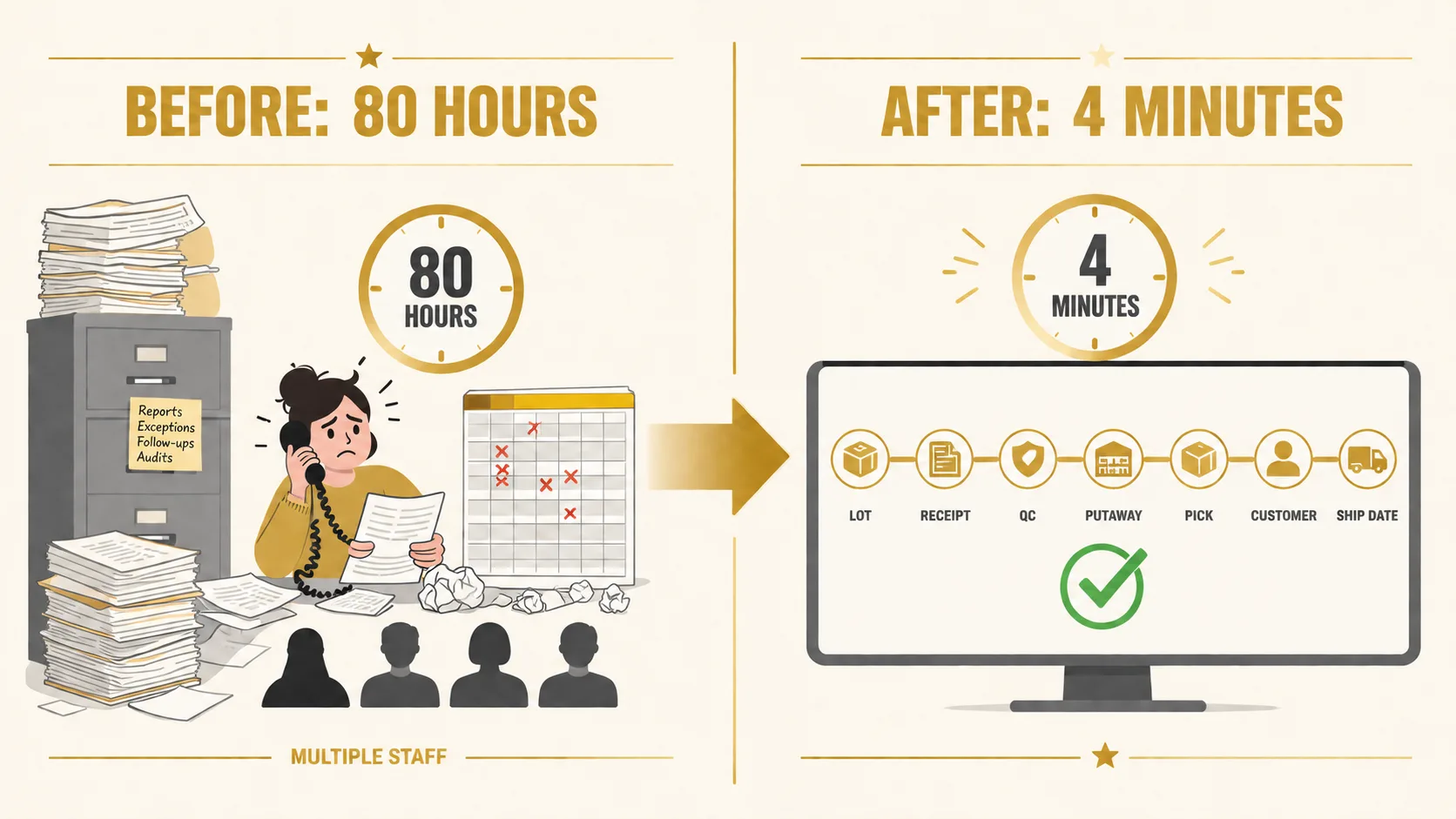
Lot-to-customer traceability at order pick time. Not a WMS replacement. A lightweight connector that records which lot went to which customer during the fulfillment step. The picker confirms the SKU and quantity. The system appends the lot number from the receiving record. The customer order now carries full lot lineage: Lot 8472-B . Receipt March 3 . QC March 4 . Putaway March 5 . Pick March 14 . Customer Heartland Medical Center . Ship date March 14. Every step. Every handoff. One record.
A recall that consumed 80 staff hours and 4 people becomes a database query. The operations director types "Lot 8472-B" and sees every customer, every unit, every ship date. The affected hospitals are notified before the manufacturer recall notice reaches them. The FDA auditor sees a complete trace chain: Lot to Receipt to QC to Putaway to Pick to Customer to Ship Date. The audit closes in 2 hours instead of 2 weeks. The supplier who can trace lots in 4 minutes keeps their GPO contracts. The supplier who cannot loses them, not to a better product, but to a traceable one.
This is not a technology problem. The ERP already holds the receiving record. It already holds the customer order. The two tables sit in the same database. The connector between them is the missing piece. The gap was never technical. It was architectural. Procurement modules were built to validate purchase orders, not to preserve lot lineage through fulfillment. Filling that gap does not require a new ERP. It does not require a WMS. It requires a system that asks one question at the pick step: which lot did this unit come from? And writes the answer to the customer record.
The same principle applies to the quarterly stockout cycle medical distributors face when ERPs cannot forecast demand. The ERP has the data. It has the receiving records, the order history, the customer list. It was never asked to connect them in a way that produces actionable intelligence. The intelligence is what changes the outcome, not a new transactional system.
What to ask next
Common questions operators ask after reading this:
How do medical device distributors comply with FDA lot traceability requirements without a full WMS?
What is the difference between lot tracking and lot traceability in medical supply fulfillment?
How much does a failed FDA traceability audit actually cost a mid-market medical supplier?
Can a $10M medical distributor afford lot-level traceability software?