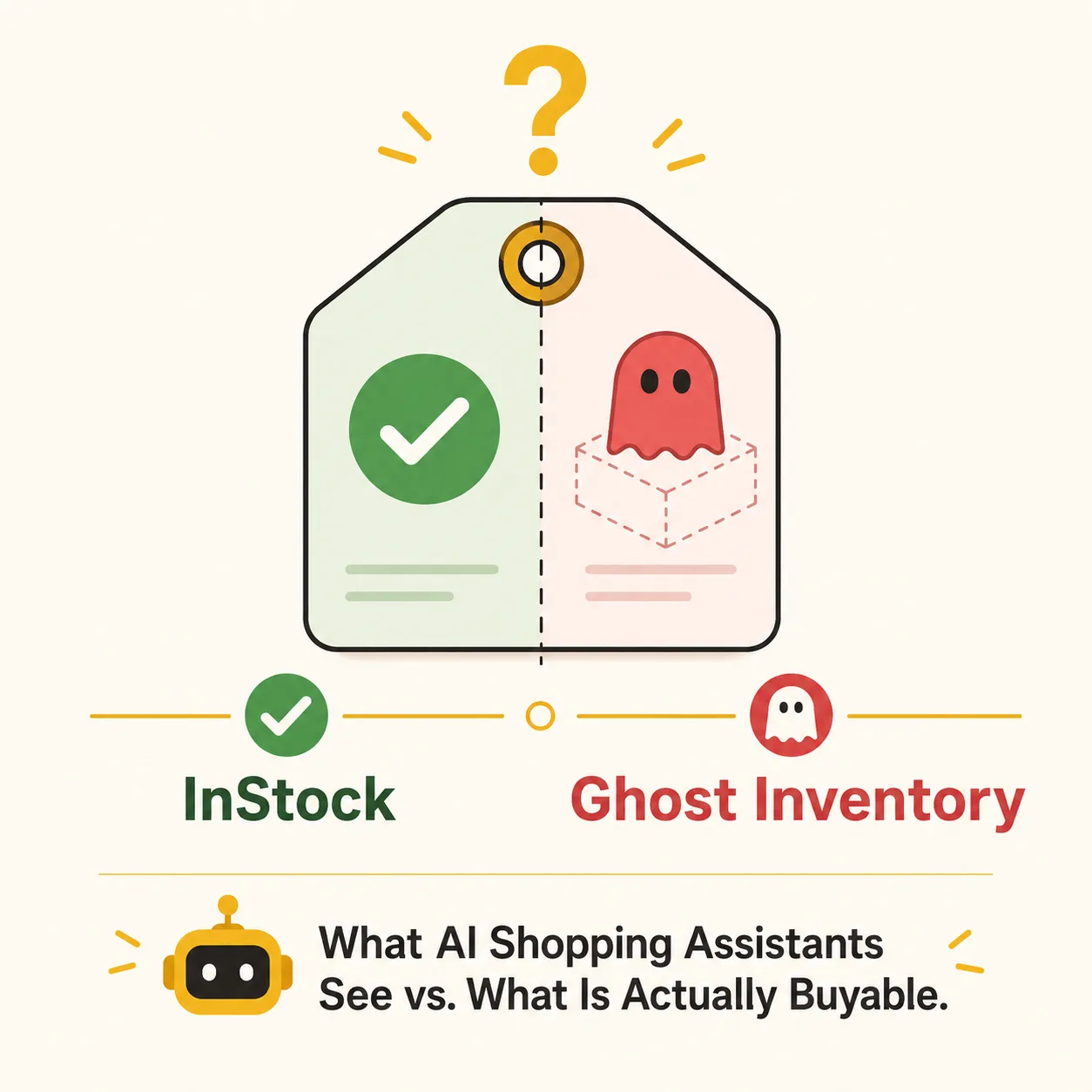
AI shopping assistants recommend ghost inventory because the availability field syncs on a batch schedule and freezes between the sale and the crawl. The schema says InStock at 8 AM; the warehouse has been empty since the 11 PM flash sale.
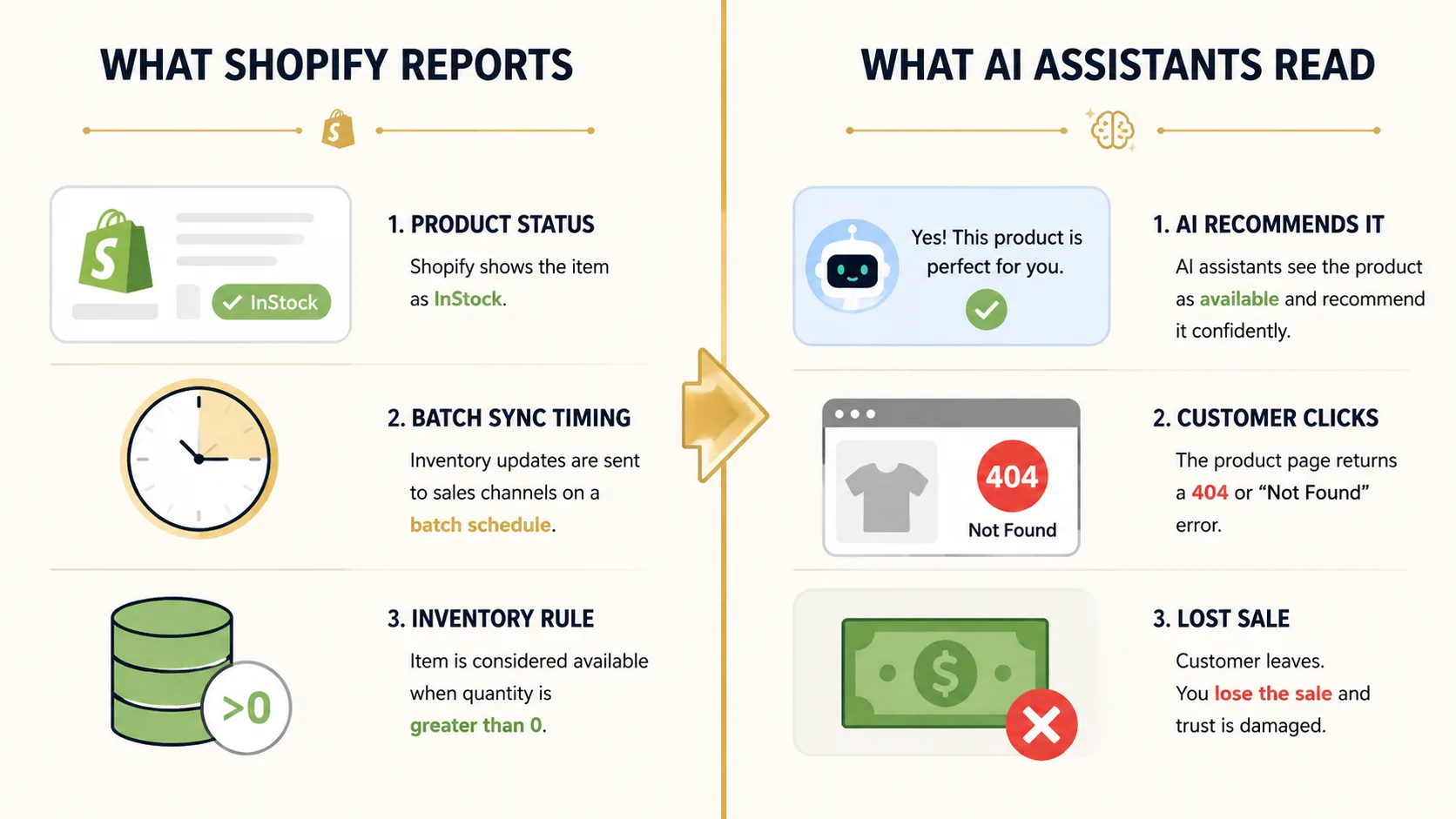
Shopify syncs inventory levels to the storefront on a batch schedule. A product sells at 11 PM on a flash-sale variant. The availability field still reads InStock at 8 AM when an AI shopping assistant scrapes it. The assistant recommends it. The customer clicks. 404 or "sold out." The brand looks unreliable. Not because they are. Because their inventory data froze sometime between the sale and the crawl. Nobody sees the gap until a customer hits a dead page an AI assistant sent them to. By then the damage is done. The brand did not get a chance to fix it because the brand never knew it was broken.
How Shopify's Availability Schema Fails AI Shoppers
Shopify's ItemAvailability schema has three values: InStock, OutOfStock, PreOrder. That is it. No "selling fast." No "back in 3 days." No "allocated to wholesale — 12 units reserved." AI assistants ingest this binary flag and treat it as truth. The schema.org specification for product offers defines availability as a controlled vocabulary. It was designed for Google Shopping results. It was not designed for AI agents that skip the product page entirely and answer from structured data alone.
Shopify's Spring '26 Edition changed the stakes. The company introduced Agentic Storefronts — infrastructure that structures product data (titles, descriptions, variants, pricing, availability) and pushes it directly to ChatGPT, Claude, and Gemini. This is not a potential channel. It is live. One Shopify store reported $23,346 in 30 days from ChatGPT product recommendations. The brand did nothing to earn those recommendations except have product data the AI could read. The flip side is just as real and entirely invisible: brands whose availability flags were stale got recommended for products that no longer existed. They lost the sale. They lost the trust. They never knew it happened.
This is not a hypothetical edge case. A recent study demonstrated that a single fake web page could manipulate AI shopping recommendations. The models trust structured data. They do not verify it against live inventory. If the schema says InStock, the assistant recommends. If the schema says OutOfStock, the product disappears from recommendations entirely. There is no intermediate state. No partial availability. No allocation awareness. The schema is a light switch in a world that needs a dimmer.
Inventory tools like ShipStation, Skubana, and Cin7 track real allocation. They know which units are committed to wholesale. They know which pallets are quarantined for damage inspection. They know which restocks are en route. But allocation data stops at the operations screen. It never reaches the schema markup AI assistants consume. The entire Shopify app ecosystem optimizes for the Google Shopping funnel where "in stock" is good enough because the customer lands on the product page and sees real-time availability. AI assistants skip the product page. They answer from structured data alone. The toolchain was built for a funnel that no longer exists.
The counterintuitive truth about agentic commerce is that the model is not the scarce resource. AI agents can compare products, summarize reviews, remember preferences. The hard part is finding live inventory. When the availability flag is stale, the AI has no way to know. It trusts the schema. The schema was wrong. The brand pays the price.
What Ghost Inventory Costs DTC Brands
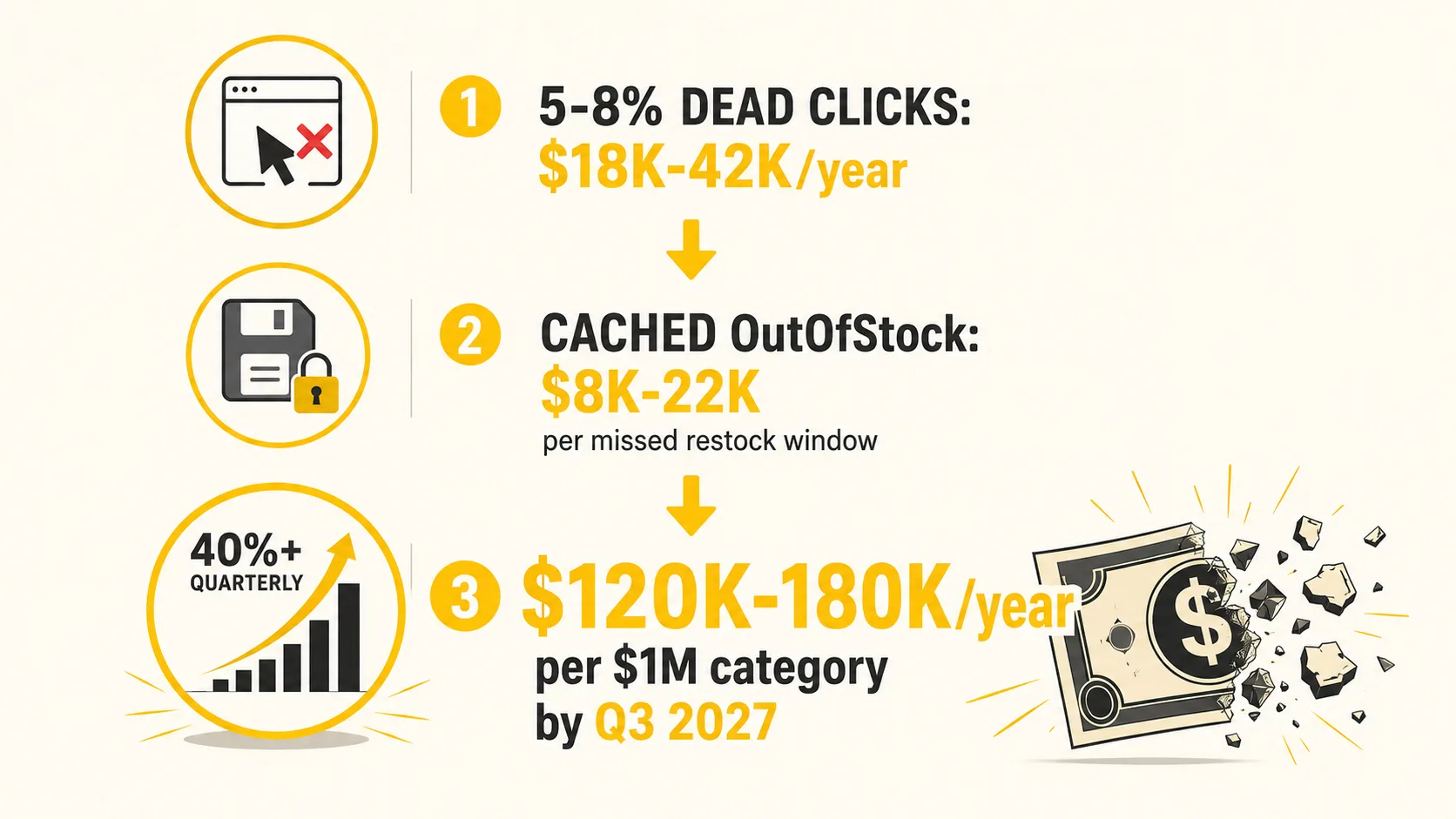
The obvious cost: 5 to 8 percent of AI-assisted clicks land on dead product pages. For a $3M DTC store with 12 to 18 percent AI query share of traffic, that is $18,000 to $42,000 per year in lost revenue. 58 percent of shoppers already use GenAI instead of traditional search for product recommendations. The traffic is real. The conversion path is broken at the final step. Each dead click also wastes paid acquisition cost if the customer arrived via an AI recommendation that cited a now-unavailable SKU.
The hidden cost: AI assistants cache product data. A product flagged OutOfStock due to a batch-sync delay stays unavailable in the assistant's index for hours or days after restock. During that window, competitors occupy the recommendation slot. One missed restock window in a trending category costs $8,000 to $22,000 in lost discovery. The competitor keeps the slot. The brand that restocked on time gets zero credit because the schema never updated.
The compounding cost: AI shopping query volume grows 40 percent or more per quarter. The AI shopping assistant market is projected to grow from $4.6 billion to nearly $42 billion over the next decade. Today's 5 to 8 percent dead-click rate becomes 12 to 18 percent within 12 months as AI-assisted search displaces Google SERP traffic. A $1M category loses $120,000 to $180,000 per year to this gap by Q3 2027. The brand that does not close the inventory-data gap is invisible to AI shoppers for entire product lines. Not because the products are bad. Because the availability signal is stale.
Why Inventory Tools Do Not Fix This
Shopify's structured data pipeline is batch-oriented. Inventory sync runs on cron — every 15 minutes to 2 hours depending on the plan. AI assistants scrape at query time and cache results. The batch window plus cache duration equals hours where inventory data is stale. A product sells. The ERP records the sale instantly. The schema still reads InStock for the next 90 minutes. The AI assistant scrapes at minute 45. Ghost inventory.
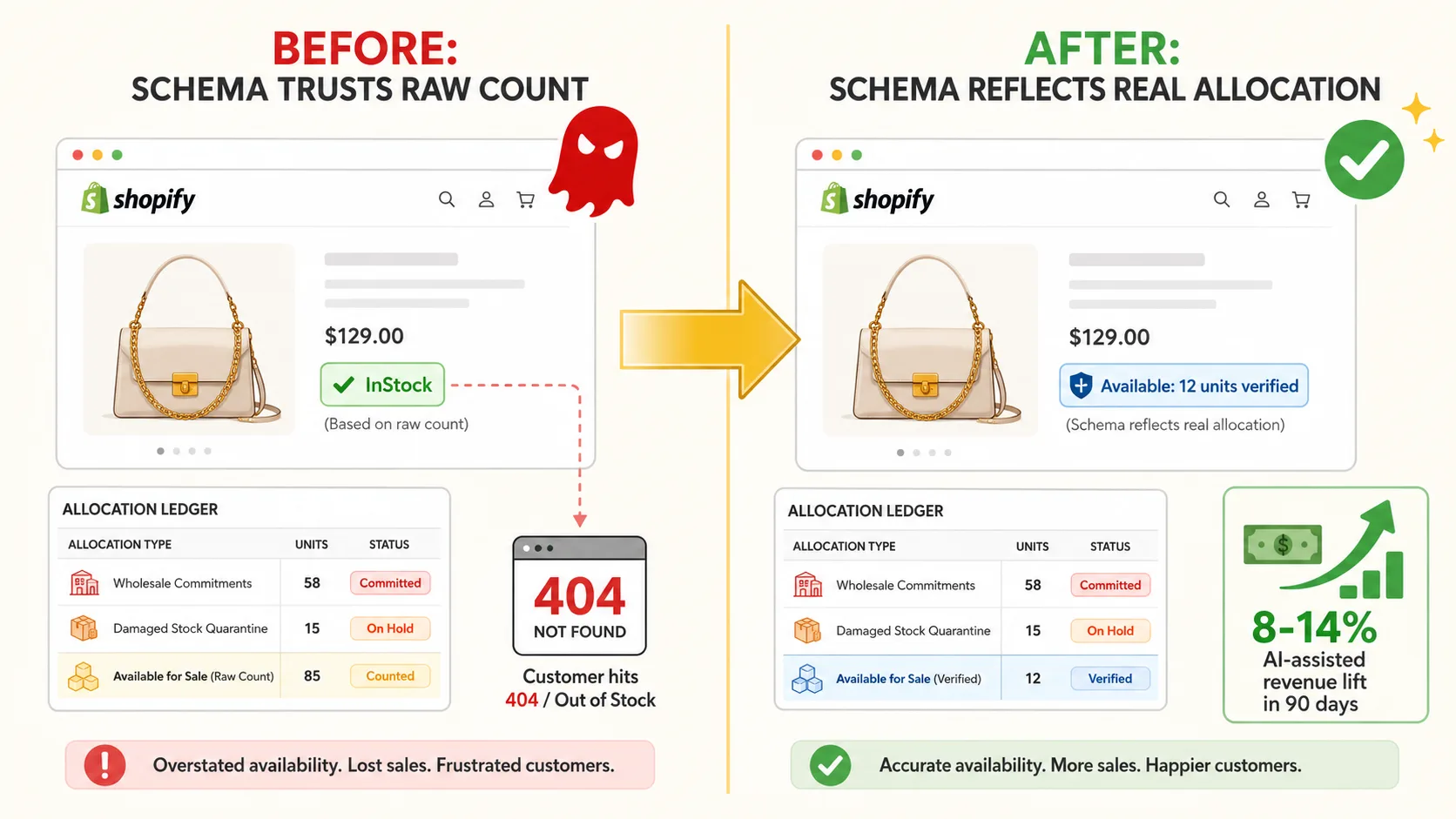
The "available" flag Shopify exposes is quantity > 0. Not quantity minus allocated minus damaged minus reserved > 0. Allocation logic (wholesale holds, pre-sale commitments, damaged stock quarantine) exists in the ERP and the inventory management system. It never surfaces in schema markup. Two systems. Same data. Different answers. The assistant reads the wrong one.
Most Shopify sellers have not even checked whether AI assistants mention their store. One operator on X put it bluntly: "Do AI shopping assistants ever mention your store? Most sellers I have asked have not checked." The awareness gap compounds the technical gap. Brands invest in photography, reviews, inventory management. They assume the product data is accurate everywhere. It is not. The schema the AI reads is a snapshot. The inventory reality moves faster than the snapshot cycle. Nobody is measuring the delta.
The Shopify Community forums are filling with operators asking about schema markup for AI search visibility. The questions reveal the pattern: operators know something is wrong. Their products are not appearing in AI recommendations. They do not know why. They ask about schema markup. The real answer is that schema markup is not the problem. The data inside the schema markup is the problem. A perfectly formatted InStock flag on a product that sold out three hours ago is still wrong.
What Changes With Real Availability Data
An audit of the top 40 revenue SKUs answers three questions. Which products show InStock when allocation, pre-sale, or damage quarantine says they are effectively gone? Which restocked products still show OutOfStock days later because the schema has not refreshed? What is the actual dollar cost of the gap between schema-reported availability and actual availability?
Fixing this means structured data that reflects allocation logic. Not the raw inventory count. Not quantity > 0. quantity minus allocated minus damaged minus reserved > 0. Surfaces "available to sell" as distinct from "physically present." This is not a technology problem. It is a plumbing problem. The data already exists. It lives in the ERP. It lives in the inventory management system. It has never been connected to the schema markup AI assistants consume.
The audit takes under two weeks for a mid-market DTC brand. The result is three changes that compound. First: dead AI clicks drop below 2 percent. The brand stops sending AI-assisted traffic to dead product pages. Second: restock visibility is near-real-time. Products that were invisible to AI assistants during the OutOfStock cache window appear in recommendations within hours of actual restock. Third: AI-assisted revenue lifts 8 to 14 percent within 90 days for the audited SKUs. Not because the products changed. Because the signal the AI reads finally matches what the warehouse knows.
This is the same structural pattern described in why AI shoppers cannot compare products accurately. The schema carries the product attributes. The schema does not carry the operational reality. The gap is invisible to anyone who trusts the schema. It is invisible to the brand until someone measures it. And it is invisible to the AI assistant that has no mechanism to verify what the schema claims against what the warehouse door reports. Readable inventory earns a seat. Holding it means keeping the signal accurate as stock moves, because the assistant defaults to whoever it trusts this week. Visibility is the ongoing fight.
What to ask next
Common questions operators ask after reading this:
How do I check if my Shopify products show correct availability to AI assistants?
Why do AI shopping tools recommend sold-out products?
How does Shopify availability schema affect AI product recommendations?
What is ghost inventory in e-commerce and how do I fix it?
Get a Diagnostic of Your Top 20 SKUs
The diagnostic scans a brand's top revenue SKUs for availability schema accuracy. It identifies which products AI assistants are recommending as available that actually are not. It finds which restocked products AI assistants are still ignoring because the schema has not refreshed. The output is a list of specific SKUs with exact gap data. Root cause identification in under 15 minutes. No software to buy. No Shopify migration. Just the signal the schema was always supposed to carry.
How TheiaOps builds operational intelligence for mid-market businesses →