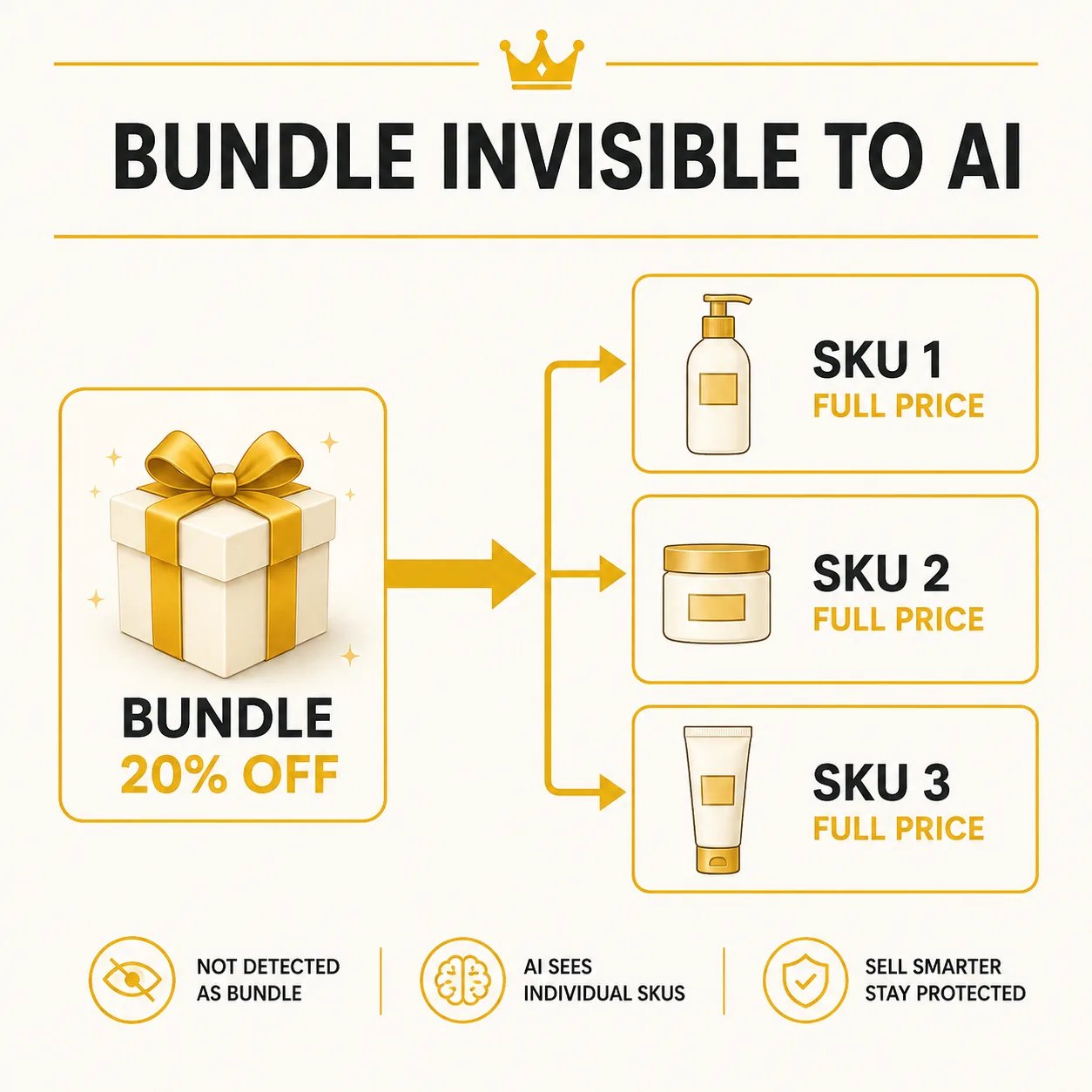
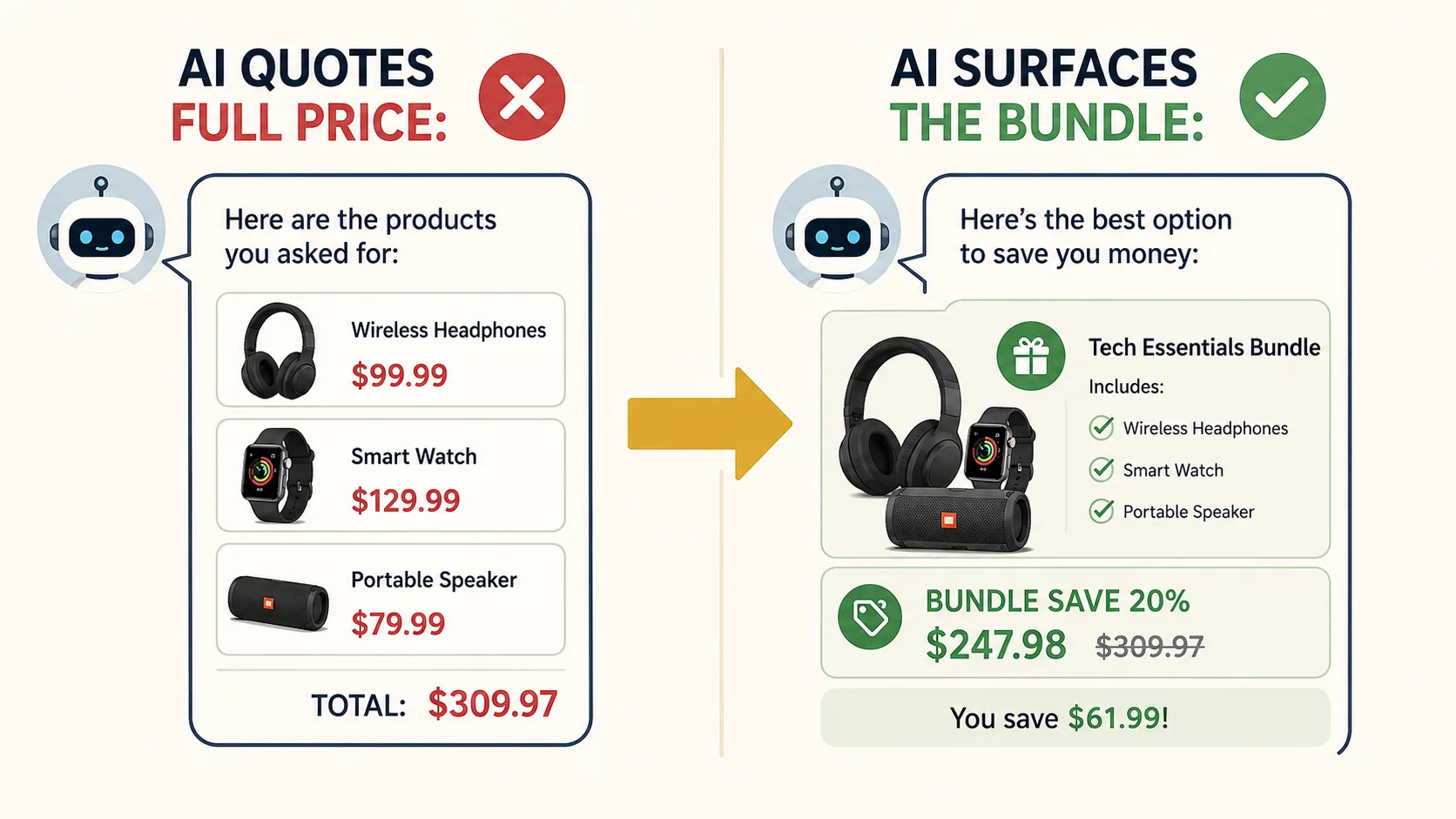
AI shoppers ignore bundles and quote full price because the bundle never makes it into structured data. Shopify’s auto-generated schema marks each component SKU at its own full price. The discounted bundle price, the component list, and the “save $X” value live only in the JavaScript a bundle app renders for human eyes. The machine reads three flat SKUs, never the offer, so it quotes the three items individually at full price.
A DTC founder builds a “Complete Routine” bundle, three products at 20% off, and watches it convert human shoppers at a healthy clip. Then she asks an AI assistant for the best starter kit in her category. The answer comes back with a competitor’s bundle, or her own three SKUs quoted separately at full price. The bundle exists. It converts. The machine cannot see it.
Why Shopify’s Schema Ships Flat
Shopify auto-generates Offer schema for every product: price, priceCurrency, availability. What it does not generate is any representation of a bundle as a priced offer. schema.org’s Product type has hasVariant and isVariantOf for relating products, and Offer carries a priceSpecification for a was-versus-now breakdown. None of these get populated from a bundle app.
There is no isBundle field in schema.org’s Product type. The closest the feed world offers is Google Merchant Center’s is_bundle attribute, a yes/no marker for Google Shopping ads that carries no component list and no bundle price. It tells a feed a listing is a bundle. It tells an AI assistant nothing about what is inside or what the bundle actually costs.
The structural gap:
Bundles are configured in an app like Bundler or Rebuy. That configuration drives the storefront’s bundle widget and the cart discount at checkout. It never touches the product page’s structured data. AI shopping assistants scrape product pages. They read three component SKUs at full price. The data that defines the bundle is the one piece of the page the machine cannot see.
What existing tools do instead:
SEO apps flag missing schema but do not populate bundle depth. Bundle apps optimize for human conversion, pop-ups and cart upsells, not machine readability. Google Merchant Center captures the is_bundle flag in the feed, but that serves Google Shopping ads, not AI assistants scraping product pages. The rich-results validator confirms the schema is present. It never checks bundle depth, so the store passes while the offer stays invisible.
What Invisible Bundles Cost
The obvious cost: $24K–$48K a year in lost bundle-driven AI-assisted revenue for a $3M store. Bundles are the highest-margin, highest-AOV segment of the catalog. Missing the AI discovery channel on them bleeds exactly where the margin is. By comparison, 58% of shoppers now use generative AI instead of traditional search for recommendations, per Capital One Shopping Research.
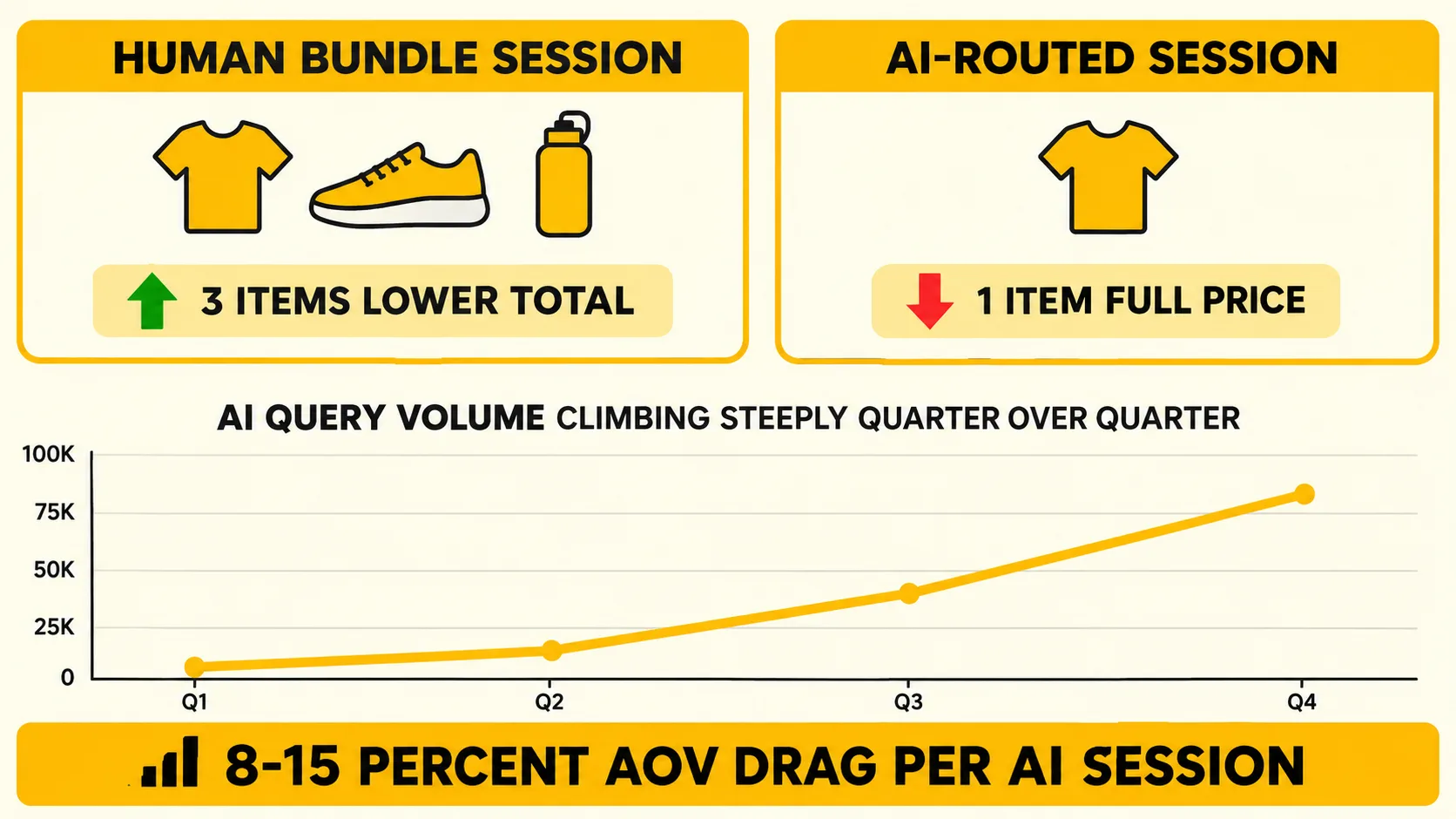
The hidden cost: an 8–15% AOV drag on every AI-routed session. AI steers shoppers to full-price singles, so the customer buys one item instead of three. Slow-moving SKUs stop moving, because the bundle was the clearance mechanism and the machine cannot see it. The inventory the bundle was built to clear now sits.
The compounding cost: permanent “more expensive” positioning. As AI query volume grows 40% or more each quarter, the default answer for “best starter kit” becomes a competitor whose bundle is machine-readable. Losing the default answer today means losing the whole category’s bundle demand by Q3 2027. AI-referred shoppers convert 80% better than organic search visitors, and Shopify itself reported AI search is now driving more traffic and sales, not replacing Google. The AI shopping assistant market is projected to grow from $4.62B in 2025 to $41.88B by 2035, a 24.75% compound annual rate per SNS Insider. Switching the default answer later costs 3–5 times more than claiming it first.
Why the Industry Accepts This
Three reasons nobody has fixed it:
Bundle apps optimize for human conversion, not machine readability, so the tooling never produced structured bundle data. The apps render JavaScript for shoppers. Nothing in that stack emits schema for machines.
Schema validators check presence, not depth. Google’s Rich Results Test marks product schema valid without any bundle representation. The bar is transaction completeness: price, availability, image. Bundle depth is treated as nice to have, not structural.
The mid-market gap. Enterprise PIM and feed tools like Feedonomics and Akeneo handle bundles, but they are priced for $20M+ brands. The mid-market has no bridge between “bundle that converts humans” and “bundle the machine can parse.” The data already exists, trapped in a different part of the stack, the same gap TheiaOps maps when validating markets before building.
What Changes When AI Can Read the Bundle
Mapping existing bundle offers into structured data on the top 20–30 bundle SKUs takes under two weeks, requires no new products or photography, and delivers an 8–14% AI-assisted bundle discovery lift within 90 days. Not a replatform. A correction on the existing store.
Week 1–2: audit. Identify the top 20–30 bundle SKUs. For each, map the component SKUs through hasVariant, then add a bundle-level offers object with the discounted bundle price and a priceSpecification showing the was-versus-now savings. No new copy, no new photography. Existing data moved into machine-readable format.
Week 3: validate and deploy. Test with Google Rich Results and the schema.org validator. Deploy on the top bundles. AI assistants can now parse the bundle price and the savings. This is the same format gap that hides sale prices, covered in what DTC brands lose when AI shoppers cannot see sale prices. Bundles are the highest-margin version of the same problem.
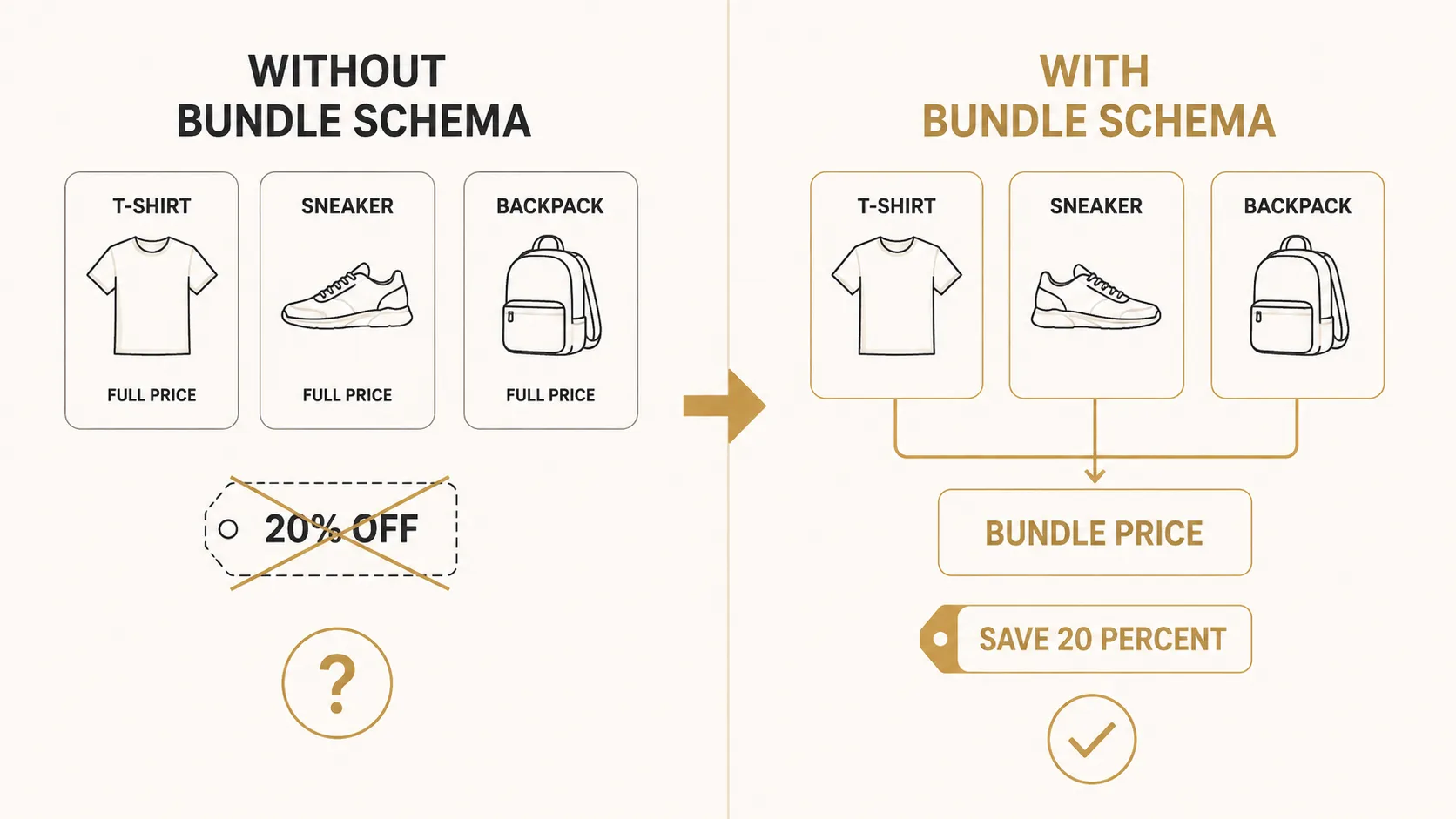
90-day outcome: 8–14% AI-assisted bundle discovery lift. AI assistants that previously quoted three SKUs at full price now surface the bundle. AOV on AI-routed sessions recovers toward human-session levels. Slow-moving SKUs move again, because the bundle that clears them is now visible. The founder’s offer gets seen, the same way AI shoppers get better answers about competitor products when the competitor’s data is complete. But being seen earns a seat, not a guarantee. Assistants default to Amazon and the big brands, so staying recommended is the fight, measured every week and won by whoever the assistant trusts this week.
What to ask next
Common questions operators ask after reading this:
Why do AI shopping assistants ignore my Shopify bundles?
How do I add bundle structured data to Shopify?
What is isBundle schema and why does it matter?
Why is my bundle discount not showing in AI search results?
Get a Bundle Schema Diagnostic
An audit of the top 20–30 bundles surfaces exactly what AI shopping assistants see when they ask about a bundle. The output is a side-by-side: the PDP versus what Perplexity, ChatGPT, and Claude actually parse. No new products. No new photography. Just machine-readable bundle data from offers already live in the store.